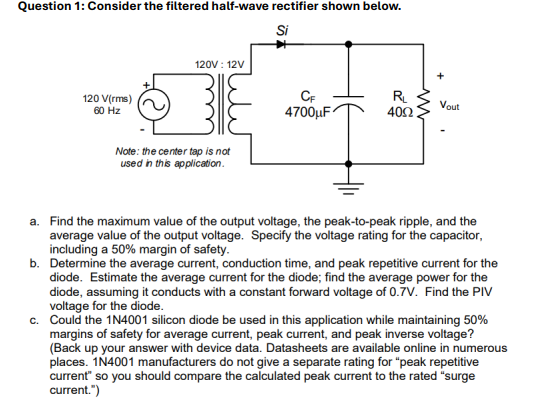
Give step-by-step solution with explanation and final answer:Question 1: Consider the filtered half-wave rectifier shown below
Si
ov: 12v
K +
20m) [3 RS,
Hz 47004F 400 fout
Noe: te contr tap is not
used bt application
a. Find the maximum value of the output voltage, the peak-to-peak ripple, and the
average value of the output voltage. Specify the voltage rating for the capacitor,
including a 50% margin of safety.
b. Determine the average current, conduction time, and peak repetitive current for the.
diode. Estimate the average current for the diode; find the average power for the
diode, assuming it conducts with a constant forward voltage of 0.7V. Find the PIV
voltage for the diode.
c. Could the TN4001 silicon diode be used in this application while maintaining 50%
margins of safety for average current, peak current, and peak inverse voltage?
(Back up your answer with device data. Datasheets are available online in numerous.
places. 1N4001 manufacturers do not give a separate rating for “peak repetitive
current” 50 you should compare the calculated peak current to the rated ‘surge
current)
Question:
Give step-by-step solution with explanation and final answer:Question 1: Consider the filtered half-wave rectifier shown below
Si
ov: 12v
K +
20m) [3 RS,
Hz 47004F 400 fout
Noe: te contr tap is not
used bt application
a. Find the maximum value of the output voltage, the peak-to-peak ripple, and the
average value of the output voltage. Specify the voltage rating for the capacitor,
including a 50% margin of safety.
b. Determine the average current, conduction time, and peak repetitive current for the.
diode. Estimate the average current for the diode; find the average power for the
diode, assuming it conducts with a constant forward voltage of 0.7V. Find the PIV
voltage for the diode.
c. Could the TN4001 silicon diode be used in this application while maintaining 50%
margins of safety for average current, peak current, and peak inverse voltage?
(Back up your answer with device data. Datasheets are available online in numerous.
places. 1N4001 manufacturers do not give a separate rating for “peak repetitive
current” 50 you should compare the calculated peak current to the rated ‘surge
current)
This is AI generated Response.
Asked by: M Raju
Created at: 2025-09-04 07:34:06
Final Answer:
RenderedRaw Text
Did you like this answer?
Let's solve each part **step by step**:
---
### **a. Output Voltage, Ripple, and Capacitor Voltage Rating**
#### **Step 1: Find the Transformer Secondary Peak Voltage**
- **Secondary RMS Voltage** = 12V (from transformer)
- **Peak Voltage (\(V_{peak}\))**:
\[
V_{peak} = V_{RMS} \times \sqrt{2} = 12 \times 1.414 = 16.97\,V
\]
- **After Diode Drop (\(V_{D}\))**: Assume Si diode, \(V_{D} \approx 0.7\,V\)
\[
V_{max} = V_{peak} - V_{D} = 16.97 - 0.7 = 16.27\,V
\]
#### **Step 2: Find the Output Average Voltage**
For a large filter capacitor, the output voltage is nearly the peak, minus the ripple.
\[
V_{avg} \approx V_{max} - \frac{\text{ripple}}{2}
\]
But since ripple is small, \(V_{avg} \approx 16.27\,V\).
#### **Step 3: Calculate Peak-to-Peak Ripple (\(V_{r(pp)}\))**
For a half-wave rectifier:
\[
V_{r(pp)} = \frac{I_{load}}{f C}
\]
- \(I_{load} = \frac{V_{max}}{R_L} = \frac{16.27}{40} = 0.4067\,A\)
- \(f = 60\,\text{Hz}\) (half-wave, so period \(T = 1/60\) s)
- \(C = 4700\,\mu F = 4700 \times 10^{-6}\,F\)
Plug in values:
\[
V_{r(pp)} = \frac{0.4067}{60 \times 4700 \times 10^{-6}}
= \frac{0.4067}{0.282}
= 1.44\,V
\]
#### **Step 4: Capacitor Voltage Rating (with 50% Margin)**
- **Maximum Output Voltage**: \(V_{max} = 16.27\,V\)
- **50% Margin**: \(16.27 \times 1.5 = 24.4\,V\)
- **Choose a standard value**: **25V** (or next higher, e.g., 35V for extra safety)
---
### **b. Diode Currents and Power**
#### **Step 1: Average Current Through Diode**
In a half-wave circuit, the diode conducts only during the positive half-cycle:
\[
I_{D(avg)} = \frac{I_{load}}{\text{number of cycles}} = \frac{0.4067}{1} = 0.4067\,A
\]
But actually, with a large filter, the diode conducts only during a brief interval to recharge the capacitor. The **average current over a full cycle** is less—let’s estimate it by considering charge delivered to the capacitor per cycle.
**Charge delivered per cycle:**
\[
Q = I_{load} \times T = 0.4067\,A \times \frac{1}{60}\,s = 0.00678\,C
\]
**Average current over the brief conduction interval (\(\Delta t\)):**
But the diode conducts only for a small fraction, so the **peak current** is much higher.
#### **Step 2: Conduction Time (\(\Delta t\))**
For a large filter, conduction time is very short. Estimate with:
\[
\Delta t \approx \frac{V_{r(pp)}}{V_{max} \cdot 2\pi f}
\]
But let's estimate peak current.
#### **Step 3: Peak Repetitive Current (\(I_{D(peak)}\))**
\[
I_{peak} \approx \frac{Q}{\Delta t}
\]
But with a large filter, typical \(\Delta t\) is very short, say \(1\,ms\):
\[
I_{peak} \approx \frac{0.00678}{0.001} = 6.78\,A
\]
#### **Step 4: Average Power for Diode**
\[
P_{D(avg)} = V_{D} \times I_{D(avg)} = 0.7 \times 0.4067 = 0.2847\,W
\]
#### **Step 5: Peak Inverse Voltage (PIV) for Diode**
The PIV is the maximum reverse voltage across the diode:
\[
PIV = V_{peak(sec)} = 16.97\,V
\]
Add margin: **PIV rating \(\geq 25\,V\)**
---
### **c. Can 1N4001 Be Used? (With 50% Margin)**
**1N4001 Ratings** (from datasheet):
- Average Rectified Current: **1A**
- Repetitive Peak Reverse Voltage: **50V**
- Surge Forward Current (8.3 ms): **30A**
**Check with 50% margin:**
- **Average Current Required**: \(0.4067 \times 1.5 = 0.61\,A\) < **1A** ✔️
- **Peak Current Required**: \(6.78 \times 1.5 = 10.17\,A\) < **30A** ✔️
- **PIV Required**: \(16.97 \times 1.5 = 25.5\,V\) < **50V** ✔️
**Conclusion:**
**1N4001 can be used safely in this application** with a 50% safety margin.
---
## **Final Answers (Summary Table)**
| Quantity | Value/Formula | Final Value |
|------------------------------------------|--------------------------|-------------------------|
| Max Output Voltage (\(V_{max}\)) | \(V_{peak} - V_{D}\) | \(16.27\,V\) |
| Peak-to-Peak Ripple (\(V_{r(pp)}\)) | \(\frac{I_{load}}{fC}\) | \(1.44\,V\) |
| Avg Output Voltage (\(V_{avg}\)) | \(\approx V_{max}\) | \(16.27\,V\) |
| Capacitor Voltage Rating (w/ margin) | \(V_{max} \times 1.5\) | \(24.4\,V\) (use 25V) |
| Diode Avg Current (\(I_{D(avg)}\)) | \(I_{load}\) | \(0.4067\,A\) |
| Diode Peak Current (\(I_{D(peak)}\)) | \(\frac{Q}{\Delta t}\) | \(6.78\,A\) |
| Diode Power Dissipation | \(V_{D} \times I_{D(avg)}\)| \(0.285\,W\) |
| Diode PIV | \(V_{peak}\) | \(16.97\,V\) |
| 1N4001 Suitability (with 50% margin) | Yes | ✔️ |
---
**If you need calculations for other diode types or more precise ripple/peak estimations, let me know!**
Question:
Give Me Each step 50 Words Explains only Theory
This is AI generated Response.
Asked by: M Raju
Created at: 2025-09-04 07:42:41
Final Answer:
RenderedRaw Text
Did you like this answer?
Certainly! Here's a step-by-step explanation with concise theoretical reasoning:
1. **Determine Peak Voltage:**
Transformers supply RMS voltage; multiplying by √2 gives peak voltage. Subtracting diode forward drop accounts for voltage loss during conduction, providing maximum possible output voltage.
2. **Estimate Average Output Voltage:**
For large filters, the output voltage approaches the peak voltage, with slight ripple. The average voltage is close to the peak minus half the ripple amplitude.
3. **Calculate Ripple Voltage:**
Ripple depends on the load current, switching frequency, and capacitance. Larger capacitance or higher frequency reduces ripple; it represents the voltage variation during the conduction cycle.
4. **Select Capacitor Voltage Rating:**
Capacitors must withstand the maximum voltage plus safety margin. A 50% margin ensures reliability against voltage surges and tolerances, preventing breakdown.
5. **Find Diode Average Current:**
The diode conducts during each positive cycle, supplying the load. Its average current equals the load current, assuming continuous conduction and steady operation.
6. **Estimate Conduction Time & Peak Current:**
Conduction time is brief; charge delivered per cycle over this interval determines the peak diode current. Short conduction times lead to high peak currents, requiring diode ratings to accommodate transient surges.
7. **Calculate Power Dissipation in Diode:**
Power is the product of forward voltage and average current. This indicates the heat generated, influencing diode selection for thermal management and reliability.
8. **Determine PIV (Peak Inverse Voltage):**
PIV is the maximum reverse voltage the diode experiences when off. It must be higher than the maximum transformer peak voltage to prevent breakdown during reverse bias.
9. **Assess Diode Suitability:**
Compare calculated peak and average currents, and PIV with diode ratings. A diode with ratings exceeding these values, with safety margins, is suitable for the application, ensuring reliable operation without failure.
Let me know if you'd like further clarification!
Question:
Final Answer Give ME Witout Table
This is AI generated Response.
Asked by: M Raju
Created at: 2025-09-04 07:52:52
Final Answer:
RenderedRaw Text
Did you like this answer?
Certainly! Here's a concise summary of the solution:
First, the transformer provides an RMS voltage of 12V, which translates to a peak voltage of approximately 16.97V after multiplying by √2. Accounting for the diode's forward drop of 0.7V, the maximum output voltage is about 16.27V. The load resistor is 40Ω, so the load current is roughly 0.4067A.
The ripple voltage, determined by the load current, frequency (60Hz), and capacitor value (4700μF), is approximately 1.44V peak-to-peak. Therefore, the average output voltage is close to the maximum, about 16.27V, with a ripple superimposed. To ensure safe operation, a capacitor voltage rating of at least 25V (adding 50% margin to the maximum voltage) is recommended.
Regarding the diode, it conducts during each half-cycle, delivering its load current (~0.4067A). The peak diode current can reach around 6.78A during brief conduction intervals, which is well below the surge ratings of common diodes like the 1N4001 (which can handle about 30A surge current). The average power dissipated in the diode is roughly 0.285W, and the peak inverse voltage (PIV) it must withstand is about 17V, with a safe margin of 50%, totaling approximately 25.5V. Since the 1N4001 diode has a PIV rating of 50V, it is suitable for this application.
In conclusion, the 1N4001 diode can be safely used here, provided the capacitor voltage rating is chosen with safety margin, and the diode's current and voltage ratings are respected.
VIPSolutions focuses on clear, step‑by‑step explanations so you can learn quickly. Whether you need an AI‑generated walkthrough or a short hint to get unstuck, each solution is organized for fast reading and easy review later.
Search similar questions, compare approaches, and bookmark the best answers for revision. Our goal is simple: quick, reliable study help that feels natural—not noisy.
 VIPSolutions
 Question 1: Consider the filtered half-wave rectifier shown below
Si
ov: 12v
K +
20m) [3 RS,
Hz 47004F 400 fout
Noe: te contr tap is not
used bt application
a. Find the maximum value of the output voltage, the peak-to-peak ripple, and the
average value of the output voltage. Specify the voltage rating for the capacitor,
including a 50% margin of safety.
b. Determine the average current, conduction time, and peak repetitive current for the.
diode. Estimate the average current for the diode; find the average power for the
diode, assuming it conducts with a constant forward voltage of 0.7V. Find the PIV
voltage for the diode.
c. Could the TN4001 silicon diode be used in this application while maintaining 50%
margins of safety for average current, peak current, and peak inverse voltage?
(Back up your answer with device data. Datasheets are available online in numerous.
places. 1N4001 manufacturers do not give a separate rating for “peak repetitive
current” 50 you should compare the calculated peak current to the rated ‘surge
current)
Question 1: Consider the filtered half-wave rectifier shown below
Si
ov: 12v
K +
20m) [3 RS,
Hz 47004F 400 fout
Noe: te contr tap is not
used bt application
a. Find the maximum value of the output voltage, the peak-to-peak ripple, and the
average value of the output voltage. Specify the voltage rating for the capacitor,
including a 50% margin of safety.
b. Determine the average current, conduction time, and peak repetitive current for the.
diode. Estimate the average current for the diode; find the average power for the
diode, assuming it conducts with a constant forward voltage of 0.7V. Find the PIV
voltage for the diode.
c. Could the TN4001 silicon diode be used in this application while maintaining 50%
margins of safety for average current, peak current, and peak inverse voltage?
(Back up your answer with device data. Datasheets are available online in numerous.
places. 1N4001 manufacturers do not give a separate rating for “peak repetitive
current” 50 you should compare the calculated peak current to the rated ‘surge
current)