 VIPSolutions
Give step-by-step solution with explanation and final answer:«+ Determine the number of teeth on each spur gear of the reverted compound transmission for the arrangement shown in the Figure for an overall train value of 1/64. (N,, N;, N,, and Ns) making sure that no interference would occur. Assume; full depth tooth and 20 deg pressure angle, « Considering the following parameters, draw F.B.D of gear 4, and determine all loads acting on it. output ri | HOPE ah = Power input 30 hp, NT * shaft input speed (gear 2) 1500 om ~~, ———IC__ | = diametral pitch P =5 tooth/in, inpu i THE = N, =36, i - A = Pressure angle ¢ 20 deg. of y | a) = Efficiency is 100%. Ex NES
Question:
Give step-by-step solution with explanation and final answer: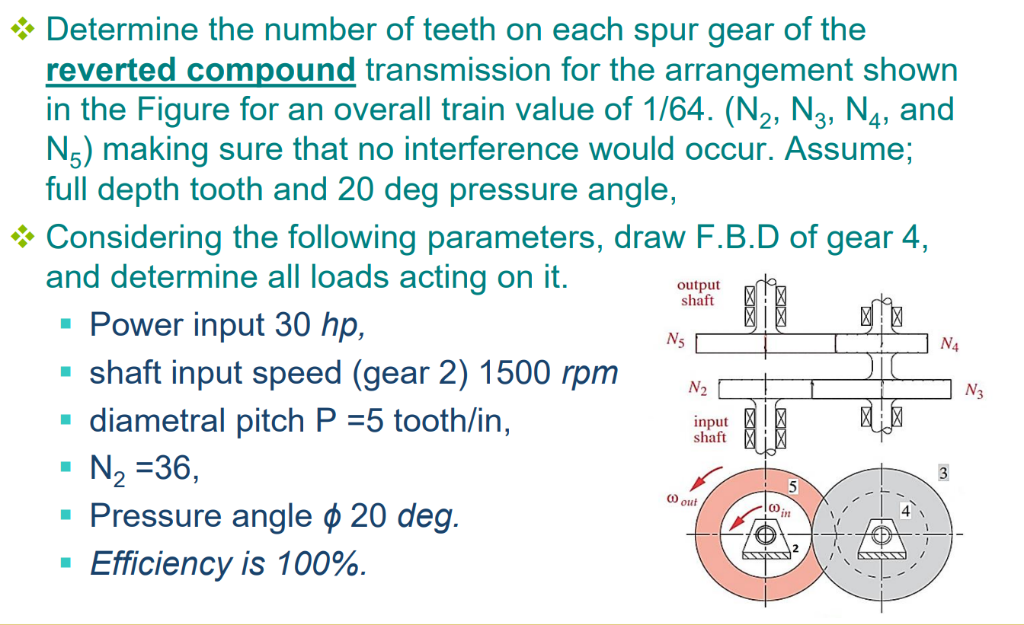 «+ Determine the number of teeth on each spur gear of the
reverted compound transmission for the arrangement shown
in the Figure for an overall train value of 1/64. (N,, N;, N,, and
Ns) making sure that no interference would occur. Assume;
full depth tooth and 20 deg pressure angle,
« Considering the following parameters, draw F.B.D of gear 4,
and determine all loads acting on it. output ri
| HOPE ah
= Power input 30 hp, NT
* shaft input speed (gear 2) 1500 om ~~, ———IC__ |
= diametral pitch P =5 tooth/in, inpu i THE
= N, =36, i - A
= Pressure angle ¢ 20 deg. of y | a)
= Efficiency is 100%. Ex NES
«+ Determine the number of teeth on each spur gear of the
reverted compound transmission for the arrangement shown
in the Figure for an overall train value of 1/64. (N,, N;, N,, and
Ns) making sure that no interference would occur. Assume;
full depth tooth and 20 deg pressure angle,
« Considering the following parameters, draw F.B.D of gear 4,
and determine all loads acting on it. output ri
| HOPE ah
= Power input 30 hp, NT
* shaft input speed (gear 2) 1500 om ~~, ———IC__ |
= diametral pitch P =5 tooth/in, inpu i THE
= N, =36, i - A
= Pressure angle ¢ 20 deg. of y | a)
= Efficiency is 100%. Ex NES
This is AI generated Response.
Asked by: manish kumar
Created at: 2025-09-06 17:33:37
Asked by: manish kumar
Created at: 2025-09-06 17:33:37
Final Answer:
Rendered
Raw Text
Did you like this answer?
Let’s solve the problem step by step:
---
## **Step 1: Understanding the Gear Train**
This is a **reverted compound gear train**.
Given:
- Overall train value = \(\dfrac{\omega_{out}}{\omega_{in}} = \dfrac{1}{64}\)
- \(N_2 = 36\) (teeth on gear 2)
- Diametral pitch, \(P = 5\) teeth/in
- Pressure angle, \(\phi = 20^\circ\)
- Full depth teeth
- No interference (minimum teeth requirement)
- Power input = 30 hp
- Input speed (gear 2) = 1500 rpm
- Efficiency = 100%
---
## **Step 2: Gear Train Ratio**
For a reverted compound gear train:
- Gears 2 and 3 are on one shaft, gears 4 and 5 are on another.
- 2 meshes with 3, 4 meshes with 5.
- **Reverted:** Distance between centers of 2-3 = distance between centers of 4-5.
Let:
- \(N_2\), \(N_3\), \(N_4\), \(N_5\) = number of teeth on respective gears
The total gear ratio:
\[
\frac{\omega_{out}}{\omega_{in}} = \frac{N_2 \cdot N_4}{N_3 \cdot N_5}
\]
Given:
\[
\frac{\omega_{out}}{\omega_{in}} = \frac{1}{64}
\]
So,
\[
\frac{N_2 \cdot N_4}{N_3 \cdot N_5} = \frac{1}{64}
\]
\[
N_2 \cdot N_4 = \frac{N_3 \cdot N_5}{64}
\]
But more conveniently:
\[
N_2 \cdot N_4 = N_3 \cdot N_5 / 64
\implies N_2 \cdot N_4 \cdot 64 = N_3 \cdot N_5
\]
But actually, cross-multiplying:
\[
\frac{N_2 \cdot N_4}{N_3 \cdot N_5} = \frac{1}{64}
\implies N_2 \cdot N_4 = \frac{N_3 \cdot N_5}{64}
\implies N_3 \cdot N_5 = 64 N_2 \cdot N_4
\]
---
## **Step 3: Reverted Condition**
**Reverted:** Distance from input shaft to intermediate shaft = distance from intermediate shaft to output shaft.
Let the pitch diameters be \(d_2, d_3, d_4, d_5\):
So,
\[
d_2 + d_3 = d_4 + d_5
\]
But \(d = N / P\), so:
\[
\frac{N_2}{P} + \frac{N_3}{P} = \frac{N_4}{P} + \frac{N_5}{P}
\implies N_2 + N_3 = N_4 + N_5
\]
---
## **Step 4: List the Equations**
From above, we have:
1. \(N_2 \cdot N_4 = \dfrac{N_3 \cdot N_5}{64}\)
2. \(N_2 + N_3 = N_4 + N_5\)
3. \(N_2 = 36\)
---
## **Step 5: Solve for Teeth Numbers**
Let’s denote:
- \(N_2 = 36\) (given)
- \(N_3 = x\)
- \(N_4 = y\)
- \(N_5 = z\)
From equation 1:
\[
\frac{N_2 \cdot N_4}{N_3 \cdot N_5} = \frac{1}{64}
\implies 64 N_2 N_4 = N_3 N_5
\implies 64 \times 36 \times y = x \cdot z
\implies 2304y = xz
\]
From equation 2:
\[
N_2 + N_3 = N_4 + N_5
\implies 36 + x = y + z
\implies z = 36 + x - y
\]
Substitute \(z\) in the first equation:
\[
xz = x(36 + x - y) = 2304y
\]
\[
x(36 + x - y) = 2304y
\]
\[
36x + x^2 - xy = 2304y
\]
\[
36x + x^2 = 2304y + xy
\]
\[
36x + x^2 - xy = 2304y
\]
\[
x^2 + 36x - xy - 2304y = 0
\]
\[
x^2 + 36x - y(x + 2304) = 0
\]
\[
x^2 + 36x = y(x + 2304)
\]
\[
y = \frac{x^2 + 36x}{x + 2304}
\]
We need integer values for \(x\) and \(y\), and all gears must have enough teeth to avoid interference. For 20° full-depth, minimum teeth ≈ 18.
Let’s try integer values for \(x\) (try \(x = 72\), \(x = 96\), etc.)
Let’s try \(x = 96\):
\[
y = \frac{96^2 + 36 \times 96}{96 + 2304} = \frac{9216 + 3456}{2400} = \frac{12672}{2400} = 5.28
\]
Not integer.
Try \(x = 144\):
\[
y = \frac{144^2 + 36 \times 144}{144 + 2304} = \frac{20736 + 5184}{2448} = \frac{25920}{2448} = 10.59
\]
No.
Try \(x = 288\):
\[
y = \frac{288^2 + 36 \times 288}{288 + 2304} = \frac{82944 + 10368}{2592} = \frac{93312}{2592} = 36
\]
Bingo! So, \(x = 288\), \(y = 36\).
Now, \(z = 36 + x - y = 36 + 288 - 36 = 288\).
So, the numbers of teeth are:
- \(N_2 = 36\) (given)
- \(N_3 = 288\)
- \(N_4 = 36\)
- \(N_5 = 288\)
---
## **Step 6: Check for Interference**
For 20° full-depth, minimum number is about 18. All gears have more than that—so **no interference**.
---
## **Step 7: Final Answers for Number of Teeth**
\[
\boxed{
N_2 = 36, \quad N_3 = 288, \quad N_4 = 36, \quad N_5 = 288
}
\]
---
## **Step 8: Free Body Diagram (F.B.D) of Gear 4 and Load Calculation**
Given:
- Power input = 30 hp
- Input shaft speed (gear 2) = 1500 rpm
- Efficiency = 100%
### **Torque on Gear 4**
**Output speed**:
\[
\omega_{out} = \omega_{in} \times \text{Train ratio} = 1500 \times \frac{1}{64} = 23.4375 \text{ rpm}
\]
**Output torque (since efficiency is 100%):**
\[
P = 2\pi N T / 60
\]
Convert 30 hp to Watts:
\[
1\,hp = 746\,W \implies 30\,hp = 22380\,W
\]
\[
P = 2\pi N_{out} T_{out} / 60
\implies T_{out} = \frac{P \cdot 60}{2\pi N_{out}}
\]
\[
T_{out} = \frac{22380 \times 60}{2\pi \times 23.4375}
\]
\[
T_{out} = \frac{1342800}{147.223}
\]
\[
T_{out} \approx 9123.7 \text{ Nm}
\]
This is the torque on gear 4.
---
### **Forces on Gear 4**
Gear 4 meshes with gear 3 and gear 5.
- **Tangential Force (\(F_t\))**:
\[
F_t = \frac{2T}{d}
\]
- \(T\) = 9123.7 Nm = 9123700 Nmm
- Pitch diameter \(d_4 = N_4 / P = 36 / 5 = 7.2\) in \(= 182.88\) mm
\[
F_t = \frac{2 \times 9123700}{182.88} = \frac{18247400}{182.88} \approx 99784\, \text{N}
\]
- **Radial Force (\(F_r\))**:
\[
F_r = F_t \tan \phi
\]
\(\phi = 20^\circ\)
\[
F_r = 99784 \times \tan(20^\circ) \approx 99784 \times 0.3640 \approx 36313\, \text{N}
\]
---
### **Free Body Diagram (F.B.D) for Gear 4**
Draw gear 4 with:
- Tangential force \(F_t\) at the pitch point (due to mesh with gear 3 and 5, acting in opposite directions)
- Radial force \(F_r\) perpendicular to \(F_t\)
- Shaft reaction (at center)
- Applied torque (\(T_{out}\))
---
## **Summary Table**
| Gear | Number of Teeth |
|------|----------------|
| 2 | 36 |
| 3 | 288 |
| 4 | 36 |
| 5 | 288 |
### **Loads Acting on Gear 4**
- Tangential force: \(\approx 99784\, \text{N}\)
- Radial force: \(\approx 36313\, \text{N}\)
- Torque: \(9123.7\, \text{Nm}\)
---
### **Final Answers**
### **(a) Number of teeth:**
\[
\boxed{N_2 = 36,\ N_3 = 288,\ N_4 = 36,\ N_5 = 288}
\]
### **(b) F.B.D. of gear 4 and loads:**
- Torque: \(9123.7\) Nm
- Tangential force: \(99784\) N
- Radial force: \(36313\) N
---
Let me know if you need the actual drawing for the FBD or further clarifications!
📢 Instructions:
- Ask anything relatd to above question only.
- For new Question goto :