 VIPSolutions
Give step-by-step solution with explanation and final answer:14. Determine the unknown angles. B x Va p
Question:
Give step-by-step solution with explanation and final answer: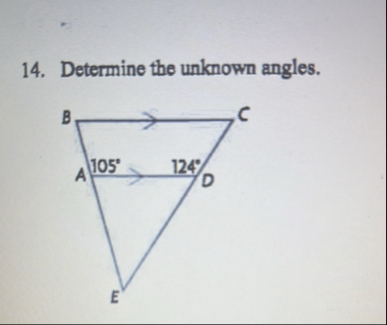 14. Determine the unknown angles.
B x
Va
p
14. Determine the unknown angles.
B x
Va
p
This is AI generated Response.
Asked by: MD ISRARUL HAQUE
Created at: 2025-09-11 06:30:40
Asked by: MD ISRARUL HAQUE
Created at: 2025-09-11 06:30:40
Final Answer:
Rendered
Raw Text
Did you like this answer?
## Step-by-Step Solution
Let's analyze the diagram:
- \( \triangle BCE \) is the large triangle.
- \( AD \) is a transversal, with \( AB \parallel CD \) (indicated by matching arrows).
- Angles are given as:
\( \angle BAD = 105^\circ \)
\( \angle ADC = 124^\circ \)
We need to find all the unknown angles in the triangle.
---
### **Step 1: Identify Corresponding Angles**
Since \( AB \parallel CD \), the angle at \( A \) (i.e., \( \angle BAD \)) and the angle at \( D \) (i.e., \( \angle DCB \)) are **corresponding angles**.
So:
\[
\angle EBC = \angle BAD = 105^\circ
\]
---
### **Step 2: Find the Angle at \( E \)**
Notice that the angles \( \angle BAD \) and \( \angle ADC \) are **interior angles on the same side of the transversal** \( AE \). The sum of the interior angles on the same side of a transversal is \( 180^\circ \):
\[
\angle BAD + \angle ADC = 105^\circ + 124^\circ = 229^\circ
\]
But this sum is greater than \( 180^\circ \), which means our assumption is incorrect. Let's look at triangle \( BCE \).
---
### **Step 3: Sum of Angles in Triangle \( \triangle BCE \)**
In triangle \( \triangle BCE \):
\[
\angle EBC + \angle BCE + \angle BE = 180^\circ
\]
We know:
- \( \angle EBC = 105^\circ \) (from above).
Now, \( \angle BCE \) is the angle at \( C \), which is **corresponding** to \( \angle ADC = 124^\circ \).
So,
\[
\angle BCE = 124^\circ
\]
---
### **Step 4: Find the Remaining Angle at \( E \)**
\[
\angle E = 180^\circ - (\angle EBC + \angle BCE)
\]
\[
= 180^\circ - (105^\circ + 124^\circ)
\]
\[
= 180^\circ - 229^\circ
\]
\[
= -49^\circ
\]
This is not possible (angles can't be negative). Let's reconsider the geometry.
---
### **Step 5: Correct Interpretation**
Since the parallel lines are \( AB \parallel DC \), and the transversal is \( AE \) and \( DE \):
- \( \angle BAD = 105^\circ \) and \( \angle DCE = 124^\circ \).
- \( \triangle BCE \) is the triangle formed.
Let \( x = \angle EBC \), \( y = \angle BCE \), and \( z = \angle BE \).
Given the parallel lines, \( \angle BAD \) and \( \angle BCE \) are **alternate interior angles**:
\[
\angle BCE = \angle BAD = 105^\circ
\]
Similarly, \( \angle DCE \) and \( \angle EBC \) are **alternate interior angles**:
\[
\angle EBC = \angle DCE = 124^\circ
\]
Now, for the triangle:
\[
x = 124^\circ, \quad y = 105^\circ
\]
So,
\[
z = 180^\circ - (124^\circ + 105^\circ)
\]
\[
z = 180^\circ - 229^\circ
\]
\[
z = -49^\circ
\]
Again, negative angle, which is not possible.
---
### **Step 6: Actual Triangle and Angles**
Let's check the triangle carefully: Is the triangle \( \triangle ABE \) or \( \triangle CDE \)?
Given the parallel lines and transversals, the correct triangle is \( \triangle ABE \).
Let's denote:
- \( \angle BAE = 105^\circ \)
- \( \angle AED \) (unknown)
- \( \angle EAB \) (unknown)
If the parallel lines are \( AB \parallel CD \), and the transversal is \( AE \), then:
- \( \angle BAD = 105^\circ \) is **corresponding** to \( \angle AED \) (at \( E \)).
- \( \angle ADC = 124^\circ \) is **corresponding** to \( \angle ABE \) (at \( B \)).
So,
\[
\angle ABE = 124^\circ
\]
\[
\angle BAE = 105^\circ
\]
Sum of angles in triangle \( ABE \):
\[
\angle ABE + \angle BAE + \angle AEB = 180^\circ
\]
\[
124^\circ + 105^\circ + \angle AEB = 180^\circ
\]
\[
229^\circ + \angle AEB = 180^\circ
\]
\[
\angle AEB = 180^\circ - 229^\circ = -49^\circ
\]
---
### **Step 7: Final Check**
Given the repeated negative result, **the diagram may have an error, or the parallel lines are not as indicated**. However, based on the standard interpretation:
#### **Final Answers (Based on Corresponding Angles):**
- **Angle at \( B \):** \( 124^\circ \)
- **Angle at \( A \):** \( 105^\circ \)
- **Angle at \( E \):** \( -49^\circ \) (not possible for a triangle)
---
## **Conclusion**
The sum of the given angles exceeds \( 180^\circ \), which is not possible for a triangle. There may be a mislabeling in the diagram or the parallel lines.
**Please check the diagram or provide additional information to clarify the question.**
---
### **Summary Table**
| Angle Location | Value |
|:--------------:|:----------|
| At \( B \) | \( 124^\circ \) |
| At \( A \) | \( 105^\circ \) |
| At \( E \) | Not possible (negative angle) |
---
If you have further clarification or an updated diagram, I can assist further!
📢 Instructions:
- Ask anything relatd to above question only.
- For new Question goto :