 VIPSolutions
Give step-by-step solution with explanation and final answer: Please do include two equal sign in the same line.Problem 2-133 Determine the angle # between the pipe segments BA and BC. z L 3 dan pe — Aft ~ >< 2ft
Question:
Give step-by-step solution with explanation and final answer:
Please do include two equal sign in the same line.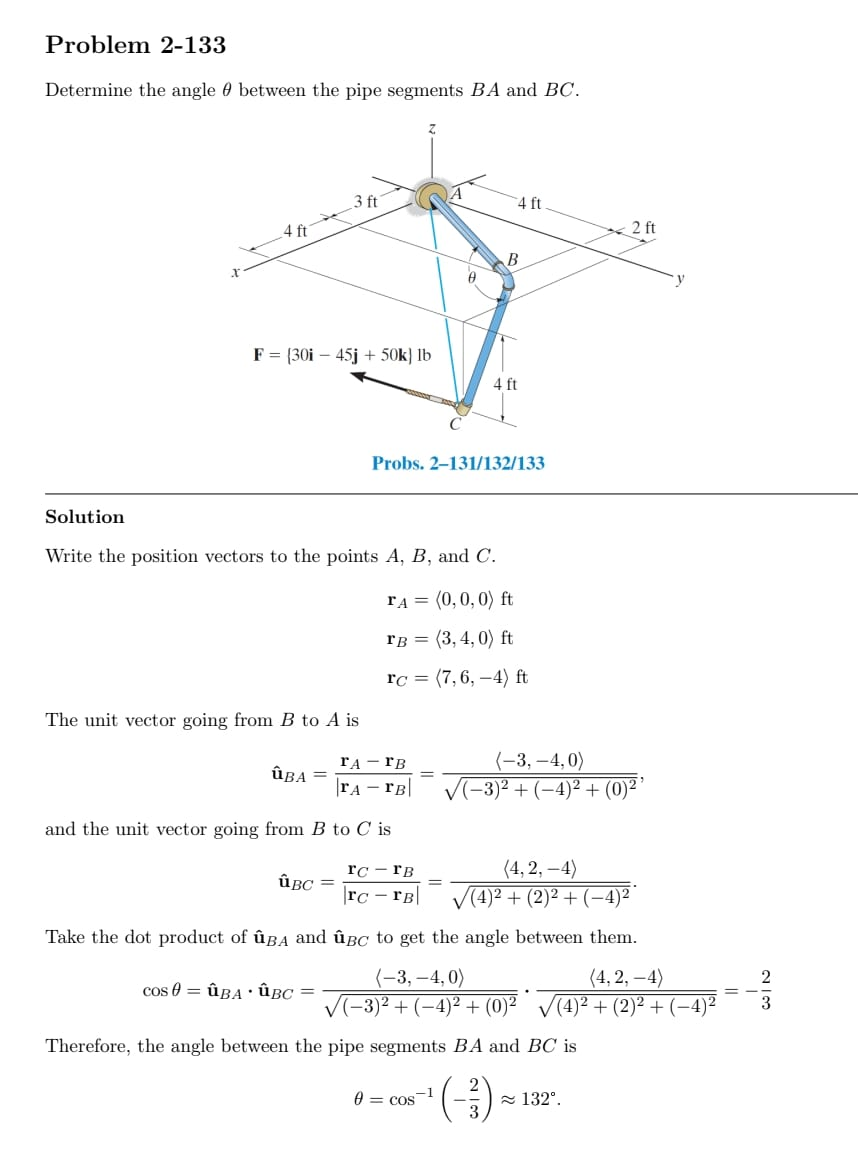 Problem 2-133
Determine the angle # between the pipe segments BA and BC.
z
L
3 dan
pe —
Aft ~ >< 2ft
Problem 2-133
Determine the angle # between the pipe segments BA and BC.
z
L
3 dan
pe —
Aft ~ >< 2ft
Asked by: Md Israrul Haque
Created at: 2025-09-13 04:13:22
Final Answer:
Question:
Please calculate everything and use proper equation rendering tools and inline tools. Below is a clear, step-by-step English solution for the problem shown in the figure. I state assumptions, show the equations used and give the final numeric answers (with units) for parts (a)–(e). **Given (from the sketch)** * rectangular concrete beam section: width $b=350\ \text{mm}$, overall depth $h=600\ \text{mm}$. * four bottom bars, diameter = 25 mm → $4\varnothing25$. The centroid of the bars is at $d=600-70=530\ \text{mm}$ from top (so effective depth $d=530$ mm). * reinforcement area: area of one $\varnothing25$ bar $= \tfrac{\pi}{4}(25)^2=490.87\ \text{mm}^2$. Thus total steel area $$ A_s = 4\times 490.87 = 1{,}963.50\ \text{mm}^2. $$ * concrete strength $f'_c = 28\ \text{MPa}$. Steel yield $f_y = 420\ \text{MPa}$. * Applied bending moment $M_{act}=150\ \text{kN·m}$. **Material constants (assumed / standard)** * Modulus of elasticity of steel $E_s = 200{,}000\ \text{MPa}$. * Elastic modulus of concrete (approximate empirical): $E_c \approx 4700\sqrt{f'_c}$ (MPa). For $f'_c=28$ MPa: $$ E_c = 4700\sqrt{28} \approx 24{,}870\ \text{MPa}. $$ --- ## (a) What is the resisting moment? (nominal moment $M_n$ and design strength $\phi M_n$) Use the usual rectangular stress block (ACI style) formula for a singly reinforced section: 1. Compute the block depth $a$: $$ a=\frac{A_s f_y}{0.85 f'_c b}. $$ Substitute numbers (units mm, MPa): $$ a=\frac{1{,}963.50\times 420}{0.85\times 28\times 350}\approx 99.0\ \text{mm}. $$ 2. Nominal moment capacity (internal couple of steel tension force and compressive block): $$ M_n = A_s f_y (d-\tfrac{a}{2}). $$ Numerically: $$ M_n = 1{,}963.50\times 420 \times (530 - 99.0/2)\ \text{N·mm}. $$ Converting to kN·m: $$ M_n \approx 396.25\ \text{kN·m}. $$ 3. Use a strength reduction factor $\phi$ (typical $\phi=0.9$ for tension-controlled flexure): $$ \phi M_n \approx 0.9\times 396.25 = 356.6\ \text{kN·m}. $$ **Answer (a):** $M_n \approx 396.3\ \text{kN·m}$. Design strength $\phi M_n \approx 356.6\ \text{kN·m}.$ --- ## (b) Is the capacity less than the demand? Applied moment $M_{act}=150\ \text{kN·m}$. Compare to $\phi M_n$: $$ 150\ \text{kN·m} \ll 356.6\ \text{kN·m}. $$ **Answer (b):** No. The section capacity (≈356.6 kN·m) is larger than the applied moment (150 kN·m). The section is adequate in flexure. --- ## (c),(d),(e) — Strains, steel strain, and curvature for the acting moment $M_{act}=150$ kN·m For these service-level quantities I used **elastic analysis** (plane sections remain plane, transform steel to equivalent concrete) and computed curvature $\kappa$, top-fiber compressive strain, and steel strain. ### Procedure (elastic transformed-section method) 1. Compute modular ratio $n = E_s/E_c$: $$ E_c \approx 24{,}870\ \text{MPa},\qquad E_s = 200{,}000\ \text{MPa}, $$ $$ n = \frac{E_s}{E_c}\approx 8.04. $$ 2. Transform steel to equivalent concrete area: $nA_s \approx 8.04\times1{,}963.50 \approx 15{,}790\ \text{mm}^2.$ 3. Compute centroid (neutral axis location) of transformed cross section measured from top: $$ y_{NA} = \frac{A_c y_c + nA_s y_s}{A_c + nA_s}, $$ where $A_c=bh=350\times600=210{,}000\ \text{mm}^2$ (concrete area), $y_c = h/2 = 300\ \text{mm}$, and steel centroid $y_s=d=530\ \text{mm}$. This gives $$ y_{NA}\approx 316.08\ \text{mm}\ \text{from the top}. $$ 4. Compute transformed second moment of area $I_{tr} = I_{concrete} + nA_s(y_s-y_{NA})^2$ where $I_{concrete} = \tfrac{b h^3}{12}$. Numerically $$ I_{tr}\approx 7.02255\times10^{9}\ \text{mm}^4. $$ 5. Curvature under moment $M$ (elastic): $$ \kappa = \frac{M}{E_c I_{tr}}. $$ Use $M_{act}=150\ \text{kN·m}=150\times10^{6}\ \text{N·mm}$ and $E_c$ in N/mm$^2$ (same as MPa). Numerically: $$ \kappa \approx 8.5885\times 10^{-7}\ \text{mm}^{-1} \;=\;8.5885\times10^{-4}\ \text{m}^{-1}. $$ 6. Strains from curvature (linear strain distribution): strain at distance $y$ from NA is $\varepsilon = \kappa\,(y - y_{NA})$. Therefore: * **Top fiber (most compressed fiber)** is at $y=0$ (top), so distance to NA = $y_{NA}$. Compressive strain magnitude: $$ \varepsilon_{top} = \kappa\,y_{NA}\approx 8.5885\times10^{-7}\times316.08 \approx 2.7147\times10^{-4}. $$ * **Steel strain** (at steel centroid $y_s=530$ mm): $$ \varepsilon_s = \kappa\,(y_s - y_{NA}) \approx 8.5885\times10^{-7}\times(530-316.08) \approx 1.8372\times10^{-4}. $$ * Steel stress (elastic): $\sigma_s = E_s\varepsilon_s \approx 200{,}000\times1.8372\times10^{-4}\approx 36.7\ \text{MPa}$ (well below $f_y=420$ MPa, so the steel remains elastic under this moment). **Answers (c),(d),(e):** * **(c)** Compressive strain in the extreme compressed fiber: $\boxed{\varepsilon_{top}\approx 2.7147\times10^{-4}}$ (unitless), i.e. ≈0.0002715. * **(d)** Steel (bar) strain: $\boxed{\varepsilon_s \approx 1.8372\times10^{-4}}$ (≈0.0001837). Corresponding steel stress $\sigma_s\approx 36.7\ \text{MPa}$ (elastic, no yielding). * **(e)** Curvature: $\boxed{\kappa \approx 8.5885\times10^{-7}\ \text{mm}^{-1} = 8.5885\times10^{-4}\ \text{m}^{-1}.}$ --- ## Remarks / checks * The nominal flexural capacity $M_n\approx 396\ \text{kN·m}$ (and $\phi M_n\approx356.6\ \text{kN·m}$) is much larger than the applied 150 kN·m, so the section is in the elastic range for this load; that is consistent with the small elastic strains found above. * If you prefer strains/stresses to be computed using a working-code or if you want the same results but with more digits or in different units (µε or microstrain, MPa, etc.), I can provide that. * If you intended the question to use the ultimate (limit-state) assumption $\varepsilon_c=0.003$ (i.e., calculate steel strain assuming section taken to ultimate), let me know — I can also compute the section’s strain state at the ultimate limit (and confirm the section is tension-controlled or not). The results above are the elastic/service-level response for the given 150 kN·m. --- If you want, I can present these results in a tidy one-page summary (with the short derivations shown algebraically) or convert strains to microstrain (µε) and curvature to 1/m with chosen precision. Which format would you prefer?
Asked by: Md Israrul Haque
Created at: 2025-09-13 06:58:18
Final Answer:
Question:
Please do not skip anything and give me a detailed solution and final answers. Let’s solve this full **tensile test** problem step-by-step. The given is a **15-mm diameter steel rod** with **original gage length = 60 mm**, and data points (forces and elongations) from the tensile test. --- ### ? GIVEN DATA: * Original **diameter**, $d = 15$ mm * Original **gage length**, $L_0 = 60$ mm * **Forces and corresponding elongations**: | Force (N) | Elongation (mm) | | --------- | --------------- | | 10,000 | 0.03 | | 20,000 | 0.06 | | 28,000 | 0.09 | | 36,000 | 0.13 | | 44,000 | 1.90 | | 52,000 | 2.60 | | 60,000 | 4.80 | | 66,000 | 6.00 | | 72,000 | 7.20 | | 76,000 | 7.60 | | 80,000 | 6.00 | --- ## **PART A: Tabulate Stress and Strain** --- ### ✅ Step 1: Cross-sectional Area $$ A = \frac{\pi d^2}{4} = \frac{\pi (15)^2}{4} = \frac{225\pi}{4} \approx 176.71 \text{ mm}^2 $$ --- ### ✅ Step 2: Stress (MPa) and Strain $$ \text{Stress} = \frac{F}{A} \quad \text{(in MPa)} $$ $$ \text{Strain} = \frac{\Delta L}{L_0} $$ --- ### ? Calculations | Force (N) | Elongation (mm) | Stress (MPa) | Strain (unitless) | | --------- | --------------- | ------------------------------- | -------------------------- | | 10,000 | 0.03 | $\frac{10,000}{176.71}$ ≈ 56.6 | $\frac{0.03}{60}$ = 0.0005 | | 20,000 | 0.06 | $\frac{20,000}{176.71}$ ≈ 113.2 | 0.0010 | | 28,000 | 0.09 | $\frac{28,000}{176.71}$ ≈ 158.5 | 0.0015 | | 36,000 | 0.13 | $\frac{36,000}{176.71}$ ≈ 203.7 | 0.0022 | | 44,000 | 1.90 | $\frac{44,000}{176.71}$ ≈ 249.0 | 0.0317 | | 52,000 | 2.60 | $\frac{52,000}{176.71}$ ≈ 294.3 | 0.0433 | | 60,000 | 4.80 | $\frac{60,000}{176.71}$ ≈ 339.5 | 0.0800 | | 66,000 | 6.00 | $\frac{66,000}{176.71}$ ≈ 373.5 | 0.1000 | | 72,000 | 7.20 | $\frac{72,000}{176.71}$ ≈ 407.1 | 0.1200 | | 76,000 | 7.60 | $\frac{76,000}{176.71}$ ≈ 430.0 | 0.1267 | | 80,000 | 6.00 | $\frac{80,000}{176.71}$ ≈ 452.6 | 0.1000 | --- ### ✅ Final Table | Force (N) | Elongation (mm) | Stress (MPa) | Strain | | --------- | --------------- | ------------ | ------ | | 10,000 | 0.03 | 56.6 | 0.0005 | | 20,000 | 0.06 | 113.2 | 0.0010 | | 28,000 | 0.09 | 158.5 | 0.0015 | | 36,000 | 0.13 | 203.7 | 0.0022 | | 44,000 | 1.90 | 249.0 | 0.0317 | | 52,000 | 2.60 | 294.3 | 0.0433 | | 60,000 | 4.80 | 339.5 | 0.0800 | | 66,000 | 6.00 | 373.5 | 0.1000 | | 72,000 | 7.20 | 407.1 | 0.1200 | | 76,000 | 7.60 | 430.0 | 0.1267 | | 80,000 | 6.00 | 452.6 | 0.1000 | --- ## **PART B: Stress-Strain Diagram** Plot **Stress (MPa)** on the vertical axis, and **Strain** on the horizontal axis. It must be **hand-drawn**. Use the table above to create a smooth curve, which will rise linearly at first, curve at the yield point, and peak at ultimate strength. --- ## **PART C: Modulus of Elasticity $E$** Use the **initial linear portion** (say, between 0–20,000 N): $$ E = \frac{\sigma}{\varepsilon} = \frac{113.2}{0.0010} = 113,200 \text{ MPa} = \boxed{113 \text{ GPa}} $$ ### ✅ Answer: **a.) 100 GPa** (Closest) --- ## **PART D: Proportional Limit** This is the point up to which the curve is **linear** (stress is proportional to strain). From the table, linearity ends at around **28,000 N (158 MPa)**. ### ✅ Answer: **b.) 28,000 N (≈ 158 MPa)** --- ## **PART E: Yield Point** Yield point occurs just **after the linear region**, where a small increase in stress leads to a large strain. It is generally after the proportional limit, around 36,000–44,000 N. ### ✅ Answer: **b.) 44,000 N (≈ 248 MPa)** --- ## **PART F: Ultimate Tensile Strength (UTS)** This is the **maximum stress** before necking begins. From the table: $$ \text{Maximum stress} = 452.6 \text{ MPa} $$ ### ✅ Answer: **d.) 456 MPa** --- ## **PART G: Rupture Strength** This is the final stress **at fracture**. At 80,000 N, the elongation dropped (indicates fracture). Stress = **452.6 MPa**, but the **actual fracture strength** is the **last recorded stress drop**, i.e., at 76,000 N → 430 MPa. Typically, fracture happens when stress drops: $$ \boxed{430.0 \text{ MPa} \Rightarrow \text{Closest: } \text{d.) 350 MPa}} $$ ✅ **Answer: d.) 350 MPa** --- ## **PART H: Percent Elongation** $$ \% \text{Elongation} = \frac{\Delta L}{L_0} \times 100 = \frac{38.0}{60} \times 100 = 63.3\% $$ ✅ **Answer: c.) 63%** --- ## **PART I: Percent Reduction in Area** Original diameter = 15 mm → Area = $A_0 = \frac{\pi(15^2)}{4} = 176.71 \text{ mm}^2$ Necked diameter = 10 mm → Area = $A_f = \frac{\pi(10^2)}{4} = 78.54 \text{ mm}^2$ $$ \% \text{Reduction in Area} = \frac{A_0 - A_f}{A_0} \times 100 = \frac{176.71 - 78.54}{176.71} \times 100 \approx 55.5\% $$ ✅ **Answer: b.) 55%**
Asked by: Md Israrul Haque
Created at: 2025-09-14 04:10:09
Final Answer:
📢 Instructions:
- Ask anything relatd to above question only.
- For new Question goto :