 VIPSolutions
Give step-by-step solution with explanation and final answer: Act like a helpful tutor and exlain me :b) Mr Bhebhe is an Industrial Engineer employed by Simbi (Pvt) Ltd. After working for 5 years with this company he discovers that the drive shaft for a backup generator was persistently failing due to torsional forces. As a graduate trainee for the company you are tasked to redesign the drive shaft using a CAD system which is made up of several design software including AutoCAD, Autodesk inventor, Solid Works and ANSYS. With the aid of neat sketches explain how you can redesign the drive shaft for optimum design keeping the weight of the component constant. 15)
Question:
Give step-by-step solution with explanation and final answer:
Act like a helpful tutor and exlain me :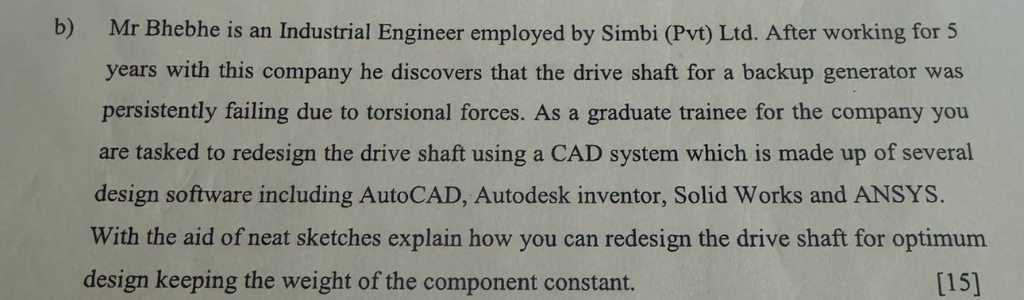 b) Mr Bhebhe is an Industrial Engineer employed by Simbi (Pvt) Ltd. After working for 5
years with this company he discovers that the drive shaft for a backup generator was
persistently failing due to torsional forces. As a graduate trainee for the company you
are tasked to redesign the drive shaft using a CAD system which is made up of several
design software including AutoCAD, Autodesk inventor, Solid Works and ANSYS.
With the aid of neat sketches explain how you can redesign the drive shaft for optimum
design keeping the weight of the component constant. 15)
b) Mr Bhebhe is an Industrial Engineer employed by Simbi (Pvt) Ltd. After working for 5
years with this company he discovers that the drive shaft for a backup generator was
persistently failing due to torsional forces. As a graduate trainee for the company you
are tasked to redesign the drive shaft using a CAD system which is made up of several
design software including AutoCAD, Autodesk inventor, Solid Works and ANSYS.
With the aid of neat sketches explain how you can redesign the drive shaft for optimum
design keeping the weight of the component constant. 15)
This is AI generated Response.
Asked by: manish prakash
Created at: 2025-09-16 13:44:12
Asked by: manish prakash
Created at: 2025-09-16 13:44:12
Final Answer:
Rendered
Raw Text
Did you like this answer?
# Step-by-Step Solution: Redesigning a Drive Shaft for Optimum Torsional Strength
Let's break down how you can approach this design problem as a graduate trainee using CAD and analysis software.
---
## **Step 1: Problem Analysis & Requirements**
### **Given:**
- The drive shaft is failing due to torsional forces.
- The redesign must **keep the weight constant**.
- Use CAD and analysis tools: AutoCAD, Inventor, SolidWorks, ANSYS.
### **Objective:**
- **Increase torsional strength** without increasing weight.
---
## **Step 2: Review of Shaft Design Concepts**
### **Torsional Strength**
The **torsional strength** of a shaft depends on:
- **Material** (Shear strength)
- **Geometry** (Polar moment of inertia, \( J \))
**Polar moment of inertia for a solid shaft:**
\[
J_{\text{solid}} = \frac{\pi}{32} d^4
\]
**For a hollow shaft:**
\[
J_{\text{hollow}} = \frac{\pi}{32} (d_o^4 - d_i^4)
\]
**Torsional shear stress:**
\[
\tau = \frac{T r}{J}
\]
Where \( T \) = Torque, \( r \) = outer radius, \( J \) = Polar moment of inertia
**Key insight:**
A **hollow shaft** of the same weight as a solid shaft can have **higher torsional strength** because material far from the center resists torsion more effectively.
---
## **Step 3: Initial Modeling in CAD**
### **A. Model Existing Shaft**
- Use AutoCAD/SolidWorks to **sketch and model** the current solid shaft.
- Measure/define:
- Length (\( L \))
- Diameter (\( d \))
- Material/density (\( \rho \))
### **B. Calculate Current Weight**
\[
\text{Weight}_{\text{solid}} = \rho \cdot \frac{\pi}{4} d^2 L
\]
---
## **Step 4: Redesign to Hollow Shaft (Keeping Weight Constant)**
### **A. Set Up New Design**
- Propose a **hollow shaft** with:
- Outer diameter (\( d_o \))
- Inner diameter (\( d_i \))
### **B. Equate Weights**
\[
\text{Weight}_{\text{hollow}} = \rho \cdot \frac{\pi}{4} (d_o^2 - d_i^2) L = \text{Weight}_{\text{solid}}
\]
\[
(d_o^2 - d_i^2) = d^2
\]
Choose \( d_o \) slightly larger than \( d \), solve for \( d_i \).
### **C. Maximize Polar Moment of Inertia**
- The further the material from the center, the higher the \( J \).
- For the same weight, a hollow shaft can be stiffer in torsion.
---
## **Step 5: CAD and FEA Analysis**
### **A. Model the Hollow Shaft**
- Use Inventor/SolidWorks to create the new hollow shaft design.
- Input the new dimensions.
### **B. Simulate in ANSYS**
- Apply the same torque as in real conditions.
- Compare maximum shear stress, angle of twist, and factor of safety with the original shaft.
---
## **Step 6: Compare and Optimize**
- **Iterate**: Adjust \( d_o \) and \( d_i \) to optimize for maximum strength and minimum angle of twist, always keeping weight constant.
- **Check manufacturability**: Ensure the new design can be manufactured and fits within spatial constraints.
---
## **Step 7: Sketches**
### **Neat Sketches (Description)**
- **Figure 1**: Original solid shaft (side and section view)
- **Figure 2**: Proposed hollow shaft (side and section view, showing \( d_o \), \( d_i \))
- **Figure 3**: Shear stress distribution (showing less stress for the hollow shaft at same weight)
_You would draw these in your CAD tool or by hand in your report._
---
## **Step 8: Final Recommendation**
- **Use a hollow shaft** with outer diameter slightly larger than the original and inner diameter chosen such that weight is unchanged.
- This maximizes torsional strength for the same mass.
- Validate design with FEA (ANSYS) and ensure all material, safety, and fit requirements are met.
---
## **Final Answer (Summary)**
> **To redesign the drive shaft for optimum torsional strength while keeping the weight constant, replace the solid shaft with a hollow shaft of the same weight but with a larger outer diameter and an appropriate inner diameter. Model both shafts in CAD, use FEA to analyze torsional performance, and iterate dimensions to maximize the polar moment of inertia. This approach increases the shaft's resistance to torsional failure without increasing weight.**
---
**If you need help with actual CAD models or sketches, let me know your preferred software and I can guide you further!**
📢 Instructions:
- Ask anything relatd to above question only.
- For new Question goto :