 VIPSolutions
Give step-by-step solution with explanation and final answer: can u solve it with excel= zt _ Calculate the theoretical flame temperature (outlet temperature of the adiabatic reactor) for CO gas burned ‘at constant pressure with 100 % excess air, when the reactants enter at 100 °C and 1 atm. See information below as well as Example 9.5-3 on page 456 to help you solve this problem. 1 cou(g | cole) +5048) — COx(8) f mol of CO(g); ref. temp. 25°C and 1atm “ud = Foc In op | sd tay 03:2 bh. x
Question:
Give step-by-step solution with explanation and final answer:
can u solve it with excel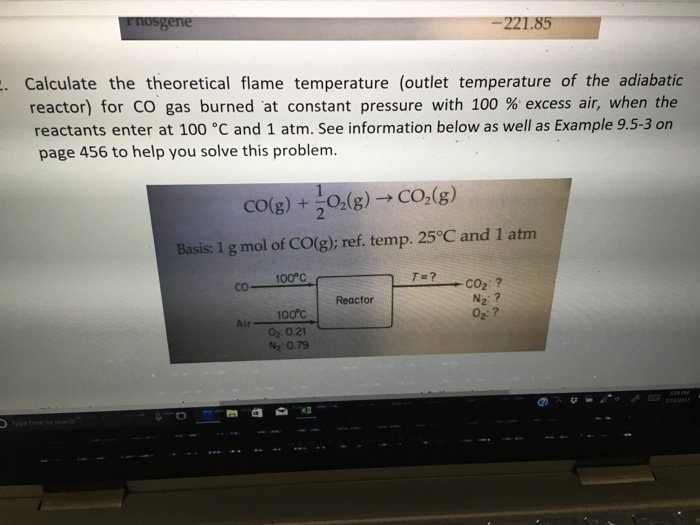 = zt
_ Calculate the theoretical flame temperature (outlet temperature of the adiabatic
reactor) for CO gas burned ‘at constant pressure with 100 % excess air, when the
reactants enter at 100 °C and 1 atm. See information below as well as Example 9.5-3 on
page 456 to help you solve this problem.
1 cou(g |
cole) +5048) — COx(8) f
mol of CO(g); ref. temp. 25°C and 1atm
“ud =
Foc In op
| sd
tay 03:2
bh. x
= zt
_ Calculate the theoretical flame temperature (outlet temperature of the adiabatic
reactor) for CO gas burned ‘at constant pressure with 100 % excess air, when the
reactants enter at 100 °C and 1 atm. See information below as well as Example 9.5-3 on
page 456 to help you solve this problem.
1 cou(g |
cole) +5048) — COx(8) f
mol of CO(g); ref. temp. 25°C and 1atm
“ud =
Foc In op
| sd
tay 03:2
bh. x
This is AI generated Response.
Asked by: Prahlad Kumar
Created at: 2025-09-18 16:19:22
Asked by: Prahlad Kumar
Created at: 2025-09-18 16:19:22
Final Answer:
Rendered
Raw Text
Did you like this answer?
# Step-by-Step Solution: Theoretical Flame Temperature for CO Combustion
Let's solve **theoretical flame temperature** for the adiabatic combustion of CO with 100% excess air, **using Excel for calculations**.
**Basis:** 1 mol CO (g).
**Reactants enter at 100°C (373 K), at 1 atm.**
---
## **Step 1: Write the Combustion Reaction**
\[
\text{CO (g)} + \frac{1}{2}\text{O}_2(\text{g}) \rightarrow \text{CO}_2(\text{g})
\]
---
## **Step 2: Determine Moles of Reactants and Products**
### **A. Stoichiometric Oxygen Required**
- 1 mol CO needs 0.5 mol O₂.
### **B. Excess Air (100%)**
- 100% excess means **double the stoichiometric O₂** supplied.
- Total O₂ supplied = \(0.5 \times 2 = 1.0 \) mol O₂
### **C. Air Composition**
- Air is 21% O₂ and 79% N₂ by mole.
- Air needed: \( \frac{1.0~\text{mol O}_2}{0.21} = 4.76~\text{mol air} \)
- N₂ supplied: \( 4.76~\text{mol air} \times 0.79 = 3.76~\text{mol N}_2 \)
### **D. Reactants Entering**
- CO: 1 mol
- O₂: 1 mol (from air)
- N₂: 3.76 mol (from air)
### **E. Products After Combustion**
- 1 mol CO₂ (from 1 mol CO)
- O₂ leftover: \( 1.0 - 0.5 = 0.5 \) mol O₂ (from excess air)
- N₂: 3.76 mol (inert, does not react)
---
## **Step 3: Write the Energy Balance (Adiabatic Reactor)**
\[
\text{Total enthalpy in at 100}^\circ\text{C} = \text{Total enthalpy out at }T_f
\]
\[
\sum n_{in} [\Delta H^\circ_{f,25^\circ\text{C}} + \text{sensible } H_{100-25^\circ\text{C}}] = \sum n_{out} [\Delta H^\circ_{f,25^\circ\text{C}} + \text{sensible } H_{T-25^\circ\text{C}}]
\]
- **Adiabatic:** No heat loss to surroundings.
---
## **Step 4: Data Needed**
| Species | ΔHf° (kJ/mol) | Cp (J/mol·K) |
|---------|---------------|--------------|
| CO (g) | -110.5 | ~29 |
| O₂ (g) | 0 | ~29 |
| N₂ (g) | 0 | ~29 |
| CO₂ (g) | -393.5 | ~37 |
> Values of Cp are **approximated**. For greater accuracy, use temperature-dependent Cp or tabulated enthalpy data.
---
## **Step 5: Calculate Enthalpy of Reactants at 100°C (373 K)**
\[
\Delta H_{reactants} = \sum n_i \left[\Delta H^\circ_{f,25^\circ\text{C}} + \int_{25^\circ\text{C}}^{100^\circ\text{C}} C_{p,i} dT\right]
\]
**Cp is assumed constant for simplicity.**
### **A. CO (g):**
\[
\Delta H_{CO} = (-110.5~\text{kJ/mol}) + (29~\text{J/mol·K}) \times (373-298)~\text{K} \times 1~\text{mol}
\]
\[
= -110.5 + (29 \times 75 / 1000) = -110.5 + 2.18 = -108.32~\text{kJ}
\]
### **B. O₂ (g):**
\[
\Delta H_{O_2} = 0 + (29 \times 75 / 1000) = 2.18~\text{kJ} \times 1~\text{mol} = 2.18~\text{kJ}
\]
### **C. N₂ (g):**
\[
\Delta H_{N_2} = 0 + (29 \times 75 / 1000) = 2.18~\text{kJ} \times 3.76~\text{mol} = 8.19~\text{kJ}
\]
### **D. Total Reactant Enthalpy**
\[
H_{reactants} = (-108.32) + (2.18) + (8.19) = -97.95~\text{kJ}
\]
---
## **Step 6: Calculate Enthalpy of Products at Flame Temperature \(T_f\) (unknown)**
### **Products:**
- CO₂: 1 mol
- O₂: 0.5 mol
- N₂: 3.76 mol
\[
H_{products} = [\Delta H^\circ_{f,CO_2} + Cp_{CO_2}(T_f-298)] \times 1
\]
\[
+ [\Delta H^\circ_{f,O_2} + Cp_{O_2}(T_f-298)] \times 0.5
\]
\[
+ [\Delta H^\circ_{f,N_2} + Cp_{N_2}(T_f-298)] \times 3.76
\]
\[
= [-393.5 + 37(T_f-298)/1000] \times 1
\]
\[
+ [0 + 29(T_f-298)/1000] \times 0.5
\]
\[
+ [0 + 29(T_f-298)/1000] \times 3.76
\]
\[
H_{products} = -393.5 + 0.037(T_f-298) + 0.0145(T_f-298) + 0.109(T_f-298)
\]
\[
= -393.5 + [0.037 + 0.0145 + 0.109](T_f-298)
\]
\[
= -393.5 + 0.1605(T_f-298)
\]
---
## **Step 7: Set Up the Energy Balance Equation**
\[
H_{reactants} = H_{products}
\]
\[
-97.95 = -393.5 + 0.1605(T_f-298)
\]
\[
0.1605(T_f-298) = -97.95 + 393.5 = 295.55
\]
\[
T_f-298 = \frac{295.55}{0.1605} = 1841~\text{K}
\]
\[
T_f = 1841 + 298 = \boxed{2139~\text{K}}
\]
---
## **Step 8: How to Set Up in Excel**
### **Excel Steps:**
1. **List all given data** (ΔHf°, Cp, moles) in one table.
2. **Calculate reactant enthalpy** at 100°C.
3. **Set up the enthalpy equation for products** as a function of \(T_f\).
4. **Use the "Goal Seek" tool** to solve for \(T_f\) that balances reactant and product enthalpy.
### **Excel Table Example:**
| Species | n (mol) | ΔHf° (kJ/mol) | Cp (J/mol·K) | Initial T (K) | Final T (K) | Sensible ΔH (kJ) | Total ΔH (kJ) |
|---------|---------|---------------|--------------|---------------|-------------|------------------|---------------|
| CO | 1 | -110.5 | 29 | 373 | - | =29*(373-298)/1000 | -110.5 + [calc]|
| O2 | 1 | 0 | 29 | 373 | - | =29*(373-298)/1000 | 0 + [calc] |
| N2 | 3.76 | 0 | 29 | 373 | - | =29*(373-298)/1000 | 0 + [calc]*3.76|
| Species | n (mol) | ΔHf° (kJ/mol) | Cp (J/mol·K) | Final T (K) | Sensible ΔH (kJ) | Total ΔH (kJ) |
|---------|---------|---------------|--------------|-------------|------------------|---------------|
| CO2 | 1 | -393.5 | 37 | T_f | =37*(T_f-298)/1000 | -393.5 + [calc] |
| O2 | 0.5 | 0 | 29 | T_f | =29*(T_f-298)/1000 | [calc]*0.5 |
| N2 | 3.76 | 0 | 29 | T_f | =29*(T_f-298)/1000 | [calc]*3.76 |
- Sum reactant and product enthalpies.
- In a cell, set `Total Reactant Enthalpy = Total Product Enthalpy`.
- Use **Goal Seek** to adjust \(T_f\) until both sides are equal.
---
## **Final Answer**
\[
\boxed{T_f \approx 2139~\text{K}}
\]
**Note:**
For more accuracy, use tabulated enthalpy values for each gas at each temperature, especially at high temperatures (Cp is not truly constant).
But this approach gives a good engineering estimate and is easily implemented in Excel.
Question:
can u solve it with excel
This is AI generated Response.
Asked by: Prahlad Kumar
Created at: 2025-09-18 16:20:56
Asked by: Prahlad Kumar
Created at: 2025-09-18 16:20:56
Final Answer:
Rendered
Raw Text
Did you like this answer?
# Step-by-Step Solution: Theoretical Flame Temperature for CO Combustion
Let's solve **theoretical flame temperature** for the adiabatic combustion of CO with 100% excess air, using Excel for calculations.
**Basis:** 1 mol CO (g).
**Reactants enter at 100°C (373 K), at 1 atm.**
---
## Step 1: Write the Combustion Reaction
\[
\text{CO (g)} + \frac{1}{2}\text{O}_2(\text{g}) \rightarrow \text{CO}_2(\text{g})
\]
---
## Step 2: Determine Moles of Reactants and Products
### A. Stoichiometric Oxygen Required
- 1 mol CO needs 0.5 mol O₂.
### B. Excess Air (100%)
- Total O₂ supplied = \(0.5 \times 2 = 1.0 \) mol O₂
### C. Air Composition
- Air is 21% O₂ and 79% N₂ by mole.
- Air needed: \( \frac{1.0~\text{mol O}_2}{0.21} = 4.76~\text{mol air} \)
- N₂ supplied: \( 4.76~\text{mol air} \times 0.79 = 3.76~\text{mol N}_2 \)
### D. Reactants Entering
- CO: 1 mol
- O₂: 1 mol (from air)
- N₂: 3.76 mol (from air)
### E. Products After Combustion
- 1 mol CO₂ (from 1 mol CO)
- O₂ leftover: \( 1.0 - 0.5 = 0.5 \) mol O₂ (from excess air)
- N₂: 3.76 mol (inert, does not react)
---
## Step 3: Write the Energy Balance (Adiabatic Reactor)
\[
\text{Total enthalpy in at 100}^\circ\text{C} = \text{Total enthalpy out at }T_f
\]
\[
\sum n_{in} [\Delta H^\circ_{f,25^\circ\text{C}} + \text{sensible } H_{100-25^\circ\text{C}}] = \sum n_{out} [\Delta H^\circ_{f,25^\circ\text{C}} + \text{sensible } H_{T-25^\circ\text{C}}]
\]
---
## Step 4: Data Needed
| Species | ΔHf° (kJ/mol) | Cp (J/mol·K) |
|---------|---------------|---------------|
| CO (g) | -110.5 | ~29 |
| O₂ (g) | 0 | ~29 |
| N₂ (g) | 0 | ~29 |
| CO₂ (g) | -393.5 | ~37 |
> Values of Cp are approximated. For greater accuracy, use temperature-dependent Cp or tabulated enthalpy data.
---
## Step 5: Calculate Enthalpy of Reactants at 100°C (373 K)
\[
\Delta H_{reactants} = \sum n_i \left[\Delta H^\circ_{f,25^\circ\text{C}} + \int_{25^\circ\text{C}}^{100^\circ\text{C}} C_{p,i} dT\right]
\]
### A. CO (g):
\[
\Delta H_{CO} = (-110.5~\text{kJ/mol}) + (29~\text{J/mol·K}) \times (373-298)~\text{K} \times 1~\text{mol}
\]
\[
= -110.5 + (29 \times 75 / 1000) = -110.5 + 2.18 = -108.32~\text{kJ}
\]
### B. O₂ (g):
\[
\Delta H_{O_2} = 0 + (29 \times 75 / 1000) = 2.18~\text{kJ} \times 1~\text{mol} = 2.18~\text{kJ}
\]
### C. N₂ (g):
\[
\Delta H_{N_2} = 0 + (29 \times 75 / 1000) = 2.18~\text{kJ} \times 3.76~\text{mol} = 8.19~\text{kJ}
\]
### D. Total Reactant Enthalpy
\[
H_{reactants} = (-108.32) + (2.18) + (8.19) = -97.95~\text{kJ}
\]
---
## Step 6: Calculate Enthalpy of Products at Flame Temperature \(T_f\) (unknown)
### Products:
- CO₂: 1 mol
- O₂: 0.5 mol
- N₂: 3.76 mol
\[
H_{products} = [\Delta H^\circ_{f,CO_2} + Cp_{CO_2}(T_f-298)] \times 1
\]
\[
+ [\Delta H^\circ_{f,O_2} + Cp_{O_2}(T_f-298)] \times 0.5
\]
\[
+ [\Delta H^\circ_{f,N_2} + Cp_{N_2}(T_f-298)] \times 3.76
\]
\[
= [-393.5 + 37(T_f-298)/1000] \times 1
\]
\[
+ [0 + 29(T_f-298)/1000] \times 0.5
\]
\[
+ [0 + 29(T_f-298)/1000] \times 3.76
\]
\[
H_{products} = -393.5 + 0.037(T_f-298) + 0.0145(T_f-298) + 0.109(T_f-298)
\]
\[
= -393.5 + [0.037 + 0.0145 + 0.109](T_f-298)
\]
\[
= -393.5 + 0.1605(T_f-298)
\]
---
## Step 7: Set Up the Energy Balance Equation
\[
H_{reactants} = H_{products}
\]
\[
-97.95 = -393.5 + 0.1605(T_f-298)
\]
\[
0.1605(T_f-298) = -97.95 + 393.5 = 295.55
\]
\[
T_f-298 = \frac{295.55}{0.1605} = 1841~\text{K}
\]
\[
T_f = 1841 + 298 = \boxed{2139~\text{K}}
\]
---
## Step 8: How to Set Up in Excel
### Excel Steps:
1. **List all given data** (ΔHf°, Cp, moles) in one table.
2. **Calculate reactant enthalpy** at 100°C.
3. **Set up the enthalpy equation for products** as a function of \(T_f\).
4. **Use the "Goal Seek" tool** to solve for \(T_f\) that balances reactant and product enthalpy.
### Excel Table Example:
| Species | n (mol) | ΔHf° (kJ/mol) | Cp (J/mol·K) | Initial T (K) | Final T (K) | Sensible ΔH (kJ) | Total ΔH (kJ) |
|---------|---------|---------------|--------------|---------------|-------------|------------------|---------------|
| CO | 1 | -110.5 | 29 | 373 | - | =29*(373-298)/1000 | -110.5 + [calc]|
| O₂ | 1 | 0 | 29 | 373 | - | =29*(373-298)/1000 | 0 + [calc] |
| N₂ | 3.76 | 0 | 29 | 373 | - | =29*(373-298)/1000 | 0 + [calc]*3.76|
| Species | n (mol) | ΔHf° (kJ/mol) | Cp (J/mol·K) | Final T (K) | Sensible ΔH (kJ) | Total ΔH (kJ) |
|---------|---------|---------------|--------------|-------------|------------------|---------------|
| CO₂ | 1 | -393.5 | 37 | T_f | =37*(T_f-298)/1000 | -393.5 + [calc] |
| O₂ | 0.5 | 0 | 29 | T_f | =29*(T_f-298)/1000 | [calc]*0.5 |
| N₂ | 3.76 | 0 | 29 | T_f | =29*(T_f-298)/1000 | [calc]*3.76 |
- Sum reactant and product enthalpies.
- In a cell, set `Total Reactant Enthalpy = Total Product Enthalpy`.
- Use **Goal Seek** to adjust \(T_f\) until both sides are equal.
---
## Final Answer
\[
\boxed{T_f \approx 2139~\text{K}}
\]
**Note:**
For more accuracy, use tabulated enthalpy values for each gas at each temperature, especially at high temperatures (Cp is not truly constant).
But this approach provides a good engineering estimate and is easily implemented in Excel.
📢 Instructions:
- Ask anything relatd to above question only.
- For new Question goto :