This is AI generated Response.
Asked by: mayank
Created at: 2025-09-19 03:57:24
Final Answer:
RenderedRaw Text
Did you like this answer?
Let's break down the problem and solve it step-by-step as instructed.
---
# **Step 1: Regular Expressions and DFA Construction**
## **Given:**
- Alphabet: \(\Sigma = \{a, b\}\)
- Regular Expression \(E = (a + b)^* bb (a + b)^*\)
---
## **A. Make a DFA \(M\) such that \(L(M) = L(E)\)**
### **Language Description:**
- \(L(E)\) represents all strings over \(\{a, b\}\) that contain "bb" as a substring.
### **DFA Construction:**
Let's construct a minimal DFA for strings containing "bb":
#### **States:**
- \(q_0\): Start state, no 'b' seen yet.
- \(q_1\): 'b' seen, but not "bb".
- \(q_2\): "bb" seen (accepting state).
#### **Transitions:**
- From \(q_0\):
- On 'a', stay at \(q_0\).
- On 'b', go to \(q_1\).
- From \(q_1\):
- On 'a', go back to \(q_0\).
- On 'b', go to \(q_2\).
- From \(q_2\) (once "bb" has been seen, always accept):
- On 'a' or 'b', stay at \(q_2\).
#### **DFA Table:**
| State | a | b |
|-------|-----|-----|
| q0 | q0 | q1 |
| q1 | q0 | q2 |
| q2 | q2 | q2 |
- Start State: \(q_0\)
- Accepting State: \(q_2\)
---
## **B. DFA \(M'\) for the Complement**
We want \(L(M') = \overline{L(E)}\): strings **not** containing "bb".
- Complement the accepting/non-accepting states of \(M\):
| State | a | b | Accepting? |
|-------|-----|-----|------------|
| q0 | q0 | q1 | Yes |
| q1 | q0 | q2 | Yes |
| q2 | q2 | q2 | **No** |
- Now, \(q_0\) and \(q_1\) are accepting; \(q_2\) is not.
---
## **C. Regular Expression \(E'\) for \(L(M')\)**
We need a regular expression for all strings over \(\{a, b\}\) that **do not contain "bb"** as a substring.
### **Let’s use Arden’s Lemma and substitution:**
Let:
- \(R_0\): Strings to reach \(q_0\)
- \(R_1\): Strings to reach \(q_1\)
- \(R_2\): Strings to reach \(q_2\) (which we want to avoid—so focus on \(R_0\) and \(R_1\))
#### **Equations:**
- \(R_0 = a R_0 + a R_1 + \epsilon\) (from \(q_0\), on 'a' stay at \(q_0\); on 'b' go to \(q_1\))
- \(R_1 = b R_0\) (from \(q_1\), on 'a' back to \(q_0\); on 'b' to \(q_2\), but we do **not** want to reach \(q_2\))
But let's use a known result:
**A string with no "bb" as substring** can be described as:
- Each 'b' is not immediately followed by another 'b'.
- So: \( (a^* (b a^*)^*) \)
**Explanation:**
- Arbitrary many 'a's.
- Followed by zero or more occurrences of a 'b' followed by zero or more 'a's.
### **Therefore:**
\[
E' = a^* (b a^*)^*
\]
---
# **Step 2: Algorithm for DFA DifferInfinite**
## **Problem Restatement:**
- **Input:** DFAs \(M\) and \(N\)
- **Question:** Do \(M\) and \(N\) differ on infinitely many inputs?
## **Algorithm Steps:**
### **1. Construct DFA for Symmetric Difference**
- Construct DFA \(D\) such that \(L(D) = L(M) \Delta L(N) = (L(M) \setminus L(N)) \cup (L(N) \setminus L(M))\).
- This can be done by taking the **cross product** of \(M\) and \(N\).
### **2. Check if \(L(D)\) is infinite**
- Use the **DFA Infiniteness** algorithm (from class).
- The language of a DFA is infinite **iff** there is a cycle reachable from the start state that leads to an accepting state.
### **3. Output**
- If \(L(D)\) is infinite, output "Yes" (they differ on infinitely many strings).
- Otherwise, output "No".
---
## **Pseudocode**
```text
Input: DFAs M and N
1. Construct DFA D for the symmetric difference L(M) Δ L(N)
- For each state (m, n) in M x N
- Accepting if (m is accepting and n is not) or (m is not and n is)
2. Run DFA-Infinite(D)
- If infinite, output "Yes"
- Else, output "No"
```
---
# **Summary of Answers**
## **1.**
- **A:** DFA for \( (a + b)^* bb (a + b)^* \) constructed above.
- **B:** Complement DFA constructed.
- **C:** Regular expression for complement: \( \boxed{a^*(b a^*)^*} \)
## **2.**
- **Algorithm:** Construct symmetric difference DFA, check for infiniteness.
---
## **If you need the explicit state diagrams, let me know!**
VIPSolutions focuses on clear, step‑by‑step explanations so you can learn quickly. Whether you need an AI‑generated walkthrough or a short hint to get unstuck, each solution is organized for fast reading and easy review later.
Search similar questions, compare approaches, and bookmark the best answers for revision. Our goal is simple: quick, reliable study help that feels natural—not noisy.
 VIPSolutions
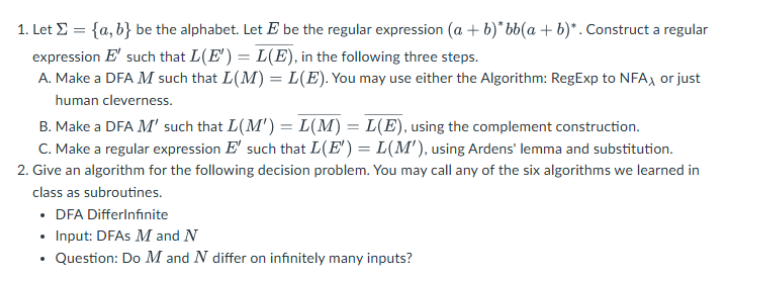 1.Let © = {a,b} be the alphabet. Let E be the regular expression (a + b)"bb(a + b)". Construct a regular
expression E' such that L(E') = L(E), in the following three steps.
A. Make a DFA M such that L(M) = L(E). You may use either the Algorithm: RegExp to NFA, or just
human cleverness.
B. Make a DFA M" such that L(M') = L(M) = L(E), using the complement construction.
C. Make a regular expression E’ such that L(E') = L(M’), using Ardens' lemma and substitution.
2. Give an algorithm for the following decision problem. You may call any of the six algorithms we learned in
class as subroutines.
+ DFA Differinfinite
« Input: DFAs M and N'
+ Question: Do M and N differ on infinitely many inputs?
1.Let © = {a,b} be the alphabet. Let E be the regular expression (a + b)"bb(a + b)". Construct a regular
expression E' such that L(E') = L(E), in the following three steps.
A. Make a DFA M such that L(M) = L(E). You may use either the Algorithm: RegExp to NFA, or just
human cleverness.
B. Make a DFA M" such that L(M') = L(M) = L(E), using the complement construction.
C. Make a regular expression E’ such that L(E') = L(M’), using Ardens' lemma and substitution.
2. Give an algorithm for the following decision problem. You may call any of the six algorithms we learned in
class as subroutines.
+ DFA Differinfinite
« Input: DFAs M and N'
+ Question: Do M and N differ on infinitely many inputs?