 VIPSolutions
Give step-by-step solution with explanation and final answer:“The dent ction 1) for te longi of thea stage, dy. fx bred of ect gran the hp ek. Smt, erp Sa LE TU ee CITT VT RCT ee CTIA TTR EEZEBEERLEE OF Swe ema iomizion = [lf x PO ON pn POSNSTPRRS te sd megs er 1 OREN ae sm FC
Question:
Give step-by-step solution with explanation and final answer: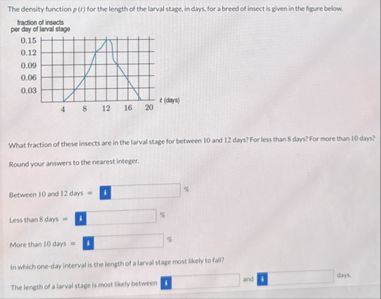 “The dent ction 1) for te longi of thea stage, dy. fx bred of ect gran the hp ek.
Smt,
erp
Sa LE TU ee
CITT VT RCT
ee CTIA TTR
EEZEBEERLEE OF
Swe
ema iomizion = [lf x
PO ON pn
POSNSTPRRS
te sd megs er 1
OREN ae sm FC
“The dent ction 1) for te longi of thea stage, dy. fx bred of ect gran the hp ek.
Smt,
erp
Sa LE TU ee
CITT VT RCT
ee CTIA TTR
EEZEBEERLEE OF
Swe
ema iomizion = [lf x
PO ON pn
POSNSTPRRS
te sd megs er 1
OREN ae sm FC
This is AI generated Response.
Asked by: Shashan Gupta
Created at: 2025-09-24 06:45:31
Asked by: Shashan Gupta
Created at: 2025-09-24 06:45:31
Final Answer:
Rendered
Raw Text
Did you like this answer?
Let's break down the given problem using the graph and the questions step by step.
---
## 1. **Fraction of Insects Between 10 and 12 Days**
**Step 1: Read the graph values between 10 and 12 days.**
- At 10 days, the density is approximately **0.10**.
- At 12 days, the density is approximately **0.08**.
**Step 2: Estimate the area (fraction) under the curve between 10 and 12 days.**
- The interval is 2 days.
- Average density: \((0.10 + 0.08)/2 = 0.09\)
- Area ≈ \(0.09 \times 2 = 0.18\)
**Step 3: Convert to a percentage (multiply by 100):**
- \(0.18 \times 100 = 18\%\)
**Answer:**
**Between 10 and 12 days = 18%**
---
## 2. **Fraction Less Than 8 Days**
**Step 1: Read graph values from 0 to 8 days.**
- At 4 days: ~0.03
- At 6 days: ~0.06
- At 8 days: ~0.09
**Step 2: Estimate area from 4 to 8 days (since 0–4 is negligible):**
- From 4 to 6 days (2 days, avg density ~0.045): \(2 \times 0.045 = 0.09\)
- From 6 to 8 days (2 days, avg density ~0.075): \(2 \times 0.075 = 0.15\)
- Total area ≈ \(0.09 + 0.15 = 0.24\)
**Step 3: Convert to percentage:**
- \(0.24 \times 100 = 24\%\)
**Answer:**
**Less than 8 days = 24%**
---
## 3. **Fraction More Than 10 Days**
**Step 1: Estimate area under the curve from 10 days onward.**
- From 10 to 12 days (already calculated): 0.18
- From 12 to 14 days: At 12 (~0.08), at 14 (~0.06), avg = 0.07, area = \(2 \times 0.07 = 0.14\)
- From 14 to 16 days: At 14 (~0.06), at 16 (~0.03), avg = 0.045, area = \(2 \times 0.045 = 0.09\)
- Sum: \(0.18 + 0.14 + 0.09 = 0.41\)
**Step 2: Convert to percentage:**
- \(0.41 \times 100 = 41\%\)
**Answer:**
**More than 10 days = 41%**
---
## 4. **Most Likely One-Day Interval**
Look for the peak of the density function on the graph.
- The peak is at **10 days** with the highest density (\(\approx 0.10\)).
**Answer:**
**One-day interval: 10 to 11 days**
---
## 5. **Most Likely Length of Larval Stage**
- The larval stage is most likely between **10 and 11 days**, since that interval contains the peak.
---
## **Summary Table**
| Question | Answer |
|---------------------------------------------------------------|------------------|
| Fraction between 10 and 12 days | 18% |
| Fraction less than 8 days | 24% |
| Fraction more than 10 days | 41% |
| One-day interval most likely | 10 to 11 days |
| Most likely length is between | 10 and 11 days |
---
### **Final Answers (to fill in boxes):**
1. **18**
2. **24**
3. **41**
4. **10** and **11** (days)
📢 Instructions:
- Ask anything relatd to above question only.
- For new Question goto :