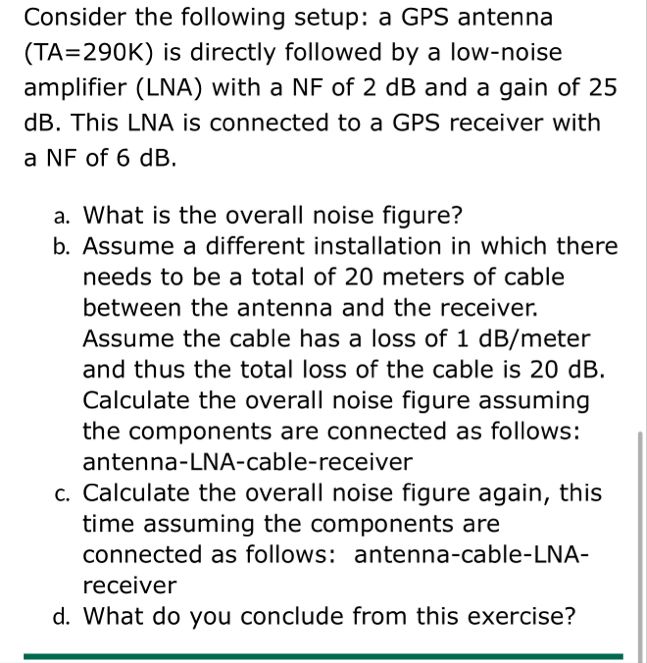
Give step-by-step solution with explanation and final answer:Consider the following setup: a GPS antenna
(TA=290K) is directly followed by a low-noise
amplifier (LNA) with a NF of 2 dB and a gain of 25
dB. This LNA is connected to a GPS receiver with
a NF of 6 dB.
a. What is the overall noise figure?
b. Assume a different installation in which there
needs to be a total of 20 meters of cable
between the antenna and the receiver.
Assume the cable has a loss of 1 dB/meter
and thus the total loss of the cable is 20 dB.
Calculate the overall noise figure assuming
the components are connected as follows:
antenna-LNA-cable-receiver
c. Calculate the overall noise figure again, this
time assuming the components are
connected as follows: antenna-cable-LNA-
receiver
d. What do you conclude from this exercise?
Question:
Give step-by-step solution with explanation and final answer:Consider the following setup: a GPS antenna
(TA=290K) is directly followed by a low-noise
amplifier (LNA) with a NF of 2 dB and a gain of 25
dB. This LNA is connected to a GPS receiver with
a NF of 6 dB.
a. What is the overall noise figure?
b. Assume a different installation in which there
needs to be a total of 20 meters of cable
between the antenna and the receiver.
Assume the cable has a loss of 1 dB/meter
and thus the total loss of the cable is 20 dB.
Calculate the overall noise figure assuming
the components are connected as follows:
antenna-LNA-cable-receiver
c. Calculate the overall noise figure again, this
time assuming the components are
connected as follows: antenna-cable-LNA-
receiver
d. What do you conclude from this exercise?
This is AI generated Response.
Asked by: Abhishek
Created at: 2025-09-24 14:58:33
Final Answer:
RenderedRaw Text
Did you like this answer?
Let's solve each part step by step using **Friis’ formula** for noise figure:
### Friis’ Formula for Noise Figure
For a cascade of three components:
\[
F_{total} = F_1 + \frac{F_2 - 1}{G_1} + \frac{F_3 - 1}{G_1 G_2}
\]
where:
- \( F = \) Noise Factor (linear, not dB)
- \( G = \) Gain (linear, not dB)
Noise Figure (NF) in dB: \( NF = 10 \log_{10}(F) \)
Gain (G) in dB: \( G_{dB} = 10\log_{10}(G) \Rightarrow G = 10^{G_{dB}/10} \)
---
## (a) **What is the overall noise figure?**
**Order:** Antenna → LNA (NF = 2 dB, Gain = 25 dB) → Receiver (NF = 6 dB)
- LNA: \( NF_1 = 2\,dB \) → \( F_1 = 10^{2/10} = 1.585 \), \( G_1 = 10^{25/10} = 316.23 \)
- Receiver: \( NF_2 = 6\,dB \) → \( F_2 = 10^{6/10} = 3.981 \)
#### Applying Friis’ Formula (only two stages since the antenna is noiseless):
\[
F_{total} = F_1 + \frac{F_2 - 1}{G_1}
\]
\[
F_{total} = 1.585 + \frac{3.981 - 1}{316.23}
\]
\[
F_{total} = 1.585 + \frac{2.981}{316.23}
\]
\[
F_{total} = 1.585 + 0.0094 = 1.5944
\]
**Noise Figure (dB):**
\[
NF_{total} = 10 \log_{10}(1.5944) \approx 2.02\, \text{dB}
\]
---
## (b) **Antenna → LNA → Cable (20 dB loss) → Receiver**
- Cable: **Loss** \( = 20\,dB \) → \( G_2 = 10^{-20/10} = 0.01 \), \( F_2 = 1/G_2 = 100 \)
- Add receiver after cable: \( NF_3 = 6\,dB \rightarrow F_3 = 3.981 \)
Order: **LNA (F1, G1) → Cable (F2, G2) → Receiver (F3)**
\[
F_{total} = F_1 + \frac{F_2 - 1}{G_1} + \frac{F_3 - 1}{G_1 G_2}
\]
\[
F_{total} = 1.585 + \frac{100 - 1}{316.23} + \frac{3.981 - 1}{316.23 \times 0.01}
\]
\[
F_{total} = 1.585 + \frac{99}{316.23} + \frac{2.981}{3.1623}
\]
\[
= 1.585 + 0.313 + 0.943 \approx 2.841
\]
**Noise Figure (dB):**
\[
NF_{total} = 10 \log_{10}(2.841) \approx 4.53\, \text{dB}
\]
---
## (c) **Antenna → Cable (20 dB loss) → LNA → Receiver**
- Cable now comes before LNA.
- LNA: \( F_2 = 1.585, G_2 = 316.23 \)
- Cable: \( F_1 = 100, G_1 = 0.01 \)
- Receiver: \( F_3 = 3.981 \)
\[
F_{total} = F_1 + \frac{F_2 - 1}{G_1} + \frac{F_3 - 1}{G_1 G_2}
\]
\[
F_{total} = 100 + \frac{1.585 - 1}{0.01} + \frac{3.981 - 1}{0.01 \times 316.23}
\]
\[
= 100 + \frac{0.585}{0.01} + \frac{2.981}{3.1623}
\]
\[
= 100 + 58.5 + 0.943 = 159.443
\]
**Noise Figure (dB):**
\[
NF_{total} = 10 \log_{10}(159.443) \approx 22.0\, \text{dB}
\]
---
## (d) **Conclusion**
- **Placing the LNA close to the antenna minimizes the overall noise figure, even with lossy cable after the LNA.**
- **If the cable comes before the LNA, the noise contribution of the cable is greatly amplified and dominates the overall system noise.**
- **Always place the LNA as close as possible to the antenna to preserve signal quality.**
---
## **Summary Table**
| Configuration | Noise Figure (dB) |
|------------------------------- |:----------------:|
| Antenna-LNA-Receiver | 2.02 |
| Antenna-LNA-Cable-Receiver | 4.53 |
| Antenna-Cable-LNA-Receiver | 22.0 |
---
### **Key Takeaway**
**Always put the LNA before any lossy cable to achieve the best noise performance.**
VIPSolutions focuses on clear, step‑by‑step explanations so you can learn quickly. Whether you need an AI‑generated walkthrough or a short hint to get unstuck, each solution is organized for fast reading and easy review later.
Search similar questions, compare approaches, and bookmark the best answers for revision. Our goal is simple: quick, reliable study help that feels natural—not noisy.
 VIPSolutions
 Consider the following setup: a GPS antenna
(TA=290K) is directly followed by a low-noise
amplifier (LNA) with a NF of 2 dB and a gain of 25
dB. This LNA is connected to a GPS receiver with
a NF of 6 dB.
a. What is the overall noise figure?
b. Assume a different installation in which there
needs to be a total of 20 meters of cable
between the antenna and the receiver.
Assume the cable has a loss of 1 dB/meter
and thus the total loss of the cable is 20 dB.
Calculate the overall noise figure assuming
the components are connected as follows:
antenna-LNA-cable-receiver
c. Calculate the overall noise figure again, this
time assuming the components are
connected as follows: antenna-cable-LNA-
receiver
d. What do you conclude from this exercise?
Consider the following setup: a GPS antenna
(TA=290K) is directly followed by a low-noise
amplifier (LNA) with a NF of 2 dB and a gain of 25
dB. This LNA is connected to a GPS receiver with
a NF of 6 dB.
a. What is the overall noise figure?
b. Assume a different installation in which there
needs to be a total of 20 meters of cable
between the antenna and the receiver.
Assume the cable has a loss of 1 dB/meter
and thus the total loss of the cable is 20 dB.
Calculate the overall noise figure assuming
the components are connected as follows:
antenna-LNA-cable-receiver
c. Calculate the overall noise figure again, this
time assuming the components are
connected as follows: antenna-cable-LNA-
receiver
d. What do you conclude from this exercise?