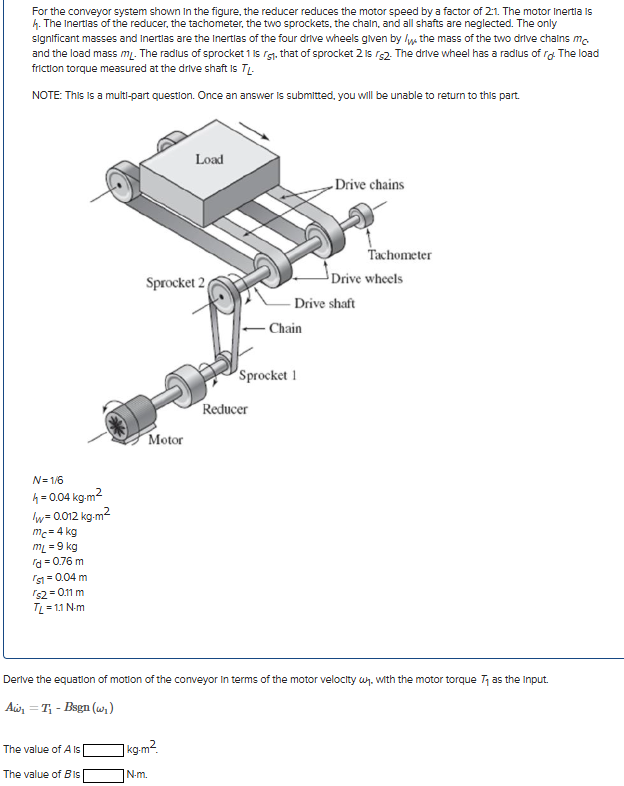
Give step-by-step solution with explanation and final answer:For the conveyor system shown In the figure, the reducer reduces the motor speed by a factor of 21. The motor Inertia Is
Tha nertas of 10 reduce, the achometa, the two sprocket, te chain, nd a shai are neglected Tha only
Sgncant acces and Inertia are th ners of 1 our Cv Wasi GEN By Jy the mass of the uo Gite chan
anc the oad mass. The rus of rocket 1 sha of Sprocket 21 rc. Tha ce hes! hi a acs ofr The oad
rcton torque messured at th dive shat Tj.
NOTE: Th 1 a mult pat question. Once an answer s sUbmiSed. you wl 8 Unable Feu hs par.
NN
#
8 2. Drive chains
DD SSE
NON
ONS oR) Tachometer
Sprocket 2/83 2) Deve wheels
EF oe
a
5
By EY sprocket |
” Reducer
—
~~ S&F Motor
N=16
=008 kgm?
Iy=0012kgm?
me=4kg
m=9kg
=076m
12=004m
rg=0nm
T=tnm
Dene the equation of moon of the conveyor n tems of the motor veocty uy, ih he mator torque 7; asthe Input.
Ay =, - Been (1)
The value of Als kgm?
The value of Bs Nm.
Question:
Give step-by-step solution with explanation and final answer:For the conveyor system shown In the figure, the reducer reduces the motor speed by a factor of 21. The motor Inertia Is
Tha nertas of 10 reduce, the achometa, the two sprocket, te chain, nd a shai are neglected Tha only
Sgncant acces and Inertia are th ners of 1 our Cv Wasi GEN By Jy the mass of the uo Gite chan
anc the oad mass. The rus of rocket 1 sha of Sprocket 21 rc. Tha ce hes! hi a acs ofr The oad
rcton torque messured at th dive shat Tj.
NOTE: Th 1 a mult pat question. Once an answer s sUbmiSed. you wl 8 Unable Feu hs par.
NN
#
8 2. Drive chains
DD SSE
NON
ONS oR) Tachometer
Sprocket 2/83 2) Deve wheels
EF oe
a
5
By EY sprocket |
” Reducer
—
~~ S&F Motor
N=16
=008 kgm?
Iy=0012kgm?
me=4kg
m=9kg
=076m
12=004m
rg=0nm
T=tnm
Dene the equation of moon of the conveyor n tems of the motor veocty uy, ih he mator torque 7; asthe Input.
Ay =, - Been (1)
The value of Als kgm?
The value of Bs Nm.
This is AI generated Response.
Asked by: gorle prasanth
Created at: 2025-09-24 15:41:47
Final Answer:
RenderedRaw Text
Did you like this answer?
Let's break down the solution step by step:
---
## **Step 1: Equivalent Inertia Calculation (A)**
We need to express all rotating and translating inertias to the motor shaft (input side).
### **1. Motor Inertia (Direct):**
\[
J_{motor} = I_m
\]
### **2. Drive Wheels Inertia (Reflected):**
There are 4 wheels, each with inertia \(I_{dw}\), reflected to the motor shaft through the gear ratio \(N\):
\[
J_{dw,eq} = 4 \times I_{dw} \times N^2
\]
### **3. Mass of Drive Chains (Reflected):**
There are 2 chains, each with mass \(m_c\), moving at the same speed as the drive wheels. The equivalent rotational inertia at the wheel is \(m_c r_{d}^2\), reflected to the motor shaft:
\[
J_{chain,eq} = 2 \times m_c \times r_d^2 \times N^2
\]
### **4. Load Mass (Reflected):**
The load mass \(m_L\) is moving linearly with the belt, but we convert to equivalent rotational inertia at the drive wheel, then to the motor shaft:
\[
J_{load,eq} = m_L r_d^2 \times N^2
\]
### **Total Equivalent Inertia (A):**
\[
A = I_m + 4I_{dw}N^2 + 2m_c r_d^2 N^2 + m_L r_d^2 N^2
\]
---
#### **Plug in the numbers:**
- \(I_m = 0.04\) kg·m²
- \(I_{dw} = 0.012\) kg·m²
- \(N = 1/6\)
- \(m_c = 4\) kg
- \(m_L = 9\) kg
- \(r_d = 0.076\) m
\[
N^2 = \left(\frac{1}{6}\right)^2 = \frac{1}{36}
\]
\[
A = 0.04 + 4(0.012)\left(\frac{1}{36}\right) + 2(4)(0.076^2)\left(\frac{1}{36}\right) + 9(0.076^2)\left(\frac{1}{36}\right)
\]
Calculate each term:
- \(4 \times 0.012 = 0.048\)
- \(0.048 \times \frac{1}{36} = 0.00133\)
- \(0.076^2 = 0.005776\)
- \(2 \times 4 = 8\)
- \(8 \times 0.005776 = 0.0462\)
- \(0.0462 \times \frac{1}{36} = 0.001283\)
- \(9 \times 0.005776 = 0.051984\)
- \(0.051984 \times \frac{1}{36} = 0.001444\)
Sum up:
\[
A = 0.04 + 0.00133 + 0.001283 + 0.001444 = \boxed{0.0441} \text{ kg·m}^2
\]
---
## **Step 2: Equivalent Load Torque (B)**
The load torque at the drive shaft is \(T_L\). Reflected to the motor shaft (input side) through the gear ratio \(N\):
\[
B = N T_L
\]
Plug in the values:
- \(N = 1/6\)
- \(T_L = 11\) N·m
\[
B = \frac{1}{6} \times 11 = \boxed{1.83} \text{ N·m}
\]
---
## **Step 3: Final Answers**
\[
\boxed{A = 0.0441 \ \text{kg·m}^2}
\]
\[
\boxed{B = 1.83 \ \text{N·m}}
\]
---
### **Summary Table**
| Parameter | Value |
|-----------|---------------|
| A | 0.0441 kg·m² |
| B | 1.83 N·m |
---
## **Equation of Motion**
\[
A \dot{\omega}_m = T_i - B \operatorname{sgn}(\omega_m)
\]
---
**Fill in the blanks:**
- The value of A is **0.0441 kg·m²**
- The value of B is **1.83 N·m**
Question:
explanation to each block
This is AI generated Response.
Asked by: gorle prasanth
Created at: 2025-09-24 15:43:39
Final Answer:
RenderedRaw Text
Did you like this answer?
# Step-by-Step Solution Explanation
This section breaks down the calculations for equivalent inertia (A) and equivalent load torque (B) in the conveyor system.
## Step 1: Equivalent Inertia Calculation (A)
### 1. Motor Inertia (Direct)
The motor inertia is given directly as:
\[
J_{motor} = I_m
\]
### 2. Drive Wheels Inertia (Reflected)
To reflect the inertia of the drive wheels back to the motor shaft, we use the gear ratio \(N\):
\[
J_{dw,eq} = 4 \times I_{dw} \times N^2
\]
### 3. Mass of Drive Chains (Reflected)
The chains also contribute to inertia, reflected to the motor shaft:
\[
J_{chain,eq} = 2 \times m_c \times r_d^2 \times N^2
\]
### 4. Load Mass (Reflected)
The load mass is reflected similarly:
\[
J_{load,eq} = m_L \times r_d^2 \times N^2
\]
### Total Equivalent Inertia (A)
Combining all contributions gives:
\[
A = I_m + 4I_{dw}N^2 + 2m_c r_d^2 N^2 + m_L r_d^2 N^2
\]
### Numerical Calculation
Substituting the values:
- \(I_m = 0.04\) kg·m²
- \(I_{dw} = 0.012\) kg·m²
- \(N = \frac{1}{6}\) (since the reducer reduces speed by a factor of 6)
- \(m_c = 4\) kg
- \(m_L = 9\) kg
- \(r_d = 0.076\) m
Calculate \(N^2\):
\[
N^2 = \left(\frac{1}{6}\right)^2 = \frac{1}{36}
\]
Now compute \(A\):
\[
A = 0.04 + 4(0.012)\left(\frac{1}{36}\right) + 2(4)(0.076^2)\left(\frac{1}{36}\right) + 9(0.076^2)\left(\frac{1}{36}\right)
\]
Calculating each term:
- \(4 \times 0.012 = 0.048\)
- \(0.048 \times \frac{1}{36} \approx 0.00133\)
- \(0.076^2 = 0.005776\)
- \(2 \times 4 \times 0.005776 = 0.046208\)
- \(0.046208 \times \frac{1}{36} \approx 0.001283\)
- \(9 \times 0.005776 = 0.051984\)
- \(0.051984 \times \frac{1}{36} \approx 0.001444\)
Summing up all contributions:
\[
A = 0.04 + 0.00133 + 0.001283 + 0.001444 \approx 0.0441 \text{ kg·m}^2
\]
**Final Inertia Value:**
\[
\boxed{A = 0.0441 \text{ kg·m}^2}
\]
---
## Step 2: Equivalent Load Torque (B)
The load torque \(T_L\) at the drive shaft needs to be reflected to the motor shaft:
\[
B = N \times T_L
\]
### Numerical Calculation
Given:
- \(N = \frac{1}{6}\)
- \(T_L = 11\) N·m
Calculating \(B\):
\[
B = \frac{1}{6} \times 11 \approx 1.83 \text{ N·m}
\]
**Final Torque Value:**
\[
\boxed{B = 1.83 \text{ N·m}}
\]
---
## Final Answers
### Summary of Results
- **Inertia (A):**
\[
\boxed{0.0441 \text{ kg·m}^2}
\]
- **Torque (B):**
\[
\boxed{1.83 \text{ N·m}}
\]
---
## Equation of Motion
The equation of motion for the conveyor system in terms of motor velocity \( \dot{\omega}_m \) and motor torque \( T_i \) is given by:
\[
A \dot{\omega}_m = T_i - B \operatorname{sgn}(\omega_m)
\]
---
## Fill in the Blanks
- The value of \( A \) is **0.0441 kg·m²**
- The value of \( B \) is **1.83 N·m**
VIPSolutions focuses on clear, step‑by‑step explanations so you can learn quickly. Whether you need an AI‑generated walkthrough or a short hint to get unstuck, each solution is organized for fast reading and easy review later.
Search similar questions, compare approaches, and bookmark the best answers for revision. Our goal is simple: quick, reliable study help that feels natural—not noisy.
 VIPSolutions
 For the conveyor system shown In the figure, the reducer reduces the motor speed by a factor of 21. The motor Inertia Is
Tha nertas of 10 reduce, the achometa, the two sprocket, te chain, nd a shai are neglected Tha only
Sgncant acces and Inertia are th ners of 1 our Cv Wasi GEN By Jy the mass of the uo Gite chan
anc the oad mass. The rus of rocket 1 sha of Sprocket 21 rc. Tha ce hes! hi a acs ofr The oad
rcton torque messured at th dive shat Tj.
NOTE: Th 1 a mult pat question. Once an answer s sUbmiSed. you wl 8 Unable Feu hs par.
NN
#
8 2. Drive chains
DD SSE
NON
ONS oR) Tachometer
Sprocket 2/83 2) Deve wheels
EF oe
a
5
By EY sprocket |
” Reducer
—
~~ S&F Motor
N=16
=008 kgm?
Iy=0012kgm?
me=4kg
m=9kg
=076m
12=004m
rg=0nm
T=tnm
Dene the equation of moon of the conveyor n tems of the motor veocty uy, ih he mator torque 7; asthe Input.
Ay =, - Been (1)
The value of Als kgm?
The value of Bs Nm.
For the conveyor system shown In the figure, the reducer reduces the motor speed by a factor of 21. The motor Inertia Is
Tha nertas of 10 reduce, the achometa, the two sprocket, te chain, nd a shai are neglected Tha only
Sgncant acces and Inertia are th ners of 1 our Cv Wasi GEN By Jy the mass of the uo Gite chan
anc the oad mass. The rus of rocket 1 sha of Sprocket 21 rc. Tha ce hes! hi a acs ofr The oad
rcton torque messured at th dive shat Tj.
NOTE: Th 1 a mult pat question. Once an answer s sUbmiSed. you wl 8 Unable Feu hs par.
NN
#
8 2. Drive chains
DD SSE
NON
ONS oR) Tachometer
Sprocket 2/83 2) Deve wheels
EF oe
a
5
By EY sprocket |
” Reducer
—
~~ S&F Motor
N=16
=008 kgm?
Iy=0012kgm?
me=4kg
m=9kg
=076m
12=004m
rg=0nm
T=tnm
Dene the equation of moon of the conveyor n tems of the motor veocty uy, ih he mator torque 7; asthe Input.
Ay =, - Been (1)
The value of Als kgm?
The value of Bs Nm.