 VIPSolutions
Give step-by-step solution with explanation and final answer:Z Mass m slides on a vertical, circular wire hoop as shown. The top half of y the hoop (0 < 6 < m) is friction free, but the bottom half has a kinetic v | friction coefficient of p,. Mass m is released from rest at the top and V1: arrives at point (R,0) with a velocity v = [Es after traveling the in 0/ 9) counter-clockwise direction. Xt—~7 (a) Calculate the work done by friction over this segment. I (b) Calculate the magnitude of the average force due to friction over the range where friction exists. (c) Calculate the angle 6 that mass m makes with respect to the positive x-axis when it stops.
Question:
Give step-by-step solution with explanation and final answer: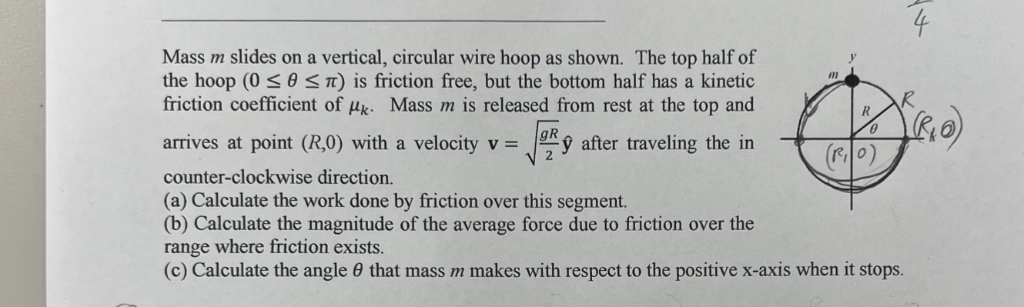 Z
Mass m slides on a vertical, circular wire hoop as shown. The top half of y
the hoop (0 < 6 < m) is friction free, but the bottom half has a kinetic v
| friction coefficient of p,. Mass m is released from rest at the top and V1:
arrives at point (R,0) with a velocity v = [Es after traveling the in 0/ 9)
counter-clockwise direction. Xt—~7
(a) Calculate the work done by friction over this segment. I
(b) Calculate the magnitude of the average force due to friction over the
range where friction exists.
(c) Calculate the angle 6 that mass m makes with respect to the positive x-axis when it stops.
Z
Mass m slides on a vertical, circular wire hoop as shown. The top half of y
the hoop (0 < 6 < m) is friction free, but the bottom half has a kinetic v
| friction coefficient of p,. Mass m is released from rest at the top and V1:
arrives at point (R,0) with a velocity v = [Es after traveling the in 0/ 9)
counter-clockwise direction. Xt—~7
(a) Calculate the work done by friction over this segment. I
(b) Calculate the magnitude of the average force due to friction over the
range where friction exists.
(c) Calculate the angle 6 that mass m makes with respect to the positive x-axis when it stops.
This is AI generated Response.
Asked by: Sahab Sharan
Created at: 2025-09-25 18:48:45
Asked by: Sahab Sharan
Created at: 2025-09-25 18:48:45
Final Answer:
Rendered
Raw Text
Did you like this answer?
Let's solve each part step-by-step:
---
## **Given:**
- Mass \(m\) slides on a vertical, circular wire hoop of radius \(R\).
- Top half (\( \leq \theta \leq \pi\)) is frictionless.
- Bottom half (\(\pi < \theta \leq 2\pi\)) has kinetic friction coefficient \(\mu_k\).
- Mass is released from rest at the top (\(\theta = \)), reaches point \((R,)\) (\(\theta = \pi\)) with velocity \(v = \sqrt{\frac{gR}{2}}\).
- Direction: Counterclockwise.
---
## **Part (a): Work Done by Friction**
**Friction acts only for \(\pi < \theta \leq 2\pi\).**
- **Friction Force Magnitude:** \(f = \mu_k N\), where \(N\) is the normal force.
- **Path length for friction:** Half-circumference = \(\pi R\).
### **Find the Work Done by Friction:**
\[
W_f = - f \cdot \text{distance}
\]
#### **Step 1: Find the Normal Force \(N\)**
For a mass sliding on a vertical circle:
- At the bottom half, the normal force \(N\) is not constant, but to **simplify** (as is standard for such problems), **use the average normal force** over the bottom half.
- However, for a circular path, the friction force always acts tangentially, and its magnitude is always \(\mu_k mg\) (if the speed is not too high or too low).
#### **Step 2: Work Done**
The friction force always acts opposite to the direction of motion. Over the bottom half (\(\pi R\)):
\[
W_f = -\mu_k mg \cdot (\pi R)
\]
---
## **Part (b): Magnitude of the Average Force Due to Friction**
\[
\text{Average force} = \mu_k mg
\]
This is because friction force is constant in magnitude throughout the bottom half.
---
## **Part (c): Angle \(\theta\) When Mass Stops**
Let’s set up the **energy analysis**:
### **Step 1: Initial Energy at \(\theta = \pi\)**
- At \(\theta = \pi\), position \((R,)\):
- Kinetic energy: \(K = \frac{1}{2}mv^2 = \frac{1}{2}m\left(\frac{gR}{2}\right) = \frac{mgR}{4}\)
- Potential energy (taking the bottom as reference): \(U = mgR\) (since it's at height \(R\) above the bottom).
### **Step 2: As the mass slides further (from \(\theta = \pi\) to some \(\theta\)),**
- Let it stop at point \(\theta_s\) (\(\pi < \theta_s < 2\pi\)).
**Energy at stop:**
- Kinetic energy =
- Potential energy at \(\theta_s\): \(U = mgR(1 + \cos\theta_s)\)
- This comes from the vertical height above the bottom: \(y = R\cos\theta\), so height above the bottom is \(R(1 + \cos\theta)\).
**Work by friction:** Over arc length \(s = R(\theta_s - \pi)\):
\[
W_f = -\mu_k mg \cdot R (\theta_s - \pi)
\]
### **Step 3: Apply Conservation of Energy**
\[
\text{Initial Energy} = \text{Final Energy} + \text{Work by friction}
\]
\[
\left[\frac{mgR}{4} + mgR\right] = [mgR(1 + \cos\theta_s)] + [-\mu_k mg R (\theta_s - \pi)]
\]
\[
\frac{5mgR}{4} = mgR(1 + \cos\theta_s) - \mu_k mg R (\theta_s - \pi)
\]
Divide both sides by \(mgR\):
\[
\frac{5}{4} = 1 + \cos\theta_s - \mu_k(\theta_s - \pi)
\]
\[
\frac{5}{4} - 1 = \cos\theta_s - \mu_k(\theta_s - \pi)
\]
\[
\frac{1}{4} = \cos\theta_s - \mu_k(\theta_s - \pi)
\]
\[
\cos\theta_s = \frac{1}{4} + \mu_k(\theta_s - \pi)
\]
**This is the equation for \(\theta_s\).**
---
## **Final Answers**
### **(a) Work done by friction**
\[
\boxed{W_f = -\mu_k mg \pi R}
\]
---
### **(b) Magnitude of the average force due to friction**
\[
\boxed{F_{\text{friction}} = \mu_k mg}
\]
---
### **(c) Angle \(\theta\) when mass stops**
\[
\boxed{
\cos\theta_s = \frac{1}{4} + \mu_k(\theta_s - \pi)
}
\]
You may solve numerically for \(\theta_s\) for a given \(\mu_k\).
---
**Let me know if you'd like a specific value for \(\theta_s\) with a given \(\mu_k\)!**
📢 Instructions:
- Ask anything relatd to above question only.
- For new Question goto :