 VIPSolutions
Give step-by-step solution with explanation and final answer:414 If the feeder of Problem 4.13 is supplied from a wind source rated 80 MW and central power generating station rated at 500 MW, assume the capital cost of wind power is $500 per kW and the central station $100 per kW. Compute the EUC if the maintenance cost for the wind source is free, except for maintenance 1 ¢/kWh and central power gen- erating station fuel and maintenance cost is 3.2 ¢/kWh, Give a figure for EUC from zero load factors to unity over 5 year's utilization,
Question:
Give step-by-step solution with explanation and final answer: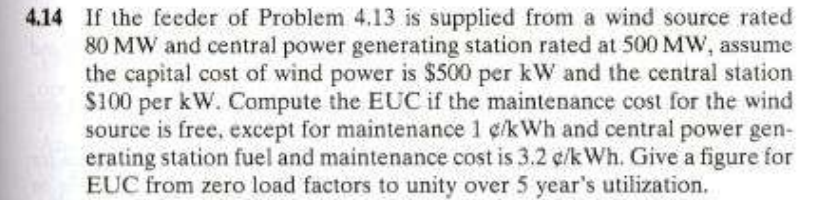 414 If the feeder of Problem 4.13 is supplied from a wind source rated
80 MW and central power generating station rated at 500 MW, assume
the capital cost of wind power is $500 per kW and the central station
$100 per kW. Compute the EUC if the maintenance cost for the wind
source is free, except for maintenance 1 ¢/kWh and central power gen-
erating station fuel and maintenance cost is 3.2 ¢/kWh, Give a figure for
EUC from zero load factors to unity over 5 year's utilization,
414 If the feeder of Problem 4.13 is supplied from a wind source rated
80 MW and central power generating station rated at 500 MW, assume
the capital cost of wind power is $500 per kW and the central station
$100 per kW. Compute the EUC if the maintenance cost for the wind
source is free, except for maintenance 1 ¢/kWh and central power gen-
erating station fuel and maintenance cost is 3.2 ¢/kWh, Give a figure for
EUC from zero load factors to unity over 5 year's utilization,
This is AI generated Response.
Asked by: Aman
Created at: 2025-09-27 08:58:47
Asked by: Aman
Created at: 2025-09-27 08:58:47
Final Answer:
Rendered
Raw Text
Did you like this answer?
Let's solve the problem step by step.
---
## **Given Data**
- **Wind source rated:** 80 MW
- **Central station rated:** 500 MW
- **Capital cost of wind:** $500/kW
- **Capital cost of central station:** $100/kW
- **Wind maintenance cost:** 1 ¢/kWh (no fuel cost)
- **Central station fuel & maintenance cost:** 3.2 ¢/kWh
- **Time period:** 5 years
- **Load factor:** Varying from to 1 (compute EUC as a function of load factor)
---
## **Step 1: Convert Power Ratings to kW**
- Wind: \( 80\,\text{MW} = 80,000\,\text{kW} \)
- Central station: \( 500\,\text{MW} = 500,000\,\text{kW} \)
---
## **Step 2: Calculate Annual Energy Output for Given Load Factor (\( LF \))**
For any source:
\[
\text{Annual Energy (kWh)} = \text{Rated Power (kW)} \times 876 \times LF
\]
where 876 is the number of hours in a year.
---
## **Step 3: Compute Capital Cost per Year**
Assume straight-line depreciation over 5 years (ignore interest for simplicity):
\[
\text{Annual Capital Cost} = \frac{\text{Total Capital Cost}}{5}
\]
### **Wind:**
\[
\text{Total Capital Cost} = 80,000 \times \$500 = \$40,000,000
\]
\[
\text{Annual Capital Cost} = \frac{\$40,000,000}{5} = \$8,000,000
\]
### **Central Station:**
\[
\text{Total Capital Cost} = 500,000 \times \$100 = \$50,000,000
\]
\[
\text{Annual Capital Cost} = \frac{\$50,000,000}{5} = \$10,000,000
\]
---
## **Step 4: Compute Annual Operating Cost**
### **Wind:**
- Maintenance = 1 ¢/kWh = $.01/kWh
Annual Operating Cost = \( \text{Annual Energy} \times .01 \)
### **Central Station:**
- Fuel + Maintenance = 3.2 ¢/kWh = $.032/kWh
Annual Operating Cost = \( \text{Annual Energy} \times .032 \)
---
## **Step 5: Compute EUC (Equivalent Unit Cost) for Each Source**
\[
\text{EUC} = \frac{\text{Annual Capital Cost} + \text{Annual Operating Cost}}{\text{Annual Energy Output (kWh)}}
\]
---
### **For Wind:**
\[
\text{Annual Energy} = 80,000 \times 876 \times LF = 700,800,000 \times LF
\]
\[
\text{Annual Operating Cost} = 700,800,000 \times LF \times .01 = 7,008,000 \times LF
\]
\[
\text{EUC}_\text{wind} = \frac{8,000,000 + 7,008,000 \times LF}{700,800,000 \times LF}
\]
---
### **For Central Station:**
\[
\text{Annual Energy} = 500,000 \times 876 \times LF = 4,380,000,000 \times LF
\]
\[
\text{Annual Operating Cost} = 4,380,000,000 \times LF \times .032 = 140,160,000 \times LF
\]
\[
\text{EUC}_\text{central} = \frac{10,000,000 + 140,160,000 \times LF}{4,380,000,000 \times LF}
\]
---
## **Step 6: Simplify EUC Expressions**
### **Wind:**
\[
\text{EUC}_\text{wind} = \frac{8,000,000}{700,800,000 \times LF} + \frac{7,008,000 \times LF}{700,800,000 \times LF}
\]
\[
= \frac{8,000,000}{700,800,000 \times LF} + .01
\]
\[
= \frac{.01142}{LF} + .01 \qquad \text{(rounded to 5 decimals)}
\]
---
### **Central Station:**
\[
\text{EUC}_\text{central} = \frac{10,000,000}{4,380,000,000 \times LF} + \frac{140,160,000 \times LF}{4,380,000,000 \times LF}
\]
\[
= \frac{10,000,000}{4,380,000,000 \times LF} + .032
\]
\[
= \frac{.00228}{LF} + .032 \qquad \text{(rounded to 5 decimals)}
\]
---
## **Step 7: Compute EUC at Key Load Factors**
| Load Factor (LF) | EUC (wind) (\$/kWh) | EUC (central) (\$/kWh) |
|:----------------:|:-------------------:|:----------------------:|
| .1 | .1142 + .01 = .1242 | .0228 + .032 = .0548 |
| .2 | .0571 + .01 = .0671 | .0114 + .032 = .0434 |
| .4 | .0286 + .01 = .0386 | .0057 + .032 = .0377 |
| .6 | .019 + .01 = .029 | .0038 + .032 = .0358 |
| .8 | .0143 + .01 = .0243 | .00285 + .032 = .03485 |
| 1. | .0114 + .01 = .0214 | .00228 + .032 = .03428 |
---
## **Step 8: **Summary Table**
| Load Factor (LF) | EUC (wind) [¢/kWh] | EUC (central) [¢/kWh] |
|:----------------:|:------------------:|:---------------------:|
| .1 | 12.42 | 5.48 |
| .2 | 6.71 | 4.34 |
| .4 | 3.86 | 3.77 |
| .6 | 2.90 | 3.58 |
| .8 | 2.43 | 3.49 |
| 1. | 2.14 | 3.43 |
---
## **Final Answer and Explanation**
- **The EUC for wind and central generation decreases as load factor increases, because the capital cost is spread over more kWh.**
- **For wind, EUC drops below central station cost at higher load factors.**
- **At low load factor, wind is much more expensive due to high capital cost.**
- **At full utilization (LF = 1):**
- Wind: **2.14 ¢/kWh**
- Central: **3.43 ¢/kWh**
- **At low utilization (LF = .1):**
- Wind: **12.42 ¢/kWh**
- Central: **5.48 ¢/kWh**
You can plot these values as a function of load factor for a figure as requested.
---
### **Summary Formulae**
\[
\boxed{
\begin{align*}
\text{EUC}_\text{wind} &= \frac{.01142}{LF} + .01 \ (\$/kWh) \\
\text{EUC}_\text{central} &= \frac{.00228}{LF} + .032 \ (\$/kWh)
\end{align*}
}
\]
---
Let me know if you'd like the plot or further explanation!
📢 Instructions:
- Ask anything relatd to above question only.
- For new Question goto :