This is AI generated Response.
Asked by: anil
Created at: 2025-09-27 12:04:39
Final Answer:
RenderedRaw Text
Did you like this answer?
Let's solve **Question 1 step-by-step using the Student t-test**.
---
## **Step 1: Write the Data**
| Set | Data |
|------|----------------------------------------|
| set1 | 36.4, 42.4, 31.9, 36.6, 37.4, 41.9, 33.1 |
| set2 | 30.9, 42.6, 28.4, 33.5, 38.2, 40.1, 34.1 |
---
## **Step 2: Calculate the Means**
\[
\bar{x}_1 = \frac{36.4 + 42.4 + 31.9 + 36.6 + 37.4 + 41.9 + 33.1}{7} = \frac{259.7}{7} = 37.1
\]
\[
\bar{x}_2 = \frac{30.9 + 42.6 + 28.4 + 33.5 + 38.2 + 40.1 + 34.1}{7} = \frac{247.8}{7} = 35.4
\]
---
## **Step 3: Calculate the Sample Variances**
Use the formula:
\[
s^2 = \frac{\sum (x_i - \bar{x})^2}{n-1}
\]
### For Set 1:
- Find squared differences from the mean (37.1):
- (36.4 - 37.1)² = .49
- (42.4 - 37.1)² = 28.09
- (31.9 - 37.1)² = 27.04
- (36.6 - 37.1)² = .25
- (37.4 - 37.1)² = .09
- (41.9 - 37.1)² = 23.04
- (33.1 - 37.1)² = 16.00
- Sum = .49 + 28.09 + 27.04 + .25 + .09 + 23.04 + 16.00 = 94.99
- Variance: \( s_1^2 = \frac{94.99}{6} = 15.83 \)
### For Set 2:
- Find squared differences from the mean (35.4):
- (30.9 - 35.4)² = 20.25
- (42.6 - 35.4)² = 51.84
- (28.4 - 35.4)² = 49.00
- (33.5 - 35.4)² = 3.61
- (38.2 - 35.4)² = 7.84
- (40.1 - 35.4)² = 22.09
- (34.1 - 35.4)² = 1.69
- Sum = 20.25 + 51.84 + 49.00 + 3.61 + 7.84 + 22.09 + 1.69 = 156.32
- Variance: \( s_2^2 = \frac{156.32}{6} = 26.05 \)
---
## **Step 4: Apply the t-test Formula**
\[
t = \frac{\bar{x}_1 - \bar{x}_2}{\sqrt{\frac{s_1^2}{n_1} + \frac{s_2^2}{n_2}}}
\]
Where \( n_1 = n_2 = 7 \).
\[
t = \frac{37.1 - 35.4}{\sqrt{\frac{15.83}{7} + \frac{26.05}{7}}}
\]
Calculate denominator:
\[
\frac{15.83}{7} = 2.26
\]
\[
\frac{26.05}{7} = 3.72
\]
\[
2.26 + 3.72 = 5.98
\]
\[
\sqrt{5.98} = 2.45
\]
So,
\[
t = \frac{1.7}{2.45} = .694
\]
---
## **Step 5: Degrees of Freedom (df)**
\[
df = n_1 + n_2 - 2 = 7 + 7 - 2 = 12
\]
---
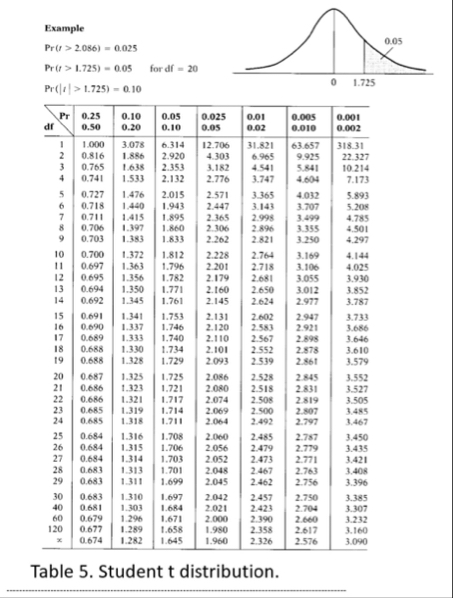
## **Step 6: Find the Critical t-value (from table) for 50% confidence, df = 12**
- For 50% confidence (two-tailed), \(\alpha = .5\).
- From the table, for \(df = 12\), at .5: \(t_{critical} = .695\)
---
## **Step 7: Compare t-value**
- Calculated t = .694
- Critical t = .695
\[
|t| < t_{critical}
\]
---
## **Conclusion**
- Since the calculated t-value is **less than** the critical t-value, we **fail to reject the null hypothesis**.
- **The two data sets are statistically the same at the 50% confidence interval.**
---
### **Final Answer**
> **At the 50% confidence interval, the two data sets are statistically the same.**
---
**Let me know if you need the solution for Question 2 as well!**
Question:
q 2 also
This is AI generated Response.
Asked by: anil
Created at: 2025-09-27 12:05:40
Final Answer:
RenderedRaw Text
Did you like this answer?
## **Question 2: Linear Regression Analysis Step-by-Step**
### **Step 1: Write the Data**
| x | y |
|----|-----|
| 12 | 100 |
| 53 | 202 |
| 35 | 31 |
| a | 389 |
| 55 | 532 |
*Note: The value for 'a' is unspecified in the provided data. Assuming 'a' is a placeholder, you will need to replace it with a numerical value to proceed.*
### **Step 2: Calculate the Means**
Assuming 'a' is a known number, calculate the means:
\[
\bar{x} = \frac{\sum x_i}{N}, \quad \bar{y} = \frac{\sum y_i}{N}
\]
Where \(N\) is the number of data points.
### **Step 3: Calculate the Slope (m) and Intercept (b)**
Using the formulas:
\[
m = \frac{N \sum (x_i y_i) - \sum x_i \sum y_i}{N \sum (x_i^2) - (\sum x_i)^2}
\]
\[
b = \bar{y} - m \bar{x}
\]
### **Step 4: Compute Required Sums**
1. Calculate \( \sum x_i \), \( \sum y_i \), \( \sum (x_i y_i) \), and \( \sum (x_i^2) \).
2. Substitute values into the formulas for \(m\) and \(b\).
### **Step 5: Calculate the Correlation Coefficient (r)**
Using the formula:
\[
r = \frac{N \sum (x_i y_i) - \sum x_i \sum y_i}{\sqrt{[N \sum (x_i^2) - (\sum x_i)^2][N \sum (y_i^2) - (\sum y_i)^2]}}
\]
### **Step 6: Calculate the Standard Error (SE)**
Standard error of estimate is given by:
\[
SE = \sqrt{\frac{\sum (y_i - \hat{y}_i)^2}{N-2}}
\]
Where \(\hat{y}_i\) are the predicted \(y\) values from the regression line.
### **Final Equations**
- **Regression Line:** \(y = mx + b\)
- **Correlation Coefficient:** \(r\)
- **Standard Error:** \(SE\)
### **Conclusion**
1. **Regression Equation:** Replace \(m\) and \(b\) with computed values.
2. **Correlation Coefficient:** Replace \(r\) with computed value.
3. **Standard Error:** Replace \(SE\) with computed value.
### **Final Answer**
> The linear regression equation, correlation coefficient, and standard error will be derived after calculating the necessary sums using the complete dataset. Ensure 'a' is defined for accurate computation.
---
If you provide a specific value for 'a', I can help finalize the calculations!
Question:
for 2nd question correct answer
This is AI generated Response.
Asked by: anil
Created at: 2025-09-27 12:31:34
2.Using the formulas for method of least square in lecture #
3
to find the equation of the linear regression line
y
=
a
0
a
1
x
,
correlation coefficient, and standard error for the following data set of x and y
.
(
2
0
pts
)
\
table
[
[
x
,
1
,
2
,
3
,
3
.
5
,
4
,
5
.
5
]
,
[
y
,
-
0
.
9
6
,
-
1
.
9
4
,
-
2
.
9
2
,
-
3
.
4
1
,
-
3
.
8
9
,
-
5
.
3
2
]
]
This is AI generated Response.
Asked by: anil
Created at: 2025-09-27 12:34:14
VIPSolutions focuses on clear, step‑by‑step explanations so you can learn quickly. Whether you need an AI‑generated walkthrough or a short hint to get unstuck, each solution is organized for fast reading and easy review later.
Search similar questions, compare approaches, and bookmark the best answers for revision. Our goal is simple: quick, reliable study help that feels natural—not noisy.
 VIPSolutions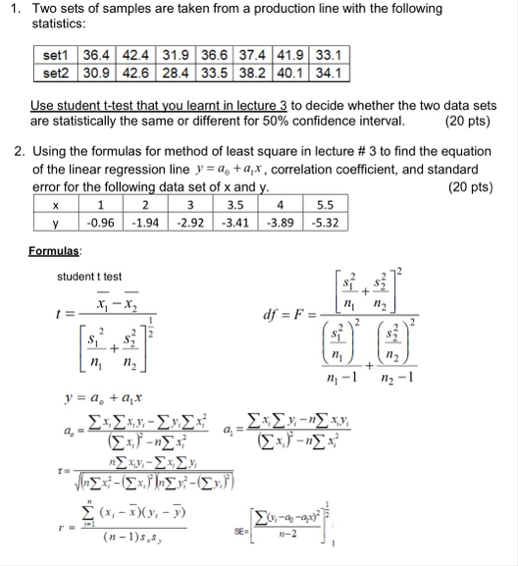
 1. Two sets of samples are taken from a production line with the following
statistics:
[sett [364424 [31.9366] 37.4 [419] 331]
[set2 [3091426 [2841335] 382[401[347]
Use student t-test that you leamt in lecture 3 to decide whether the two data sets
‘are statistically the same or different for 50% confidence interval. (20 pts)
2. Using the formulas for method of least square in lecture # 3 to find the equation
of the linear regression line v= @, +4, correlation coefficient, and standard
error for the following data setof x and y. (20 pts)
[x [12 [53 [3s] a [ss]
[oy Tose 100] 202 [31] 389 [532]
Formulas:
student tost 2 aT
== Li |
NTH mn
[er dere
al (2) (3)
noon \m) \m)
ml ml
yea, +ax
PD 23 5.2.50 35 > x 0 ZZ yong,
Eaf-nge (Ea) -ny a’
PRS > 515 1
JET Ins
3 G-R-P [Yo-a-aF
Example
00s
Pro 2086) - as
P9008 fora < 20
Pri] > 1729 = 010 oo
oor ry
a oo a
V | 10 [om [eon [izes [am [eves [meat
2 ose [rss [2 [Sor Yeas [een |i
5 loms raw [26 [am [dS [SE [Gon
slo [isn [3m | ame | dw | a | Tn
s lon | vas [20s | asm [ase [aoe | sam
o fons [13 don |i [de | dw | we
7 on [ids | res | Bes | 20m | dem | arm
Blom [13 [ike | ame [Fam [33% |
5 lem [1 [1am | Be [08 | Gn
0 [om | om [ise [2s | 27 [ve | ais
1 ow | 130 (179 | aor | 27s | dies | sexs
12 [ows | 13% [170 [Ti | Zan | dss | de
15 ae | 1350 [1mm | Tie | les | don | de
1 | ae | 13s [17 | Tis [dew | 2am | am
15 (oom | usar furs [2 | 2s | 20m | am
io [am | 13 |e [B13 | 3 | A
17 [ase | 1m |e | Eo | 3 | dem | Yew
18 oss 130 [174 | Tier | ds | dem | dew
© [ass | 1 17m [Gon | Toe | Zar | dew
0 Joo [1s (1 | 20m | 2s [2m | asm
2 oes [1m [173 | Gos | ds [ae | ds
2 fous [1m | 1717 | 20a | dee | Zee | dies
a [ous [130s | 1710 | Zs | dao | 2am | daw
FA Er RTH RE rel le
25 [osss | 130 | 1708 | 2000 | 2a | 270 | reso
26 [ass | ins |e | ose | 2am | 27e | daw
7 loss [ou 1m | des | den [37
a [aso [130 | 10 | zo | 2a | 2 | dae
B [aso [130 | Less | Zoe | 2a | 37 | ade
0 [oon [130 [rem | 200 | 2am [2m | sues
woe [ow [1a | AES NS
[aim 3 | en | Ga we [des | 3a
120 oom [12m [ess | iss | 1s | Ze | die
= Joes [de [ies | ise | 3 | 350 | Sow
Table 5. Student t distribution.
1. Two sets of samples are taken from a production line with the following
statistics:
[sett [364424 [31.9366] 37.4 [419] 331]
[set2 [3091426 [2841335] 382[401[347]
Use student t-test that you leamt in lecture 3 to decide whether the two data sets
‘are statistically the same or different for 50% confidence interval. (20 pts)
2. Using the formulas for method of least square in lecture # 3 to find the equation
of the linear regression line v= @, +4, correlation coefficient, and standard
error for the following data setof x and y. (20 pts)
[x [12 [53 [3s] a [ss]
[oy Tose 100] 202 [31] 389 [532]
Formulas:
student tost 2 aT
== Li |
NTH mn
[er dere
al (2) (3)
noon \m) \m)
ml ml
yea, +ax
PD 23 5.2.50 35 > x 0 ZZ yong,
Eaf-nge (Ea) -ny a’
PRS > 515 1
JET Ins
3 G-R-P [Yo-a-aF
Example
00s
Pro 2086) - as
P9008 fora < 20
Pri] > 1729 = 010 oo
oor ry
a oo a
V | 10 [om [eon [izes [am [eves [meat
2 ose [rss [2 [Sor Yeas [een |i
5 loms raw [26 [am [dS [SE [Gon
slo [isn [3m | ame | dw | a | Tn
s lon | vas [20s | asm [ase [aoe | sam
o fons [13 don |i [de | dw | we
7 on [ids | res | Bes | 20m | dem | arm
Blom [13 [ike | ame [Fam [33% |
5 lem [1 [1am | Be [08 | Gn
0 [om | om [ise [2s | 27 [ve | ais
1 ow | 130 (179 | aor | 27s | dies | sexs
12 [ows | 13% [170 [Ti | Zan | dss | de
15 ae | 1350 [1mm | Tie | les | don | de
1 | ae | 13s [17 | Tis [dew | 2am | am
15 (oom | usar furs [2 | 2s | 20m | am
io [am | 13 |e [B13 | 3 | A
17 [ase | 1m |e | Eo | 3 | dem | Yew
18 oss 130 [174 | Tier | ds | dem | dew
© [ass | 1 17m [Gon | Toe | Zar | dew
0 Joo [1s (1 | 20m | 2s [2m | asm
2 oes [1m [173 | Gos | ds [ae | ds
2 fous [1m | 1717 | 20a | dee | Zee | dies
a [ous [130s | 1710 | Zs | dao | 2am | daw
FA Er RTH RE rel le
25 [osss | 130 | 1708 | 2000 | 2a | 270 | reso
26 [ass | ins |e | ose | 2am | 27e | daw
7 loss [ou 1m | des | den [37
a [aso [130 | 10 | zo | 2a | 2 | dae
B [aso [130 | Less | Zoe | 2a | 37 | ade
0 [oon [130 [rem | 200 | 2am [2m | sues
woe [ow [1a | AES NS
[aim 3 | en | Ga we [des | 3a
120 oom [12m [ess | iss | 1s | Ze | die
= Joes [de [ies | ise | 3 | 350 | Sow
Table 5. Student t distribution.