Give step-by-step solution with explanation and final answer:
Explain like I am a beginner and do not know anything about the topic:
Explain like I am a beginner and do not know anything about the topic:
Think like the best software engineer and give e the code for :
Act like a helpful tutor and exlain me :
Act like a helpful tutor and exlain me :Vv Bohr Model
-e mv2_ Ke? q
FT
mvr = fs @)
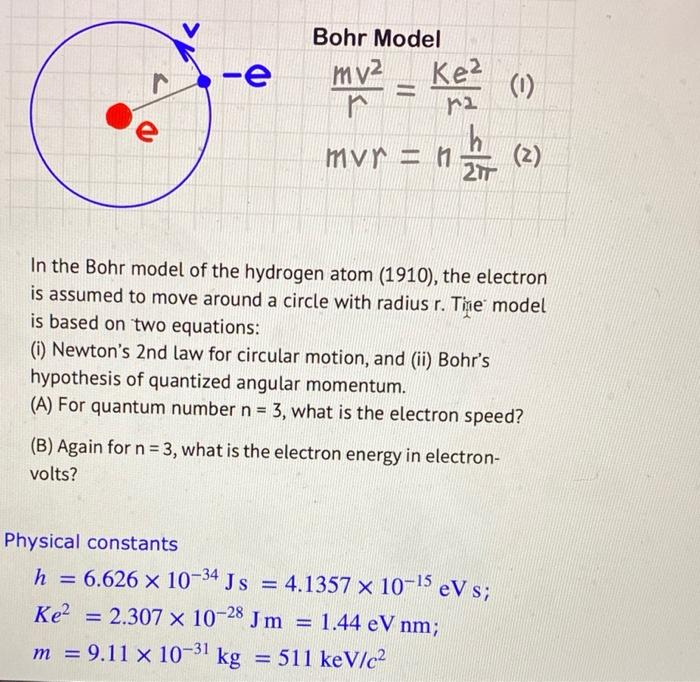
In the Bohr model of the hydrogen atom (1910), the electron
is assumed to move around a circle with radius r. Tize' model
is based on two equations:
(i) Newton's 2nd law for circular motion, and (ii) Bohr's
hypothesis of quantized angular momentum.
(A) For quantum number n = 3, what is the electron speed?
(B) Again for n =3, what is the electron energy in electron-
volts?
Physical constants
h =6626x10*Js = 4.1357 x 10/3 eV s;
Kez —2307 x 10-2 Im = 1.44 eV nm;
m =9.11 x10 kg = 511 keV/c2
Question:
Give step-by-step solution with explanation and final answer:
Explain like I am a beginner and do not know anything about the topic:
Explain like I am a beginner and do not know anything about the topic:
Think like the best software engineer and give e the code for :
Act like a helpful tutor and exlain me :
Act like a helpful tutor and exlain me :Vv Bohr Model
-e mv2_ Ke? q
FT
mvr = fs @)
In the Bohr model of the hydrogen atom (1910), the electron
is assumed to move around a circle with radius r. Tize' model
is based on two equations:
(i) Newton's 2nd law for circular motion, and (ii) Bohr's
hypothesis of quantized angular momentum.
(A) For quantum number n = 3, what is the electron speed?
(B) Again for n =3, what is the electron energy in electron-
volts?
Physical constants
h =6626x10*Js = 4.1357 x 10/3 eV s;
Kez —2307 x 10-2 Im = 1.44 eV nm;
m =9.11 x10 kg = 511 keV/c2
This is AI generated Response.
Asked by: Sathya
Created at: 2025-09-27 20:59:30
Final Answer:
RenderedRaw Text
Did you like this answer?
# Bohr Problem Step-by-Step
Let's break the problem step by step and explain everything as as possible.
---
## **Background What is the Bohr Model?**
The Bohr Model describes the hydrogen atom as an electron moving in a circular orbit around a proton. The model makes two important assumptions:
1. The centripetal force keeping the electron in a circle is provided by the electrostatic attraction between the electron and proton.
2. The angular momentum of the electron is "quantized" (it can only have specific values).
---
## **Given Equations**
From the image, the two main equations are:
1. **Circular Motion (Newton’s Law):**
\[
\frac{mv^2}{r} = \frac{Ke^2}{r^2}
\]
- \(m\) = mass of electron
- \(v\) = speed of electron
- \(r\) = radius of orbit
- \(K\) = Coulomb's constant
- \(e\) = charge of electron
2. **Quantized Angular Momentum:**
\[
mvr = n \frac{h}{2\pi}
\]
- \(n\) = quantum number (given as \(n=3\) in the question)
- \(h\) = Planck constant
---
## **Physical Constants (from the image)**
- \(h = 6.626 \times 10^{-34} \) J·s
- \(Ke^2 = 2.307 \times 10^{-28}\) J·m
- \(m = 9.11 \times 10^{-31}\) kg
---
# **(A) Find the Electron Speed for \( n = 3 \)**
## **Step 1: Find the Radius for \( n = 3 \)**
From the angular momentum equation:
\[
mvr = n \frac{h}{2\pi}
\implies v = \frac{n h}{2\pi m r}
\]
From the circular motion equation:
\[
\frac{mv^2}{r} = \frac{Ke^2}{r^2}
\implies mv^2 = \frac{Ke^2}{r}
\implies v^2 = \frac{Ke^2}{mr}
\]
Set the two expressions for \(v\) equal (from above):
\[
v = \frac{n h}{2\pi m r}
\]
Square both sides and substitute the result from the second equation:
\[
\left( \frac{n h}{2\pi m r} \right)^2 = \frac{Ke^2}{mr}
\]
\[
\frac{n^2 h^2}{4\pi^2 m^2 r^2} = \frac{Ke^2}{mr}
\]
Multiply both sides by \(m r^2\):
\[
\frac{n^2 h^2}{4\pi^2 m} = Ke^2 r
\]
\[
r = \frac{n^2 h^2}{4\pi^2 m Ke^2}
\]
---
## **Step 2: Plug in \( n = 3 \) and Constants**
\[
r_3 = \frac{3^2 \cdot h^2}{4\pi^2 m Ke^2}
\]
Now plug in values:
- \(n = 3\)
- \(h = 6.626 \times 10^{-34}\) J·s
- \(m = 9.11 \times 10^{-31}\) kg
- \(Ke^2 = 2.307 \times 10^{-28}\) J·m
- \(\pi \approx 3.1416\)
Calculate numerator:
\[
n^2 h^2 = 9 \times (6.626 \times 10^{-34})^2 = 9 \times 4.390 \times 10^{-67} = 3.951 \times 10^{-66}
\]
Calculate denominator:
\[
4\pi^2 m Ke^2 = 4 \times (3.1416)^2 \times 9.11 \times 10^{-31} \times 2.307 \times 10^{-28}
\]
\[
= 4 \times 9.8696 \times 9.11 \times 10^{-31} \times 2.307 \times 10^{-28}
\]
\[
= 39.4784 \times 9.11 \times 10^{-31} \times 2.307 \times 10^{-28}
\]
\[
= 359.739 \times 10^{-31} \times 2.307 \times 10^{-28}
\]
\[
= 8.297 \times 10^{-29} \times 2.307 \times 10^{-28}
\]
\[
= 1.912 \times 10^{-56}
\]
So,
\[
r_3 = \frac{3.951 \times 10^{-66}}{1.912 \times 10^{-56}} \approx 2.067 \times 10^{-10} \text{ m}
\]
---
## **Step 3: Find the Speed \(v\) for \(n = 3\)**
Recall:
\[
v = \frac{n h}{2\pi m r}
\]
Plug in values:
- \(n = 3\)
- \(h = 6.626 \times 10^{-34}\) J·s
- \(m = 9.11 \times 10^{-31}\) kg
- \(r = 2.067 \times 10^{-10}\) m
\[
v = \frac{3 \times 6.626 \times 10^{-34}}{2 \times 3.1416 \times 9.11 \times 10^{-31} \times 2.067 \times 10^{-10}}
\]
Calculate denominator:
\[
2 \times 3.1416 \times 9.11 \times 10^{-31} \times 2.067 \times 10^{-10}
= 6.2832 \times 9.11 \times 10^{-31} \times 2.067 \times 10^{-10}
= 57.260 \times 10^{-31} \times 2.067 \times 10^{-10}
= 1.184 \times 10^{-39}
\]
Calculate numerator:
\[
3 \times 6.626 \times 10^{-34} = 19.878 \times 10^{-34}
\]
So,
\[
v = \frac{1.9878 \times 10^{-33}}{1.184 \times 10^{-39}} = 1.679 \times 10^{6} \text{ m/s}
\]
---
## **Final Answer for (A)**
**For quantum number \( n = 3 \), the electron speed \( v \approx 1.68 \times 10^{6} \) m/s.**
---
# **(B) Electron Energy for \( n = 3 \) in Electron-Volts (eV)**
## **Step 1: Bohr Energy Formula**
The energy at level \( n \) is:
\[
E_n = -\frac{m K^2 e^4}{2 \hbar^2 n^2}
\]
Or, for hydrogen:
\[
E_n = -\frac{13.6}{n^2} \text{ eV}
\]
For \( n = 3 \):
\[
E_3 = -\frac{13.6}{3^2}
= -\frac{13.6}{9}
= -1.51 \text{ eV}
\]
---
## **Final Answer for (B)**
**For quantum number \( n = 3 \), the electron energy \( E_3 = -1.51 \) eV.**
---
# **Summary Table**
| Part | Formula Used | Value for \(n=3\) |
|-----------|------------------------------------------------|-----------------------|
| (A) Speed | \(v = \frac{n h}{2\pi m r}\) | \(1.68 \times 10^{6}\) m/s |
| (B) Energy| \(E_n = -\frac{13.6\text{ eV}}{n^2}\) | \(-1.51\) eV |
---
## **Python Code Example for Calculation**
Here's a Python script for these calculations:
```python
import numpy as np
# Constants
h = 6.626e-34 # Planck's constant (J·s)
Ke2 = 2.307e-28 # K*e^2 (J·m)
m = 9.11e-31 # Mass of electron (kg)
n = 3 # Quantum number
# Calculate radius
numerator = n**2 * h**2
denominator = 4 * np.pi**2 * m * Ke2
r = numerator / denominator
# Calculate speed
v = n * h / (2 * np.pi * m * r)
# Calculate energy in eV
E_n = -13.6 / n**2 # eV
print("Radius (m):", r)
print("Speed (m/s):", v)
print("Energy (eV):", E_n)
```
---
## **Summary**
- The Bohr model uses physics and quantum ideas to find the speed and energy of an electron in hydrogen.
- For \(n=3\), the speed is about \(1.68 \times 10^6\) m/s and the energy is \(-1.51\) eV.
If you have any follow-up questions or want to see more code, let me know!
VIPSolutions focuses on clear, step‑by‑step explanations so you can learn quickly. Whether you need an AI‑generated walkthrough or a short hint to get unstuck, each solution is organized for fast reading and easy review later.
Search similar questions, compare approaches, and bookmark the best answers for revision. Our goal is simple: quick, reliable study help that feels natural—not noisy.
 VIPSolutions
 Vv Bohr Model
-e mv2_ Ke? q
FT
mvr = fs @)
In the Bohr model of the hydrogen atom (1910), the electron
is assumed to move around a circle with radius r. Tize' model
is based on two equations:
(i) Newton's 2nd law for circular motion, and (ii) Bohr's
hypothesis of quantized angular momentum.
(A) For quantum number n = 3, what is the electron speed?
(B) Again for n =3, what is the electron energy in electron-
volts?
Physical constants
h =6626x10*Js = 4.1357 x 10/3 eV s;
Kez —2307 x 10-2 Im = 1.44 eV nm;
m =9.11 x10 kg = 511 keV/c2
Vv Bohr Model
-e mv2_ Ke? q
FT
mvr = fs @)
In the Bohr model of the hydrogen atom (1910), the electron
is assumed to move around a circle with radius r. Tize' model
is based on two equations:
(i) Newton's 2nd law for circular motion, and (ii) Bohr's
hypothesis of quantized angular momentum.
(A) For quantum number n = 3, what is the electron speed?
(B) Again for n =3, what is the electron energy in electron-
volts?
Physical constants
h =6626x10*Js = 4.1357 x 10/3 eV s;
Kez —2307 x 10-2 Im = 1.44 eV nm;
m =9.11 x10 kg = 511 keV/c2