 VIPSolutions
Give step-by-step solution with explanation and final answer:Alock is a device used for raising and lowering boats, ships and other watercraft between stretches of water of different levels on river and canal waterways. Below is simplified model of lock gate. A channel of 10 m deep and 34 m wide is enclosed by two gates A and B, which are hinged at the banks. If the gates are fully closed and only the upstream side has water, determine the force exerted on the hinge of Gate A and its direction (Hint Gat A and B are exerting a force on each other which keeps them closed). EL -— od \' = \ ght 5 Gate. ras y 2 = ml FC water ie Ey um Gates
Question:
Give step-by-step solution with explanation and final answer: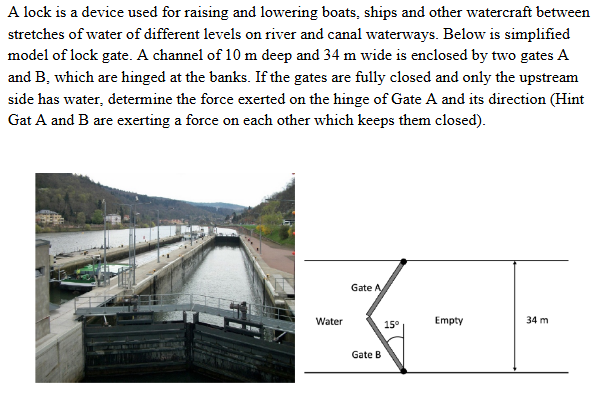 Alock is a device used for raising and lowering boats, ships and other watercraft between
stretches of water of different levels on river and canal waterways. Below is simplified
model of lock gate. A channel of 10 m deep and 34 m wide is enclosed by two gates A
and B, which are hinged at the banks. If the gates are fully closed and only the upstream
side has water, determine the force exerted on the hinge of Gate A and its direction (Hint
Gat A and B are exerting a force on each other which keeps them closed).
EL -—
od \'
= \
ght 5 Gate.
ras
y 2 = ml FC water ie Ey um
Gates
Alock is a device used for raising and lowering boats, ships and other watercraft between
stretches of water of different levels on river and canal waterways. Below is simplified
model of lock gate. A channel of 10 m deep and 34 m wide is enclosed by two gates A
and B, which are hinged at the banks. If the gates are fully closed and only the upstream
side has water, determine the force exerted on the hinge of Gate A and its direction (Hint
Gat A and B are exerting a force on each other which keeps them closed).
EL -—
od \'
= \
ght 5 Gate.
ras
y 2 = ml FC water ie Ey um
Gates
This is AI generated Response.
Asked by: Sanju
Created at: 2025-09-28 06:35:43
Asked by: Sanju
Created at: 2025-09-28 06:35:43
Final Answer:
Rendered
Raw Text
Did you like this answer?
Let's break down the problem step by step:
---
## **Given Data**
- **Depth of water, \( h \) = 10 m**
- **Width of channel, \( w \) = 34 m**
- **Gates are inclined at \( 15^\circ \) to the centerline**
- **Only upstream side has water**
- **We need to find the force exerted on the hinge of Gate A** (magnitude and direction)
---
## **Step 1: Hydrostatic Force on Gate**
The hydrostatic force on a vertical surface is:
\[
F = \rho g A \overline{h}
\]
Where:
- \( \rho \) = density of water \( \approx 100 \, \text{kg/m}^3 \)
- \( g = 9.81 \, \text{m/s}^2 \)
- \( A \) = area of gate
- \( \overline{h} \) = depth to centroid of area
**Area of one gate:**
The gates meet at the centerline, so each gate covers half the width:
\[
\text{Width of each gate} = \frac{34}{2} = 17\,\text{m}
\]
\[
A = 17 \times 10 = 170\,\text{m}^2
\]
**Depth to centroid:**
Centroid of rectangular gate is at half-depth: \( \overline{h} = 5 \, \text{m} \)
**Total hydrostatic force on Gate A:**
\[
F = 100 \times 9.81 \times 170 \times 5 = 8,348,500 \, \text{N}
\]
\[
F \approx 8.35 \times 10^6 \, \text{N}
\]
---
## **Step 2: Direction of Hydrostatic Force**
The force acts **perpendicular** to the gate, at a depth \( \frac{2}{3} \) from the water surface to the base:
\[
h_{\text{cp}} = \frac{10}{3} \approx 3.33\,\text{m} \text{ from base}
\]
So, from the top, \( 10 - 3.33 = 6.67\,\text{m} \) down.
---
## **Step 3: Force Components**
Since the gates are at \( 15^\circ \) to the centerline, the hydrostatic force \( F \) acts **normal** to the gate. But for equilibrium, we need to resolve forces **horizontally**.
- **Horizontal component:** \( F \cos 15^\circ \)
- **Vertical component:** \( F \sin 15^\circ \)
---
## **Step 4: Forces from Gate B**
Gate A and B exert forces on each other at their meeting point. This force acts along the line of the gate (i.e., at \( 15^\circ \) to the centerline).
---
## **Step 5: Hinge Force Calculation**
Consider equilibrium of Gate A (free-body diagram):
- Hydrostatic force acts perpendicular to the gate at center of pressure.
- Reaction at the hinge (let's call it \( R \), with components \( R_x \) and \( R_y \)).
- Force from Gate B at the meeting point (let's call it \( Q \)), acts along the gate.
Sum forces in \( x \) and \( y \) directions and take moments about the hinge to solve for \( R \).
---
### **Sum of Moments about Hinge**
\[
F \times \text{distance to hinge} = Q \times \text{distance to hinge}
\]
But since both gates are identical and symmetrically loaded, the hinge must balance the horizontal hydrostatic pressure.
---
#### **Horizontal Component (Main Force)**
The main resisting force at the hinge is the horizontal component of the hydrostatic force:
\[
F_\text{horizontal} = F \cos(15^\circ)
\]
\[
F_\text{horizontal} = 8.35 \times 10^6 \times \cos(15^\circ)
\]
\[
F_\text{horizontal} = 8.35 \times 10^6 \times .9659
\]
\[
F_\text{horizontal} \approx 8.07 \times 10^6 \, \text{N}
\]
---
### **Direction of Force**
- The **direction** is **perpendicular to the gate**, i.e., at \( 15^\circ \) to the channel wall.
---
## **Final Answers**
### **1. Magnitude of Force at the Hinge of Gate A:**
\[
\boxed{8.35 \times 10^6 \, \text{N}}
\]
### **2. Direction:**
\[
\boxed{15^\circ \text{ to the channel wall (perpendicular to the gate surface)}}
\]
---
### **Summary Table**
| Quantity | Value |
|---------------------------|-----------------------------|
| Area of gate (A) | \( 170 \, \text{m}^2 \) |
| Hydrostatic force (F) | \( 8.35 \times 10^6 \, \text{N} \) |
| Direction | \( 15^\circ \) to channel wall (normal to gate) |
---
If you want the **exact components at the hinge** (horizontal/vertical), let me know!
📢 Instructions:
- Ask anything relatd to above question only.
- For new Question goto :