 VIPSolutions
Give step-by-step solution with explanation and final answer:Problem 13-47 (Algo) Theory of Constraints for a Restaurant [LO 13-2] [The following information applies to the questions displayed below] Taylor's Is a popular restaurant that offers customers a large dining room and comfortable bar area. Taylor Henry, the owner and manager of the restaurant, has seen the number of patrons increase steadily over the last two years and is considering whether and when she will have to expand its available capacity. The restaurant occupies a large home, and all the space in the building is now used for dining, the bar, and kitchen, but space is available on the property to expand the restaurant. The restaurant is open from 6 p.m. to 10 p.m. each night (except Monday) and, on average, has 32 customers enter the bar and 54 enter the dining room at the beginning of each of those hours. Taylor has noticed the trends over the last 2 years and expects that within about 4 years, the number of bar customers will increase by 50% and the dining customers will increase by 20%. Taylor is worried that the restaurant will be not be able to handle the increase and has asked you to study its capacity. In your study, you consider four areas of capacity: the parking lot (which has 91 spaces), the bar (72 seats), the dining room (104 seats), and the kitchen. The Kitchen is well-staffed and can prepare any meal on the menu in an average of 12 minutes per meal. The kitchen, when fully staffed, is able to have up to 20 meals in preparation at a time, or 100 meals per hour (60 minute/12 minute x 20 meals). To assess the capacity of the restaurant, you obtain the additional information: « Diners typically come to the restaurant by car, with an average of 3 persons per car, while bar patrons arrive with an average of 1.5 persons per car. + Diners, on average, occupy a table for an hour, while bar customers usually stay for an average of 2 hours + Due to fire regulations, all bar customers must be seated. + The bar customer typically orders one drink per hour at an average of $8 per drink: the dining room customer orders a meal with an average price of $21; the restaurant's cost per drink is $2, and the direct costs for meal preparation are $4. Required: 1-a. Given the current number of customers per hour, what is the amount of excess capacity in the bar, dining room, parking lot, and kitchen? 1-b. Calculate the expected total throughput margin for the restaurant per day, and month (assuming a 26-day month). 2-a. Given the expected increase in the number of customers, determine if there is a constraint for any of the four areas of capacity. ‘What is the amount of needed capacity for each constraint? 2-b. If there is a constraint, reduce the demand on the constraint so that the restaurant is at full capacity (assume some customers would have to be turned away). Calculate the expected total throughput margin for the restaurant per day, and month (assuming a 26- day month). Complete this question by entering your answers in the tabs below. Regia | Req1s | Reaza | Req2n Given the current number of customers per hour, what is the amount of excess capacity in the bar, dining room, parking lot, and kitchen? (Round intermediate computation of capacity to the nearest whole number.) Parking (spaces) | 1 1 1 ean | fede ER Calculate the expected total throughput margin for the restaurant per day, and month (assuming a 26-day month). (Round intermediate computation of capacity to the nearest whole number.) ommoppumaon [|| < ReqiA Req2A > Req 1A Req 18 Req 24 Req 28 Given the expected increase in the number of customers, determine if there is a constraint for any of the four areas of capacity. What is the amount of needed capacity for each constraint? (Round intermediate computation of capacity to the nearest whole number.) If there is a constraint for any of the four areas of capacity? re EE IT Farr Gomes A ar eat) E— Sng eat) E— Kihen (meaty — < Req1B Req2B > Req 1A Req 18 Req 2A Req 28 If there is a constraint, reduce the demand on the constraint so that the restaurant is at full capacity (assume some customers would have to be tured away). Calculate the expected total throughput margin for the restaurant per day, and month (assuming a 26-day month). (Round intermediate computation of capacity to the nearest whole number.) < Req2A
Question:
Give step-by-step solution with explanation and final answer: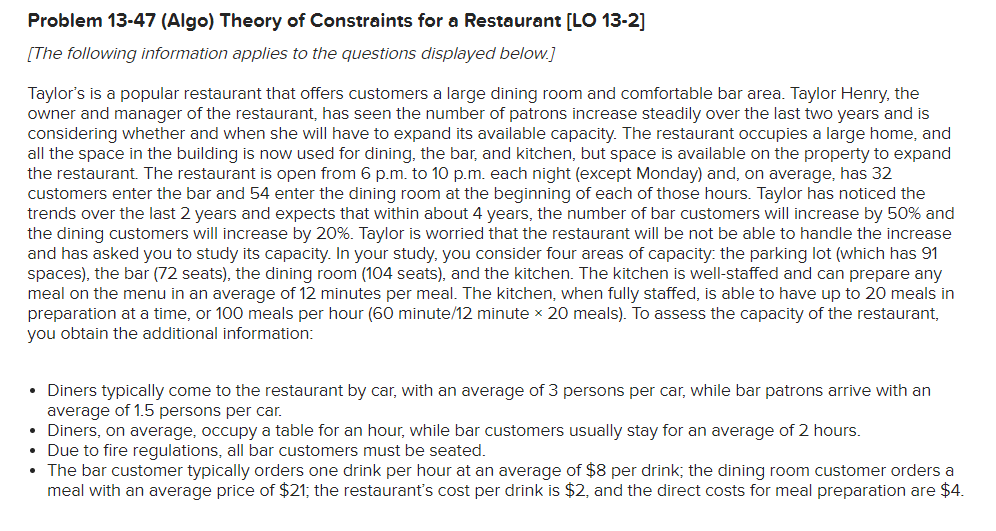
 Problem 13-47 (Algo) Theory of Constraints for a Restaurant [LO 13-2]
[The following information applies to the questions displayed below]
Taylor's Is a popular restaurant that offers customers a large dining room and comfortable bar area. Taylor Henry, the
owner and manager of the restaurant, has seen the number of patrons increase steadily over the last two years and is
considering whether and when she will have to expand its available capacity. The restaurant occupies a large home, and
all the space in the building is now used for dining, the bar, and kitchen, but space is available on the property to expand
the restaurant. The restaurant is open from 6 p.m. to 10 p.m. each night (except Monday) and, on average, has 32
customers enter the bar and 54 enter the dining room at the beginning of each of those hours. Taylor has noticed the
trends over the last 2 years and expects that within about 4 years, the number of bar customers will increase by 50% and
the dining customers will increase by 20%. Taylor is worried that the restaurant will be not be able to handle the increase
and has asked you to study its capacity. In your study, you consider four areas of capacity: the parking lot (which has 91
spaces), the bar (72 seats), the dining room (104 seats), and the kitchen. The Kitchen is well-staffed and can prepare any
meal on the menu in an average of 12 minutes per meal. The kitchen, when fully staffed, is able to have up to 20 meals in
preparation at a time, or 100 meals per hour (60 minute/12 minute x 20 meals). To assess the capacity of the restaurant,
you obtain the additional information:
« Diners typically come to the restaurant by car, with an average of 3 persons per car, while bar patrons arrive with an
average of 1.5 persons per car.
+ Diners, on average, occupy a table for an hour, while bar customers usually stay for an average of 2 hours
+ Due to fire regulations, all bar customers must be seated.
+ The bar customer typically orders one drink per hour at an average of $8 per drink: the dining room customer orders a
meal with an average price of $21; the restaurant's cost per drink is $2, and the direct costs for meal preparation are $4.
Required:
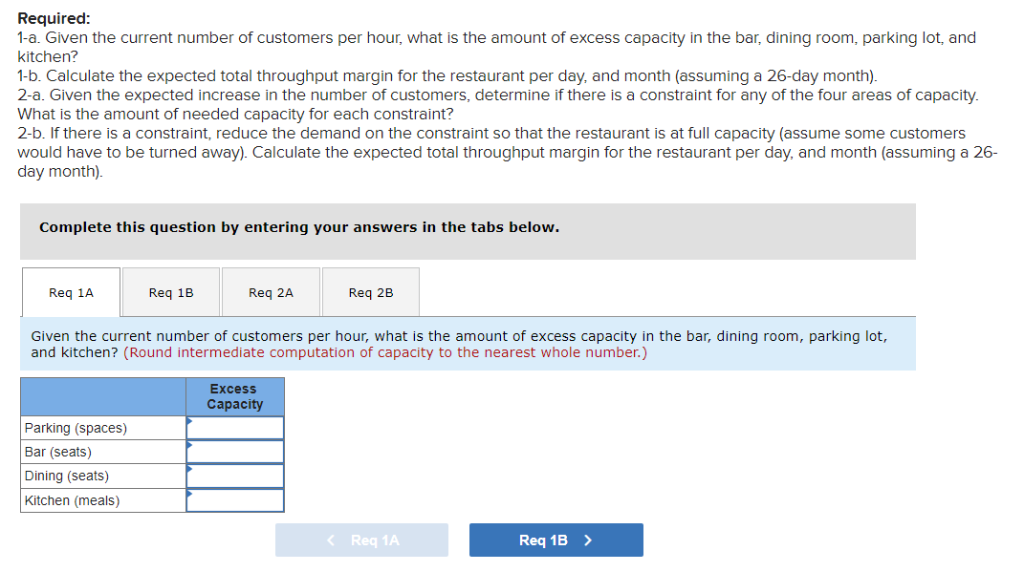
1-a. Given the current number of customers per hour, what is the amount of excess capacity in the bar, dining room, parking lot, and
kitchen?
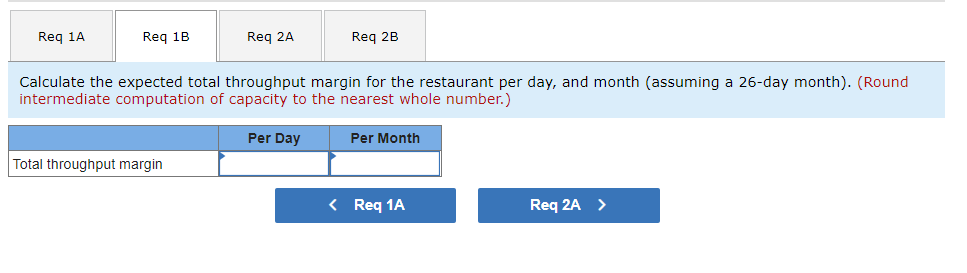
1-b. Calculate the expected total throughput margin for the restaurant per day, and month (assuming a 26-day month).
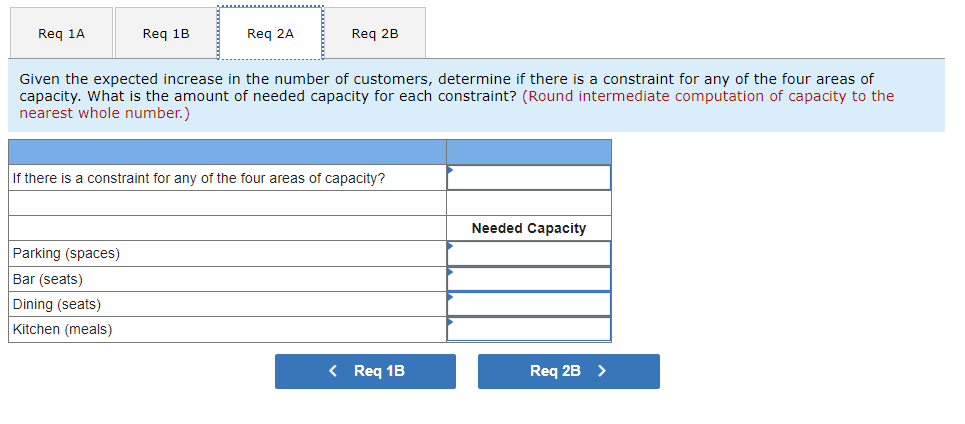
2-a. Given the expected increase in the number of customers, determine if there is a constraint for any of the four areas of capacity.
‘What is the amount of needed capacity for each constraint?
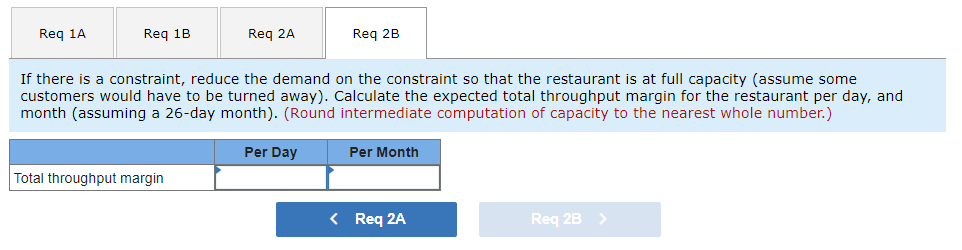
2-b. If there is a constraint, reduce the demand on the constraint so that the restaurant is at full capacity (assume some customers
would have to be turned away). Calculate the expected total throughput margin for the restaurant per day, and month (assuming a 26-
day month).
Complete this question by entering your answers in the tabs below.
Regia | Req1s | Reaza | Req2n
Given the current number of customers per hour, what is the amount of excess capacity in the bar, dining room, parking lot,
and kitchen? (Round intermediate computation of capacity to the nearest whole number.)
Parking (spaces) |
1
1
1
ean | fede ER
Calculate the expected total throughput margin for the restaurant per day, and month (assuming a 26-day month). (Round
intermediate computation of capacity to the nearest whole number.)
ommoppumaon [||
< ReqiA Req2A >
Req 1A Req 18 Req 24 Req 28
Given the expected increase in the number of customers, determine if there is a constraint for any of the four areas of
capacity. What is the amount of needed capacity for each constraint? (Round intermediate computation of capacity to the
nearest whole number.)
If there is a constraint for any of the four areas of capacity? re
EE IT
Farr Gomes A
ar eat) E—
Sng eat) E—
Kihen (meaty —
< Req1B Req2B >
Req 1A Req 18 Req 2A Req 28
If there is a constraint, reduce the demand on the constraint so that the restaurant is at full capacity (assume some
customers would have to be tured away). Calculate the expected total throughput margin for the restaurant per day, and
month (assuming a 26-day month). (Round intermediate computation of capacity to the nearest whole number.)
< Req2A
Problem 13-47 (Algo) Theory of Constraints for a Restaurant [LO 13-2]
[The following information applies to the questions displayed below]
Taylor's Is a popular restaurant that offers customers a large dining room and comfortable bar area. Taylor Henry, the
owner and manager of the restaurant, has seen the number of patrons increase steadily over the last two years and is
considering whether and when she will have to expand its available capacity. The restaurant occupies a large home, and
all the space in the building is now used for dining, the bar, and kitchen, but space is available on the property to expand
the restaurant. The restaurant is open from 6 p.m. to 10 p.m. each night (except Monday) and, on average, has 32
customers enter the bar and 54 enter the dining room at the beginning of each of those hours. Taylor has noticed the
trends over the last 2 years and expects that within about 4 years, the number of bar customers will increase by 50% and
the dining customers will increase by 20%. Taylor is worried that the restaurant will be not be able to handle the increase
and has asked you to study its capacity. In your study, you consider four areas of capacity: the parking lot (which has 91
spaces), the bar (72 seats), the dining room (104 seats), and the kitchen. The Kitchen is well-staffed and can prepare any
meal on the menu in an average of 12 minutes per meal. The kitchen, when fully staffed, is able to have up to 20 meals in
preparation at a time, or 100 meals per hour (60 minute/12 minute x 20 meals). To assess the capacity of the restaurant,
you obtain the additional information:
« Diners typically come to the restaurant by car, with an average of 3 persons per car, while bar patrons arrive with an
average of 1.5 persons per car.
+ Diners, on average, occupy a table for an hour, while bar customers usually stay for an average of 2 hours
+ Due to fire regulations, all bar customers must be seated.
+ The bar customer typically orders one drink per hour at an average of $8 per drink: the dining room customer orders a
meal with an average price of $21; the restaurant's cost per drink is $2, and the direct costs for meal preparation are $4.
Required:
1-a. Given the current number of customers per hour, what is the amount of excess capacity in the bar, dining room, parking lot, and
kitchen?
1-b. Calculate the expected total throughput margin for the restaurant per day, and month (assuming a 26-day month).
2-a. Given the expected increase in the number of customers, determine if there is a constraint for any of the four areas of capacity.
‘What is the amount of needed capacity for each constraint?
2-b. If there is a constraint, reduce the demand on the constraint so that the restaurant is at full capacity (assume some customers
would have to be turned away). Calculate the expected total throughput margin for the restaurant per day, and month (assuming a 26-
day month).
Complete this question by entering your answers in the tabs below.
Regia | Req1s | Reaza | Req2n
Given the current number of customers per hour, what is the amount of excess capacity in the bar, dining room, parking lot,
and kitchen? (Round intermediate computation of capacity to the nearest whole number.)
Parking (spaces) |
1
1
1
ean | fede ER
Calculate the expected total throughput margin for the restaurant per day, and month (assuming a 26-day month). (Round
intermediate computation of capacity to the nearest whole number.)
ommoppumaon [||
< ReqiA Req2A >
Req 1A Req 18 Req 24 Req 28
Given the expected increase in the number of customers, determine if there is a constraint for any of the four areas of
capacity. What is the amount of needed capacity for each constraint? (Round intermediate computation of capacity to the
nearest whole number.)
If there is a constraint for any of the four areas of capacity? re
EE IT
Farr Gomes A
ar eat) E—
Sng eat) E—
Kihen (meaty —
< Req1B Req2B >
Req 1A Req 18 Req 2A Req 28
If there is a constraint, reduce the demand on the constraint so that the restaurant is at full capacity (assume some
customers would have to be tured away). Calculate the expected total throughput margin for the restaurant per day, and
month (assuming a 26-day month). (Round intermediate computation of capacity to the nearest whole number.)
< Req2A
Asked by: Nishant Saini
Created at: 2025-09-28 07:26:12
Thought Process:
Final Answer:
📢 Instructions:
- Ask anything relatd to above question only.
- For new Question goto :