 VIPSolutions
Give step-by-step solution with explanation and final answer:Problem 4. Find the blended aio for A and to fit t with the recommended rang ET — TS — — ES — rT — — — EE E— EC —— CC — —— | — EE — LT —— | — CE — — —— CE — CT ——— ams EE I
Question:
Give step-by-step solution with explanation and final answer: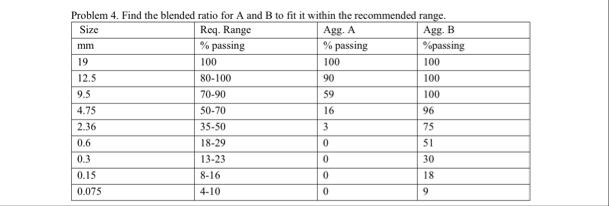 Problem 4. Find the blended aio for A and to fit t with the recommended rang
ET — TS — —
ES — rT — — —
EE E— EC ——
CC — —— | —
EE — LT —— | —
CE — — ——
CE — CT ———
ams EE I
Problem 4. Find the blended aio for A and to fit t with the recommended rang
ET — TS — —
ES — rT — — —
EE E— EC ——
CC — —— | —
EE — LT —— | —
CE — — ——
CE — CT ———
ams EE I
This is AI generated Response.
Asked by: Sanju
Created at: 2025-09-29 08:34:19
Asked by: Sanju
Created at: 2025-09-29 08:34:19
Final Answer:
Rendered
Raw Text
Did you like this answer?
Let's solve the problem step by step:
---
## **Step 1: Define the Blend Ratio**
Let
- \( x \) = proportion of Aggregate A
- \( y \) = proportion of Aggregate B
Since it's a binary blend:
\[
x + y = 1
\]
\[
y = 1 - x
\]
---
## **Step 2: Write the Blending Formula**
For each sieve size, the blended % passing is:
\[
\text{Blended \% passing} = x \times (\text{\% passing of A}) + y \times (\text{\% passing of B})
\]
---
## **Step 3: Set Up Inequalities for Each Sieve**
We'll use the recommended ranges for each size and set up inequalities:
### Example for 12.5 mm:
\[
80 \leq 90x + 100y \leq 100
\]
Replace \( y = 1 - x \):
\[
80 \leq 90x + 100(1-x) \leq 100 \\
80 \leq 90x + 100 - 100x \leq 100 \\
80 \leq 100 - 10x \leq 100
\]
\[
80 \leq 100 - 10x \implies 10x \leq 20 \implies x \leq 2 \\
100 - 10x \leq 100 \implies -10x \leq \implies x \geq
\]
So, \( \leq x \leq 2 \) (but \( x \leq 1 \) since \( x + y = 1 \)).
We'll do this for each sieve.
---
## **Step 4: Calculate the Blended Limits for All Sieves**
Let's do this systematically:
### **9.5 mm:** (Req: 70–90%)
\[
70 \leq 59x + 100y \leq 90
\]
\[
70 \leq 59x + 100(1-x) \leq 90
\]
\[
70 \leq 59x + 100 - 100x \leq 90 \\
70 \leq 100 - 41x \leq 90
\]
First inequality:
\[
70 \leq 100 - 41x \implies 41x \leq 30 \implies x \leq \frac{30}{41} \approx .732
\]
Second:
\[
100 - 41x \leq 90 \implies -41x \leq -10 \implies x \geq \frac{10}{41} \approx .244
\]
So:
\[
.244 \leq x \leq .732
\]
---
### **4.75 mm:** (Req: 50–70%)
\[
50 \leq 16x + 96y \leq 70
\]
\[
50 \leq 16x + 96(1-x) \leq 70 \\
50 \leq 16x + 96 - 96x \leq 70 \\
50 \leq 96 - 80x \leq 70
\]
First:
\[
50 \leq 96 - 80x \implies 80x \leq 46 \implies x \leq .575
\]
Second:
\[
96 - 80x \leq 70 \implies -80x \leq -26 \implies x \geq .325
\]
So:
\[
.325 \leq x \leq .575
\]
---
### **2.36 mm:** (Req: 35–50%)
\[
35 \leq 3x + 75y \leq 50
\]
\[
35 \leq 3x + 75(1-x) \leq 50 \\
35 \leq 3x + 75 - 75x \leq 50 \\
35 \leq 75 - 72x \leq 50
\]
First:
\[
35 \leq 75 - 72x \implies 72x \leq 40 \implies x \leq .556
\]
Second:
\[
75 - 72x \leq 50 \implies -72x \leq -25 \implies x \geq .347
\]
So:
\[
.347 \leq x \leq .556
\]
---
### **.6 mm:** (Req: 18–29%)
\[
18 \leq x + 51y \leq 29
\]
\[
18 \leq 51(1-x) \leq 29
\]
\[
18 \leq 51 - 51x \leq 29
\]
First:
\[
18 \leq 51 - 51x \implies 51x \leq 33 \implies x \leq .647
\]
Second:
\[
51 - 51x \leq 29 \implies -51x \leq -22 \implies x \geq .431
\]
So:
\[
.431 \leq x \leq .647
\]
---
### **.3 mm:** (Req: 13–23%)
\[
13 \leq x + 30y \leq 23
\]
\[
13 \leq 30(1-x) \leq 23
\]
\[
13 \leq 30 - 30x \leq 23
\]
First:
\[
13 \leq 30 - 30x \implies 30x \leq 17 \implies x \leq .567
\]
Second:
\[
30 - 30x \leq 23 \implies -30x \leq -7 \implies x \geq .233
\]
So:
\[
.233 \leq x \leq .567
\]
---
### **.15 mm:** (Req: 8–16%)
\[
8 \leq x + 18y \leq 16
\]
\[
8 \leq 18(1-x) \leq 16
\]
\[
8 \leq 18 - 18x \leq 16
\]
First:
\[
8 \leq 18 - 18x \implies 18x \leq 10 \implies x \leq .556
\]
Second:
\[
18 - 18x \leq 16 \implies -18x \leq -2 \implies x \geq .111
\]
So:
\[
.111 \leq x \leq .556
\]
---
### **.075 mm:** (Req: 4–10%)
\[
4 \leq x + 9y \leq 10
\]
\[
4 \leq 9(1-x) \leq 10
\]
\[
4 \leq 9 - 9x \leq 10
\]
First:
\[
4 \leq 9 - 9x \implies 9x \leq 5 \implies x \leq .556
\]
Second:
\[
9 - 9x \leq 10 \implies -9x \leq 1 \implies x \geq
\]
So:
\[
\leq x \leq .556
\]
---
## **Step 5: Find the Overlapping Range**
List all the lower and upper bounds:
- 12.5 mm: \( \leq x \leq 1\)
- 9.5 mm: \(.244 \leq x \leq .732\)
- 4.75 mm: \(.325 \leq x \leq .575\)
- 2.36 mm: \(.347 \leq x \leq .556\)
- .6 mm: \(.431 \leq x \leq .647\)
- .3 mm: \(.233 \leq x \leq .567\)
- .15 mm: \(.111 \leq x \leq .556\)
- .075 mm: \( \leq x \leq .556\)
**The valid range for \( x \) is the maximum of all lower bounds to the minimum of all upper bounds:**
- Maximum lower bound: \( \max(.244, .325, .347, .431, .233, .111, ) = .431 \)
- Minimum upper bound: \( \min(1, .732, .575, .556, .647, .567, .556, .556) = .556 \)
---
## **Step 6: Final Answer**
\[
\boxed{.431 \leq x \leq .556}
\]
Where:
- \( x \) = proportion of Aggregate A
- \( y = 1 - x \) = proportion of Aggregate B
**So, the blended ratio (by weight) of A : B should be between \(.431:.569\) and \(.556:.444\) to satisfy all requirements.**
---
### **Recommended Blend**
A typical choice is the midpoint of the range:
\[
x = \frac{.431 + .556}{2} = .493, \quad y = 1 - .493 = .507
\]
**Final Answer:**
\[
\boxed{\text{Blend Aggregate A : B in the ratio .49 : .51 (or any ratio where } .431 \leq x \leq .556\text{)}}
\]
---
### **Summary Table**
| Aggregate | Proportion (Min) | Proportion (Max) |
|-----------|------------------|------------------|
| A | .431 | .556 |
| B | .569 | .444 |
---
If you want to check for a specific ratio within this range, I can help calculate the blended gradation. Let me know!
📢 Instructions:
- Ask anything relatd to above question only.
- For new Question goto :