This is AI generated Response.
Asked by: anil
Created at: 2025-09-29 17:12:58
Final Answer:
RenderedRaw Text
Did you like this answer?
Let's solve each step-by-step and match with the correct property.
---
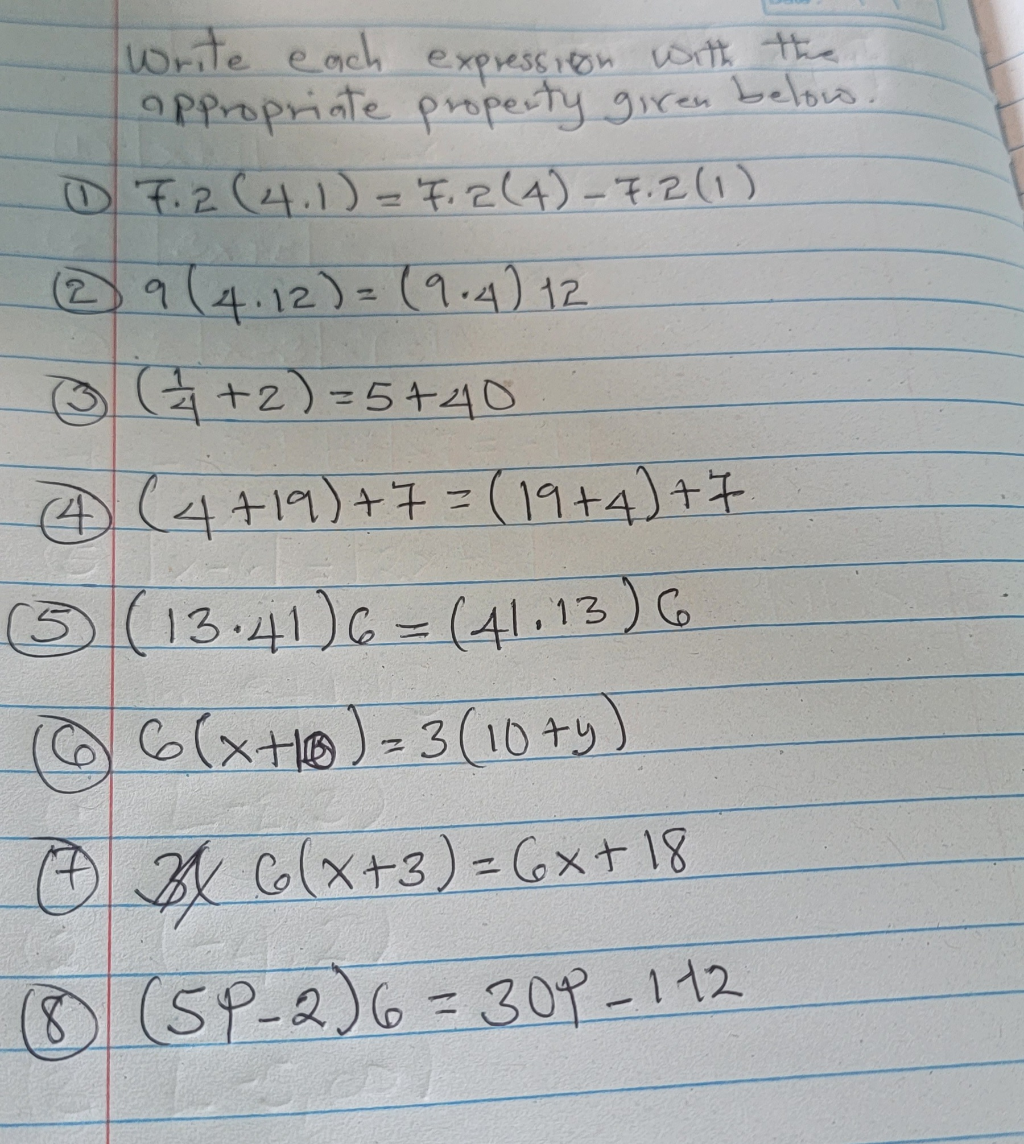
## 1. \( 7 \times 2 \times (4 \times 1) = 7 \times 2 \times 4 \times 1 \)
### Property: **Associative property of multiplication**
**Explanation:**
The associative property allows you to regroup numbers when multiplying without changing the result.
\[(a \times b) \times c = a \times (b \times c)\]
---
## 2. \( 9 \times (4 \times 12) = (9 \times 4) \times 12 \)
### Property: **Associative property of multiplication**
**Explanation:**
This is also the associative property of multiplication, as the grouping of the numbers changes, not their order.
---
## 3. \( \left(\frac{1}{2} + 2\right) = 5 + 4 + \)
### Property: **Additive inverse** (if you meant \(2 + (-2) = \)), otherwise this looks incorrect.
**Explanation:**
If the intention was to show that a number plus its additive inverse equals zero.
---
## 4. \( (4 + 19) + 7 = (19 + 4) + 7 \)
### Property: **Commutative property of addition**
**Explanation:**
Changing the order of addends does not change the sum.
\[(a + b) = (b + a)\]
---
## 5. \( (13 \times 41) \times 6 = (41 \times 13) \times 6 \)
### Property: **Commutative property of multiplication**
**Explanation:**
Changing the order of factors does not change the product.
\[(a \times b) = (b \times a)\]
---
## 6. \( 6 \times (x + 3) = 3 \times (10 + y) \)
### Property: **Not matching any standard property**
This equation doesn't fit a standard property as written. If intended as \(6 \times (x + 3) = 6x + 18\), that would be distributive property.
---
## 7. \( 6(x + 3) = 6x + 18 \)
### Property: **Distributive property of multiplication over addition**
**Explanation:**
Multiplying a number by a sum is the same as multiplying each addend separately and adding the products.
\[a(b + c) = ab + ac\]
---
## 8. \( (5p - 2)6 = 30p - 12 \)
### Property: **Distributive property of multiplication over subtraction**
**Explanation:**
Multiplying a number by a difference is the same as multiplying each term and subtracting the products.
\[a(b - c) = ab - ac\]
---
## **Summary Table**
| # | Expression | Property |
|---|------------------------------------------------|-----------------------------------------------|
| 1 | \( 7 \times 2 \times (4 \times 1) = 7 \times 2 \times 4 \times 1 \) | Associative property of multiplication |
| 2 | \( 9 \times (4 \times 12) = (9 \times 4) \times 12 \) | Associative property of multiplication |
| 3 | \( \left(\frac{1}{2} + 2\right) = 5 + 4 + \) | Additive inverse (if corrected) |
| 4 | \( (4 + 19) + 7 = (19 + 4) + 7 \) | Commutative property of addition |
| 5 | \( (13 \times 41) \times 6 = (41 \times 13) \times 6 \) | Commutative property of multiplication |
| 6 | \( 6 \times (x + 3) = 3 \times (10 + y) \) | Not a standard property as written |
| 7 | \( 6(x + 3) = 6x + 18 \) | Distributive property |
| 8 | \( (5p - 2)6 = 30p - 12 \) | Distributive property |
---
If you need clarification or if there is a typo in question 3 or 6, please let me know!
VIPSolutions focuses on clear, step‑by‑step explanations so you can learn quickly. Whether you need an AI‑generated walkthrough or a short hint to get unstuck, each solution is organized for fast reading and easy review later.
Search similar questions, compare approaches, and bookmark the best answers for revision. Our goal is simple: quick, reliable study help that feels natural—not noisy.
 VIPSolutions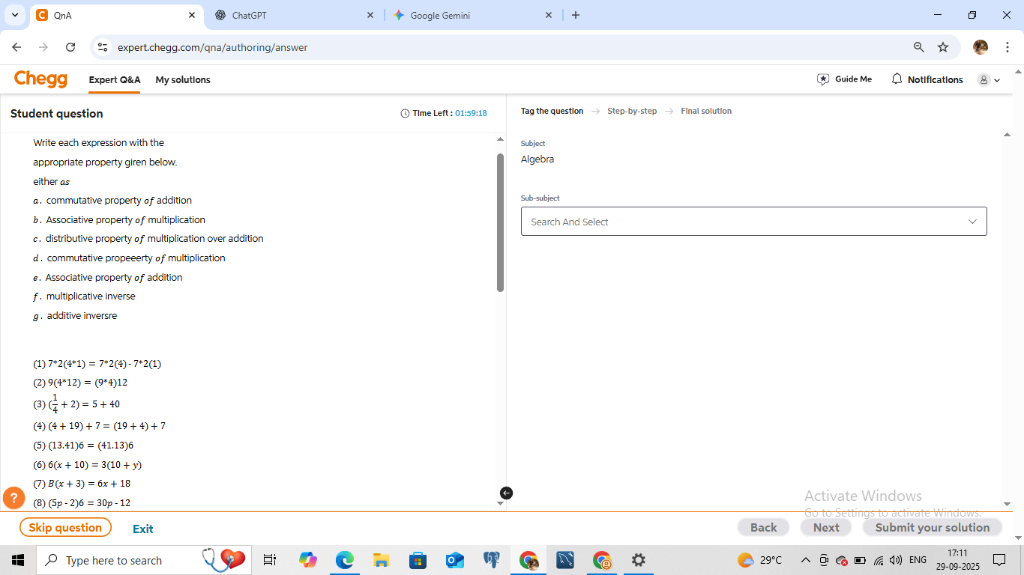
 v Ban x @ ChaGPT x | 4 Google Gemini x + - a x
€ 5 0% expertcheggcom/ansfauthoring/ansuer ax B®
Chegg ewetosa Mysolutions ® cuideme 0) Notications &
‘Student question © Time Lem: 01:5:15. Tagthe question Step bystep Final solution
Write each expression with the 4 sbjea [+
appropriate property giren below. Algebra
abrar
JR——— pre
5. Acosatn rperyof mic J—— B
. dat coy of mutcaton ov atin
i. commtatvepeoesery of milton
JRpe—————
——
5. add ere
JT
own - oon
@dsnasin
ras 57
5) (13:41)6 = (41.13)6.
Oc 10-3004)
O59 =ors1s °
[2 RT S -
Skip question Exit Back Next Submit your solution
EB Ppnensern UBD BH OQ WB AT GEE © @mc rsamawoe Th 0 |
_e ach _exprescign Vo 2 \
E Te
ak ha) Cem BUS
a - ¢ PecTy 9 = —
ere) 20)
pl i ee ;
O\ *r2) = Copied Eni
To Gra yy Tez CERIN a 7 :
eZ
NEE.
> : Ewe
Bll xr) =6xr%
B(EP.2)6 = 3% 12
i
v Ban x @ ChaGPT x | 4 Google Gemini x + - a x
€ 5 0% expertcheggcom/ansfauthoring/ansuer ax B®
Chegg ewetosa Mysolutions ® cuideme 0) Notications &
‘Student question © Time Lem: 01:5:15. Tagthe question Step bystep Final solution
Write each expression with the 4 sbjea [+
appropriate property giren below. Algebra
abrar
JR——— pre
5. Acosatn rperyof mic J—— B
. dat coy of mutcaton ov atin
i. commtatvepeoesery of milton
JRpe—————
——
5. add ere
JT
own - oon
@dsnasin
ras 57
5) (13:41)6 = (41.13)6.
Oc 10-3004)
O59 =ors1s °
[2 RT S -
Skip question Exit Back Next Submit your solution
EB Ppnensern UBD BH OQ WB AT GEE © @mc rsamawoe Th 0 |
_e ach _exprescign Vo 2 \
E Te
ak ha) Cem BUS
a - ¢ PecTy 9 = —
ere) 20)
pl i ee ;
O\ *r2) = Copied Eni
To Gra yy Tez CERIN a 7 :
eZ
NEE.
> : Ewe
Bll xr) =6xr%
B(EP.2)6 = 3% 12
i