 VIPSolutions
Give step-by-step solution with explanation and final answer: Compute the overhead costs allocated to the two groups using ( 1 ) the plantwide rate and ( 2 ) the individual department rates. What are the advantages and disadvantages of the separate rates compared to the plantwide rate?Mesa Consultants has projects with both private and government clients. Its overhead consists of both negotiations costs (including proposal preparation) and general administrative costs. Mesa has two groups, private and government, each working solely with one type of client. The following estimated operating data are available for next year: Government Direct costs: $4,000,0000 Private Direct costs: $1,000,000 Government Number of contracts: 20 Private Number of contracts: 30 Costs in the two administrative departments are expected to be as follows: Negotiations... ...............$750,000 General administrative. . .......$ 850,000 Total $1,600,00 Mesa management is considering two approaches to assigning overhead costs to projects. One is to use a plantwide rate based on direct costs. The second is to use separate rates for the negotiations and general administrative costs. Under this method, negotiations costs will be allocated based on the number of contracts, and general administrative costs will be allocated based on the direct costs. Required:
Question:
Give step-by-step solution with explanation and final answer:
Compute the overhead costs allocated to the two groups using
(
1
)
the plantwide rate and
(
2
)
the individual department rates. What are the advantages and disadvantages of the separate rates compared to the plantwide rate?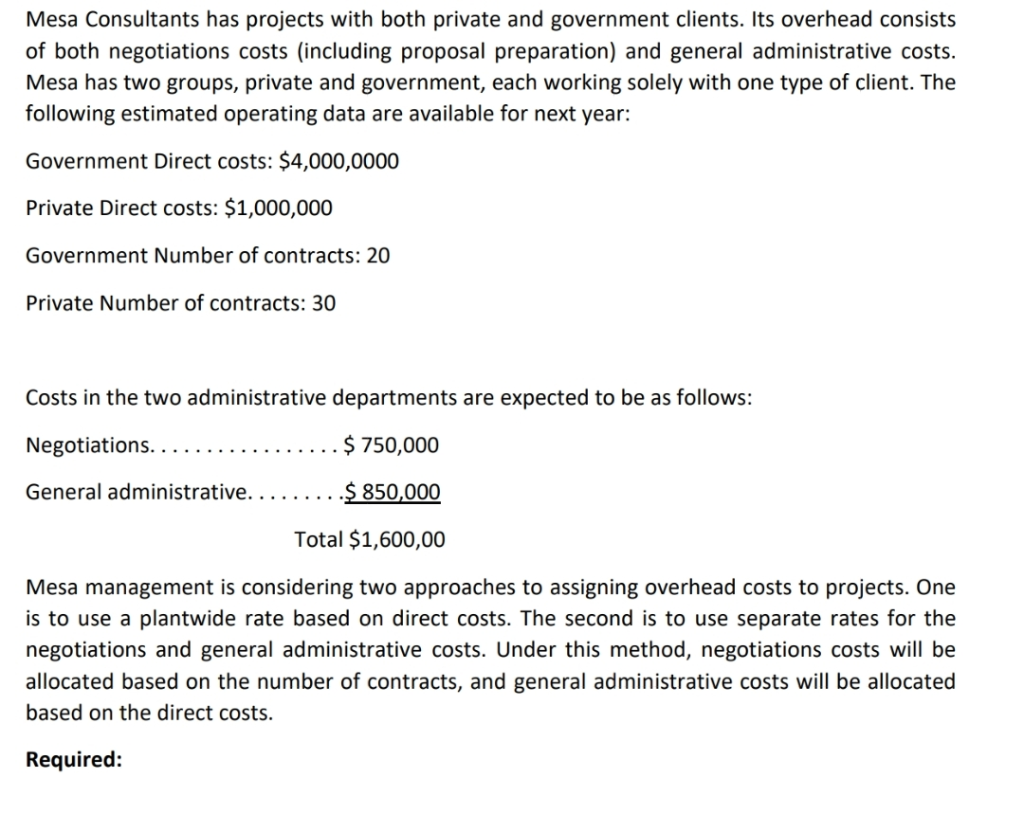 Mesa Consultants has projects with both private and government clients. Its overhead consists
of both negotiations costs (including proposal preparation) and general administrative costs.
Mesa has two groups, private and government, each working solely with one type of client. The
following estimated operating data are available for next year:
Government Direct costs: $4,000,0000
Private Direct costs: $1,000,000
Government Number of contracts: 20
Private Number of contracts: 30
Costs in the two administrative departments are expected to be as follows:
Negotiations... ...............$750,000
General administrative. . .......$ 850,000
Total $1,600,00
Mesa management is considering two approaches to assigning overhead costs to projects. One
is to use a plantwide rate based on direct costs. The second is to use separate rates for the
negotiations and general administrative costs. Under this method, negotiations costs will be
allocated based on the number of contracts, and general administrative costs will be allocated
based on the direct costs.
Required:
Mesa Consultants has projects with both private and government clients. Its overhead consists
of both negotiations costs (including proposal preparation) and general administrative costs.
Mesa has two groups, private and government, each working solely with one type of client. The
following estimated operating data are available for next year:
Government Direct costs: $4,000,0000
Private Direct costs: $1,000,000
Government Number of contracts: 20
Private Number of contracts: 30
Costs in the two administrative departments are expected to be as follows:
Negotiations... ...............$750,000
General administrative. . .......$ 850,000
Total $1,600,00
Mesa management is considering two approaches to assigning overhead costs to projects. One
is to use a plantwide rate based on direct costs. The second is to use separate rates for the
negotiations and general administrative costs. Under this method, negotiations costs will be
allocated based on the number of contracts, and general administrative costs will be allocated
based on the direct costs.
Required:
Asked by: Shikhar
Created at: 2025-10-03 09:49:25
Final Answer:
📢 Instructions:
- Ask anything relatd to above question only.
- For new Question goto :