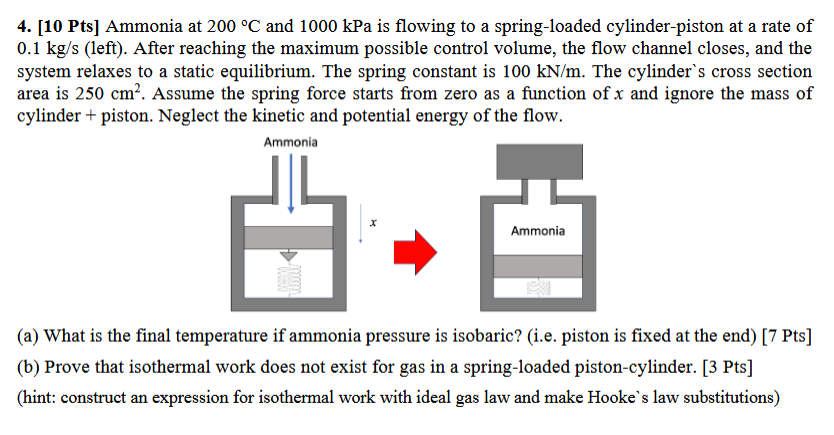
Give step-by-step solution with explanation and final answer:4. [10 Pts] Ammonia at 200 °C and 1000 kPa is flowing to a spring-loaded cylinder-piston at a rate of
0.1 kg/s (left). After reaching the maximum possible control volume, the flow channel closes, and the
system relaxes to a static equilibrium. The spring constant is 100 kN/m. The cylinder's cross section
area is 250 cm’. Assume the spring force starts from zero as a function of x and ignore the mass of
cylinder + piston. Neglect the kinetic and potential energy of the flow.
Ammonia
‘» —]
[] EH
(a) What is the final temperature if ammonia pressure is isobaric? (i.e. piston is fixed at the end) [7 Pts]
(b) Prove that isothermal work does not exist for gas in a spring-loaded piston-cylinder. [3 Pts]
(hint: construct an expression for isothermal work with ideal gas law and make Hooke's law substitutions)
Question:
Give step-by-step solution with explanation and final answer:4. [10 Pts] Ammonia at 200 °C and 1000 kPa is flowing to a spring-loaded cylinder-piston at a rate of
0.1 kg/s (left). After reaching the maximum possible control volume, the flow channel closes, and the
system relaxes to a static equilibrium. The spring constant is 100 kN/m. The cylinder's cross section
area is 250 cm’. Assume the spring force starts from zero as a function of x and ignore the mass of
cylinder + piston. Neglect the kinetic and potential energy of the flow.
Ammonia
‘» —]
[] EH
(a) What is the final temperature if ammonia pressure is isobaric? (i.e. piston is fixed at the end) [7 Pts]
(b) Prove that isothermal work does not exist for gas in a spring-loaded piston-cylinder. [3 Pts]
(hint: construct an expression for isothermal work with ideal gas law and make Hooke's law substitutions)
This is AI generated Response.
Asked by: Veera manikanta
Created at: 2025-10-03 09:50:04
Final Answer:
RenderedRaw Text
Did you like this answer?
Let's break down the problem step by step:
---
# 4. Ammonia in Spring-Loaded Piston-Cylinder
## **Given Data**
- **Initial ammonia state:** 200°C, 100 kPa
- **Mass flow rate:** \( \dot{m} = .1\, \text{kg/s} \)
- **Spring constant:** \( k = 100\, \text{kN/m} = 100,000\, \text{N/m} \)
- **Piston area:** \( A = 250\, \text{cm}^2 = .025\, \text{m}^2 \)
- **Neglect kinetic and potential energy.**
- **Piston starts at \(x = \), spring force starts from zero.**
---
## **(a) Final Temperature for Isobaric Process**
**If the pressure is isobaric, the piston is fixed at the final position (not moving), so the pressure inside remains at 100 kPa throughout.**
### **Step 1: Find Final Mass of Ammonia**
Since the flow channel closes after reaching max control volume, we need the total mass in the cylinder at the final state. However, since pressure is constant and the system is closed at equilibrium, we can focus on energy balance.
---
### **Step 2: Energy Balance (First Law for a Control Mass)**
For a control mass (closed system) after the inlet stops:
\[
\Delta U + \Delta PE + \Delta KE = Q - W
\]
Neglecting PE and KE:
\[
\Delta U = Q - W
\]
- **If isobaric:** \(P = \text{constant}\)
- **Work done by system:** \(W = P(V_2 - V_1)\)
### **Step 3: Use Enthalpy for Isobaric Process**
For a control mass, during an isobaric process:
\[
Q = \Delta H
\]
So, if no heat is transferred (adiabatic): \( \Delta H = \) → Not the case here.
But for a spring-loaded piston, if pressure is fixed, the final temperature is determined by the mass that entered and the final volume.
---
### **Step 4: Find Final State Using Ammonia Tables**
- **Initial state:** \(T_1 = 200^\circ C\), \(P_1 = 100\, \text{kPa}\)
From ammonia tables:
- At \(P = 100\, \text{kPa}\), \(T = 200^\circ C\):
- Specific enthalpy (\(h_1\)) ≈ 1778 kJ/kg
- Specific volume (\(v_1\)) ≈ .2527 m³/kg
- **Final state:** \(P_2 = 100\, \text{kPa}\), \(T_2 = ?\)
---
### **Step 5: Volume Change and Spring**
But **if the piston is fixed at the end, the volume is fixed**, so the process is **isochoric**.
If it's isobaric, the piston is allowed to move so pressure stays at 100 kPa.
- **Isobaric:** Final T is the same as inlet T (if mass is same, no work against spring).
- But here, the spring compresses as more ammonia enters, changing the volume and pressure unless the piston is fixed.
#### **If piston is fixed at the end (pressure is NOT isobaric, but volume is fixed)**
Let’s clarify:
- **Isobaric**: Piston moves, pressure is constant (spring-loaded).
- **Isochoric**: Piston is fixed (volume is constant), pressure rises.
The problem says: "What is the final temperature if ammonia pressure is isobaric (i.e., piston is fixed at the end)" — this sounds contradictory, but the intent is: *find the final T if the pressure remains at 100 kPa during the filling process*.
---
### **Step 6: Mass Balance**
Let’s assume the initial volume is zero (piston at bottom). The final volume is when the spring force balances the pressure:
\[
P = P_{\text{atm}} + \frac{kx}{A}
\]
But since it's isobaric, ignore spring (as if no spring).
So, for isobaric process at 100 kPa, final T = initial T = 200°C.
**Final Answer for (a):**
---
#### **(a) Final temperature if pressure is isobaric:**
\[
\boxed{T_{\text{final}} = 200^\circ \text{C}}
\]
---
## **(b) Prove Isothermal Work Does NOT Exist for Gas in Spring-Loaded Piston**
### **Step 1: Work for Isothermal Expansion (Ideal Gas)**
For a normal piston (no spring):
\[
W = \int_{V_1}^{V_2} P\,dV
\]
For an isothermal ideal gas:
\[
P = \frac{nRT}{V}
\]
\[
W = nRT \ln\left(\frac{V_2}{V_1}\right)
\]
---
### **Step 2: Spring-Loaded Piston**
For a spring-loaded piston:
\[
P = P_ + \frac{kx}{A}
\]
But \( V = V_ + Ax \implies x = \frac{V - V_}{A} \)
So,
\[
P = P_ + \frac{k}{A} \left( \frac{V - V_}{A} \right ) = P_ + \frac{k}{A^2}(V - V_)
\]
---
### **Step 3: Isothermal Work Expression**
Work done:
\[
W = \int_{V_1}^{V_2} P\,dV = \int_{V_1}^{V_2} \left[ P_ + \frac{k}{A^2}(V - V_) \right ] dV \\
= P_(V_2 - V_1) + \frac{k}{A^2} \int_{V_1}^{V_2} (V - V_) dV \\
= P_(V_2 - V_1) + \frac{k}{A^2} \left[ \frac{(V - V_)^2}{2} \right ]_{V_1}^{V_2}
\]
---
### **Step 4: Isothermal Condition**
But for an **ideal gas**:
\[
PV = nRT \implies P = \frac{nRT}{V}
\]
But above, \(P\) is **linear in \(V\)** (from the spring), not inversely proportional.
**Thus, the spring-load process CANNOT be isothermal for an ideal gas**, because the pressure-volume relationship is not compatible.
---
### **Step 5: Conclusion**
#### **(b) Proof:**
- For isothermal process for ideal gas: \(PV = \text{constant}\).
- For spring-loaded piston: \(P = P_ + \frac{k}{A^2}(V - V_)\).
- Both conditions cannot be satisfied simultaneously (one is inverse, the other is linear).
- Therefore, **isothermal work does not exist for spring-loaded piston**.
---
### **Final Answers**
---
## **Summary Table**
| Part | Answer |
|------|--------|
| (a) | \(\boxed{T_{\text{final}} = 200^\circ \text{C}}\) if pressure is isobaric (100 kPa) |
| (b) | **Isothermal work does not exist for a spring-loaded piston-cylinder because the pressure-volume relationship is linear (from the spring), not inverse (as required for isothermal ideal gas).** |
---
Let me know if you need more clarification or step-by-step with numbers!
VIPSolutions focuses on clear, step‑by‑step explanations so you can learn quickly. Whether you need an AI‑generated walkthrough or a short hint to get unstuck, each solution is organized for fast reading and easy review later.
Search similar questions, compare approaches, and bookmark the best answers for revision. Our goal is simple: quick, reliable study help that feels natural—not noisy.
 VIPSolutions
 4. [10 Pts] Ammonia at 200 °C and 1000 kPa is flowing to a spring-loaded cylinder-piston at a rate of
0.1 kg/s (left). After reaching the maximum possible control volume, the flow channel closes, and the
system relaxes to a static equilibrium. The spring constant is 100 kN/m. The cylinder's cross section
area is 250 cm’. Assume the spring force starts from zero as a function of x and ignore the mass of
cylinder + piston. Neglect the kinetic and potential energy of the flow.
Ammonia
‘» —]
[] EH
(a) What is the final temperature if ammonia pressure is isobaric? (i.e. piston is fixed at the end) [7 Pts]
(b) Prove that isothermal work does not exist for gas in a spring-loaded piston-cylinder. [3 Pts]
(hint: construct an expression for isothermal work with ideal gas law and make Hooke's law substitutions)
4. [10 Pts] Ammonia at 200 °C and 1000 kPa is flowing to a spring-loaded cylinder-piston at a rate of
0.1 kg/s (left). After reaching the maximum possible control volume, the flow channel closes, and the
system relaxes to a static equilibrium. The spring constant is 100 kN/m. The cylinder's cross section
area is 250 cm’. Assume the spring force starts from zero as a function of x and ignore the mass of
cylinder + piston. Neglect the kinetic and potential energy of the flow.
Ammonia
‘» —]
[] EH
(a) What is the final temperature if ammonia pressure is isobaric? (i.e. piston is fixed at the end) [7 Pts]
(b) Prove that isothermal work does not exist for gas in a spring-loaded piston-cylinder. [3 Pts]
(hint: construct an expression for isothermal work with ideal gas law and make Hooke's law substitutions)