 VIPSolutions
Give step-by-step solution with explanation and final answer:Air flowing at 4000 cfm is heated from 70°F (RH = 40%) at a rate of 95,000 Btu/hr. Find the outlet air: a. Dry bulb Temperature in °F b. RH in % c. Wet bulb temperature in °F (Show on psychometric chart)
Question:
Give step-by-step solution with explanation and final answer: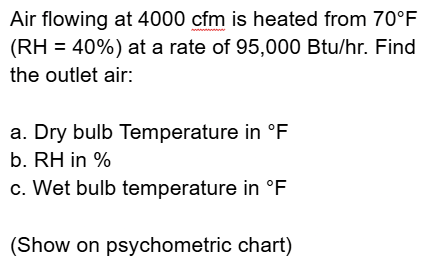 Air flowing at 4000 cfm is heated from 70°F
(RH = 40%) at a rate of 95,000 Btu/hr. Find
the outlet air:
a. Dry bulb Temperature in °F
b. RH in %
c. Wet bulb temperature in °F
(Show on psychometric chart)
Air flowing at 4000 cfm is heated from 70°F
(RH = 40%) at a rate of 95,000 Btu/hr. Find
the outlet air:
a. Dry bulb Temperature in °F
b. RH in %
c. Wet bulb temperature in °F
(Show on psychometric chart)
This is AI generated Response.
Asked by: Veera manikanta
Created at: 2025-10-03 20:29:47
Asked by: Veera manikanta
Created at: 2025-10-03 20:29:47
Final Answer:
Rendered
Raw Text
Did you like this answer?
Let's solve the problem step by step:
---
## **Given Data**
- **Air flow**: \( 400 \) cfm
- **Initial Dry Bulb Temperature (\( T_{db,in} \))**: \( 70^\circ F \)
- **Initial Relative Humidity (\( RH_{in} \))**: \( 40\% \)
- **Heating rate**: \( 95,000 \) Btu/hr
---
## **Step 1: Find Enthalpy Change (\( \Delta h \))**
**Formula:**
\[
\dot{Q} = \dot{m} \times \Delta h
\]
Where:
- \( \dot{Q} \) = Heat added (Btu/hr)
- \( \dot{m} \) = Mass flow rate of dry air (lb/hr)
- \( \Delta h \) = Change in enthalpy (Btu/lb)
### **Calculate Mass Flow Rate of Dry Air**
\[
\dot{m} = \frac{\text{CFM} \times 60 \times \rho_{da}}{1}
\]
Assume density of dry air at 70°F, atmospheric pressure (\( \rho_{da} \approx .075 \) lb/ft³):
\[
\dot{m} = 400 \times 60 \times .075 = 18,000 \text{ lb/hr}
\]
---
## **Step 2: Find Enthalpy at Inlet (\( h_{in} \))**
### **From Psychrometric Chart (at 70°F, 40% RH):**
- **Enthalpy (\( h_{in} \))** ≈ 24.5 Btu/lb (from chart or psychrometric calculator)
---
## **Step 3: Find Enthalpy at Outlet (\( h_{out} \))**
\[
\Delta h = \frac{\dot{Q}}{\dot{m}} = \frac{95,000}{18,000} \approx 5.28 \text{ Btu/lb}
\]
\[
h_{out} = h_{in} + \Delta h = 24.5 + 5.28 \approx 29.8 \text{ Btu/lb}
\]
---
## **Step 4: Find Outlet Dry Bulb Temperature (\( T_{db,out} \))**
Assuming **no moisture added or removed** (heating only):
- **Humidity ratio (\( W \)) remains constant.**
- Find \( W \) at inlet (from chart at 70°F, 40% RH):
- \( W \approx .0082 \) lb/lb
Now, on the psychrometric chart, **move horizontally to the right** (constant \( W \)) until you reach \( h_{out} \approx 29.8 \) Btu/lb.
- **This gives \( T_{db,out} \approx 102^\circ F \)** (from chart or calculator).
---
## **Step 5: Find Outlet Relative Humidity**
At:
- \( T_{db,out} \approx 102^\circ F \)
- \( W_{out} = .0082 \) lb/lb
From the chart, the **RH drops** (since air can hold more moisture at higher temperatures). At this point, **RH ≈ 9%**.
---
## **Step 6: Find Outlet Wet Bulb Temperature**
At:
- \( T_{db,out} \approx 102^\circ F \)
- \( W_{out} = .0082 \) lb/lb
From the chart, **Wet Bulb Temperature ≈ 75°F**.
---
## **Summary Table**
| Parameter | Inlet | Outlet |
|-------------------------------|--------------|---------------|
| Dry Bulb Temp (\( ^\circ F \))| 70 | ~102 |
| Relative Humidity (%) | 40 | ~9 |
| Wet Bulb Temp (\( ^\circ F \))| ~54 | ~75 |
---
## **Answers**
a. **Outlet Dry Bulb Temperature:**
\(\boxed{102^\circ F}\)
b. **Outlet Relative Humidity:**
\(\boxed{9\%}\)
c. **Outlet Wet Bulb Temperature:**
\(\boxed{75^\circ F}\)
---
### **Psychrometric Chart Path (Description)**
- Start at 70°F/40% RH.
- Move right **horizontally (constant \( W \))** until you reach enthalpy of about 29.8 Btu/lb.
- Read \( T_{db} \) (102°F), \( RH \) (9%), and \( T_{wb} \) (75°F).
---
**If you wish to see this on an actual chart, you can use an online psychrometric chart tool and plot these points.**
---
### **References**
- [ASHRAE Psychrometric Chart](https://www.linric.com/webpcyc/psychonline)
- [Engineering Toolbox - Psychrometric Calculator](https://www.engineeringtoolbox.com/psychrometric-chart-online-d_694.html)
---
**Let me know if you need a graph or more explanation!**
📢 Instructions:
- Ask anything relatd to above question only.
- For new Question goto :