 VIPSolutions
Give step-by-step solution with explanation and final answer: Act like a helpful tutor and exlain me :Problem 4.32. The following table gives the prices of bonds Bond Principal (8) Time to Maturity (yrs) | Annual Coupon ($)* Bond Price ($) [wo 10 [00 [9% | *Half the stated coupon is paid every six months a) Calculate zero rates for maturities of 6 months, 12 months, 18 months, and 24 months. b) What are the forward rates for the periods: 6 months to 12 months, 12 months to 18 months, 18 months to 24 months? ¢) What are the 6-month, 12-month, 18-month, and 24-month par yields for bonds that provide semiannual coupon payments? d) Estimate the price and yield of a two-year bond providing a semiannual coupon of 7% per annum.
Question:
Give step-by-step solution with explanation and final answer:
Act like a helpful tutor and exlain me :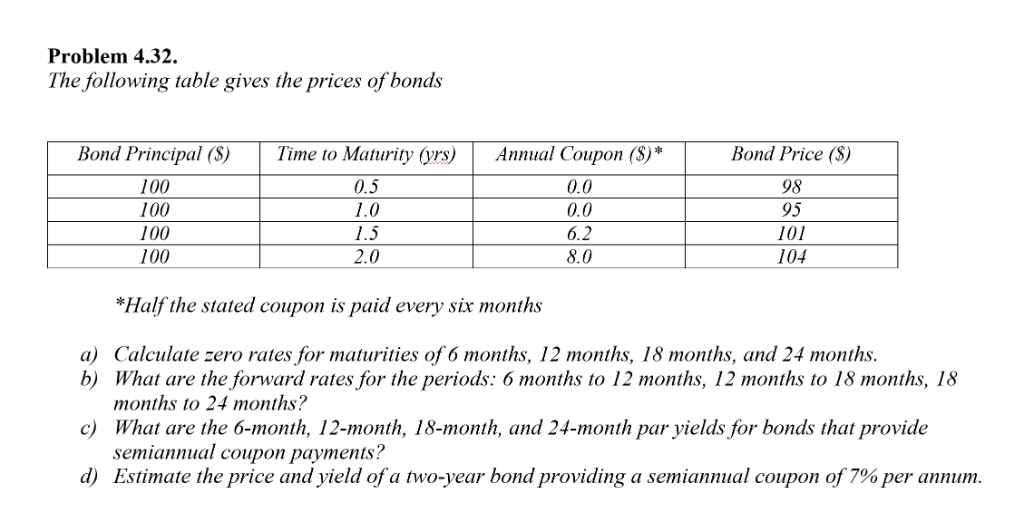 Problem 4.32.
The following table gives the prices of bonds
Bond Principal (8) Time to Maturity (yrs) | Annual Coupon ($)* Bond Price ($)
[wo 10 [00 [9% |
*Half the stated coupon is paid every six months
a) Calculate zero rates for maturities of 6 months, 12 months, 18 months, and 24 months.
b) What are the forward rates for the periods: 6 months to 12 months, 12 months to 18 months, 18
months to 24 months?
¢) What are the 6-month, 12-month, 18-month, and 24-month par yields for bonds that provide
semiannual coupon payments?
d) Estimate the price and yield of a two-year bond providing a semiannual coupon of 7% per annum.
Problem 4.32.
The following table gives the prices of bonds
Bond Principal (8) Time to Maturity (yrs) | Annual Coupon ($)* Bond Price ($)
[wo 10 [00 [9% |
*Half the stated coupon is paid every six months
a) Calculate zero rates for maturities of 6 months, 12 months, 18 months, and 24 months.
b) What are the forward rates for the periods: 6 months to 12 months, 12 months to 18 months, 18
months to 24 months?
¢) What are the 6-month, 12-month, 18-month, and 24-month par yields for bonds that provide
semiannual coupon payments?
d) Estimate the price and yield of a two-year bond providing a semiannual coupon of 7% per annum.
This is AI generated Response.
Asked by: Smart Tv
Created at: 2025-10-05 17:17:55
Asked by: Smart Tv
Created at: 2025-10-05 17:17:55
Final Answer:
Rendered
Raw Text
Did you like this answer?
Let's solve the problem step by step:
---
## **a) Calculate zero rates for 6, 12, 18, and 24 months**
**Zero-coupon bonds:**
- 6 months: Price = $98, Principal = $100, Coupon = $
- 12 months: Price = $95, Principal = $100, Coupon = $
### **Step 1: 6-Month Zero Rate**
For a zero-coupon bond, the price formula is:
\[
P = \frac{F}{(1 + r)^{n}}
\]
Where:
- \( P \) = Price now
- \( F \) = Face value ($100)
- \( r \) = periodic rate (for 6 months)
- \( n \) = number of periods (here, just 1 for 6 months)
\[
98 = \frac{100}{1 + r_{.5}}
\]
\[
1 + r_{.5} = \frac{100}{98} = 1.02041
\]
\[
r_{.5} = 2.041\%
\]
Annualized (compounded semiannually):
\[
\text{Zero rate for 6 months (annualized)} = 2 \times 2.041\% = 4.08\%
\]
---
### **Step 2: 12-Month Zero Rate**
\[
95 = \frac{100}{(1 + r_{1})^2}
\]
\[
(1 + r_{1})^2 = \frac{100}{95} = 1.05263
\]
\[
1 + r_{1} = \sqrt{1.05263} = 1.02596
\]
\[
r_{1} = 2.596\% \ \text{per 6 months}
\]
Annualized:
\[
\text{Zero rate for 12 months (annualized)} = 2 \times 2.596\% = 5.19\%
\]
---
### **Step 3: 18-Month Zero Rate**
The 1.5-year bond has a 6.2% coupon (paid semiannually: 3.1 every 6 months).
\[
\text{Cash flows: } 3.1 \ (\text{at 6, 12 months}), \ 103.1 \ (\text{at 18 months})
\]
The price is:
\[
101 = \frac{3.1}{1.02041} + \frac{3.1}{(1.02596)^2} + \frac{103.1}{(1 + r_{1.5})^3}
\]
Calculate present values of the first two coupons using earlier zero rates:
\[
\frac{3.1}{1.02041} = 3.038
\]
\[
\frac{3.1}{(1.02596)^2} = \frac{3.1}{1.05263} = 2.946
\]
So:
\[
101 = 3.038 + 2.946 + \frac{103.1}{(1 + r_{1.5})^3}
\]
\[
101 - 3.038 - 2.946 = \frac{103.1}{(1 + r_{1.5})^3}
\]
\[
95.016 = \frac{103.1}{(1 + r_{1.5})^3}
\]
\[
(1 + r_{1.5})^3 = \frac{103.1}{95.016} = 1.0852
\]
\[
1 + r_{1.5} = (1.0852)^{1/3} = 1.02764
\]
\[
r_{1.5} = 2.764\% \text{ per 6 months}
\]
Annualized:
\[
\text{Zero rate for 18 months (annualized)} = 2 \times 2.764\% = 5.53\%
\]
---
### **Step 4: 24-Month Zero Rate**
2-year bond: 8.% coupon (4. every 6 months), price = $104
\[
\text{Cash flows: } 4., 4., 4., 104. \text{ at 6, 12, 18, 24 months}
\]
\[
104 = \frac{4}{1.02041} + \frac{4}{(1.02596)^2} + \frac{4}{(1.02764)^3} + \frac{104}{(1 + r_2)^4}
\]
\[
\frac{4}{1.02041} = 3.922
\]
\[
\frac{4}{1.05263} = 3.801
\]
\[
\frac{4}{1.0852} = 3.687
\]
\[
104 = 3.922 + 3.801 + 3.687 + \frac{104}{(1 + r_2)^4}
\]
\[
104 - 3.922 - 3.801 - 3.687 = \frac{104}{(1 + r_2)^4}
\]
\[
92.59 = \frac{104}{(1 + r_2)^4}
\]
\[
(1 + r_2)^4 = \frac{104}{92.59} = 1.1232
\]
\[
1 + r_2 = (1.1232)^{1/4} = 1.02945
\]
\[
r_2 = 2.945\% \text{ per 6 months}
\]
Annualized:
\[
\text{Zero rate for 24 months (annualized)} = 2 \times 2.945\% = 5.89\%
\]
---
### **Summary Table**
| Maturity | Zero Rate (annualized, comp. semiannual) |
|------------|------------------------------------------|
| 6 months | 4.08% |
| 12 months | 5.19% |
| 18 months | 5.53% |
| 24 months | 5.89% |
---
## **b) Forward Rates**
The formula for the forward rate \( f \) from time \( t_1 \) to \( t_2 \) is:
\[
(1 + z_2)^{t_2} = (1 + z_1)^{t_1} \cdot (1 + f)^{t_2 - t_1}
\]
Where \( z_1 \) and \( z_2 \) are the zero rates for \( t_1 \) and \( t_2 \) (in periods of 6 months).
- \( z_1 \) for 6 months = 2.041% (per 6 months)
- \( z_2 \) for 12 months = 2.596% (per 6 months)
**Forward Rate from 6 to 12 months:**
\[
(1 + .02596)^2 = (1 + .02041)^1 \cdot (1 + f_{.5,1})^1
\]
\[
1.05263 = 1.02041 \cdot (1 + f_{.5,1})
\]
\[
(1 + f_{.5,1}) = \frac{1.05263}{1.02041} = 1.0316
\]
\[
f_{.5,1} = 3.16\% \text{ per 6 months}
\]
Annualized: 6.32%
---
**Forward Rate from 12 to 18 months:**
- \( z_1 \) for 12 months = 2.596%
- \( z_2 \) for 18 months = 2.764%
\[
(1 + .02764)^3 = (1 + .02596)^2 \cdot (1 + f_{1,1.5})^1
\]
\[
1.0852 = 1.05263 \cdot (1 + f_{1,1.5})
\]
\[
(1 + f_{1,1.5}) = \frac{1.0852}{1.05263} = 1.031
\]
\[
f_{1,1.5} = 3.10\% \text{ per 6 months}
\]
Annualized: 6.20%
---
**Forward Rate from 18 to 24 months:**
- \( z_1 \) for 18 months = 2.764%
- \( z_2 \) for 24 months = 2.945%
\[
(1 + .02945)^4 = (1 + .02764)^3 \cdot (1 + f_{1.5,2})^1
\]
\[
1.1232 = 1.0852 \cdot (1 + f_{1.5,2})
\]
\[
(1 + f_{1.5,2}) = \frac{1.1232}{1.0852} = 1.0351
\]
\[
f_{1.5,2} = 3.51\% \text{ per 6 months}
\]
Annualized: 7.02%
---
### **Summary Table**
| Period | Forward Rate (per 6 mo) | Annualized |
|--------------------|------------------------|-------------|
| 6 to 12 months | 3.16% | 6.32% |
| 12 to 18 months | 3.10% | 6.20% |
| 18 to 24 months | 3.51% | 7.02% |
---
## **c) Par Yields (6, 12, 18, 24 months)**
Par yield is the coupon rate that makes the bond price equal to face value ($100).
### **Formula:**
\[
P = \sum_{i=1}^{n} \frac{c}{(1 + z_i)^i} + \frac{100}{(1 + z_n)^n}
\]
Set \( P = 100 \) and solve for \( c \).
**Let’s do for each:**
---
### **6-month Par Yield**
\[
100 = \frac{c}{1.02041} + \frac{100}{1.02041}
\]
\[
100 = \frac{c + 100}{1.02041}
\]
\[
c + 100 = 100 \times 1.02041 = 102.041
\]
\[
c = 2.041
\]
Annual coupon = \( 2 \times 2.041 = 4.08\% \)
---
### **12-month Par Yield**
\[
100 = \frac{c}{1.02041} + \frac{c}{(1.02596)^2} + \frac{100}{(1.02596)^2}
\]
\[
(1.02596)^2 = 1.05263
\]
\[
100 = \frac{c}{1.02041} + \frac{c}{1.05263} + \frac{100}{1.05263}
\]
\[
100 = .980 + .950c + 95.
\]
Calculate each term:
\[
\frac{c}{1.02041} = .980c
\]
\[
\frac{c}{1.05263} = .950c
\]
\[
\frac{100}{1.05263} = 95.
\]
So,
\[
100 = .980c + .950c + 95.
\]
\[
100 - 95. = 1.93c
\]
\[
c = \frac{5.}{1.93} = 2.59
\]
Annual coupon = \( 2 \times 2.59 = 5.18\% \)
---
### **18-month Par Yield**
\[
100 = \frac{c}{1.02041} + \frac{c}{1.05263} + \frac{c}{1.0852} + \frac{100}{1.0852}
\]
\[
\frac{c}{1.02041} = .980c
\]
\[
\frac{c}{1.05263} = .950c
\]
\[
\frac{c}{1.0852} = .921c
\]
\[
\frac{100}{1.0852} = 92.18
\]
\[
100 = .980c + .950c + .921c + 92.18
\]
\[
100 - 92.18 = 2.851c
\]
\[
7.82 = 2.851c
\]
\[
c = \frac{7.82}{2.851} = 2.74
\]
Annual coupon = \( 2 \times 2.74 = 5.48\% \)
---
### **24-month Par Yield**
\[
100 = \frac{c}{1.02041} + \frac{c}{1.05263} + \frac{c}{1.0852} + \frac{c}{1.1232} + \frac{100}{1.1232}
\]
\[
\frac{c}{1.02041} = .980
📢 Instructions:
- Ask anything relatd to above question only.
- For new Question goto :