Give step-by-step solution with explanation and final answer:
Give step-by-step solution with explanation and final answer:
Summarize briefly about :
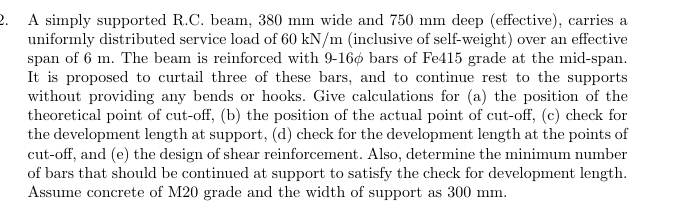
Give step-by-steA simply supported R.C. beam, 380 mm wide and 750 mm deep (effective), carries a
uniformly distributed service load of 60 kN/m (inclusive of self-weight) over an effective
span of 6 m. The beam is reinforced with 9-166 bars of Fe415 grade at the mid-span.
It is proposed to curtail three of these bars, and to continue rest to the supports
without providing any bends or hooks. Give calculations for (a) the position of the
theoretical point of cut-off, (b) the position of the actual point of cut-off, (c) check for
the development length at support, (d) check for the development length at the points of
cut-off, and (¢) the design of shear reinforcement. Also, determine the minimum number
of bars that should be continued at support to satisfy the check for development length.
Assume concrete of M20 grade and the width of support as 300 mm.
Question:
Give step-by-step solution with explanation and final answer:
Give step-by-step solution with explanation and final answer:
Summarize briefly about :
Give step-by-steA simply supported R.C. beam, 380 mm wide and 750 mm deep (effective), carries a
uniformly distributed service load of 60 kN/m (inclusive of self-weight) over an effective
span of 6 m. The beam is reinforced with 9-166 bars of Fe415 grade at the mid-span.
It is proposed to curtail three of these bars, and to continue rest to the supports
without providing any bends or hooks. Give calculations for (a) the position of the
theoretical point of cut-off, (b) the position of the actual point of cut-off, (c) check for
the development length at support, (d) check for the development length at the points of
cut-off, and (¢) the design of shear reinforcement. Also, determine the minimum number
of bars that should be continued at support to satisfy the check for development length.
Assume concrete of M20 grade and the width of support as 300 mm.
This is AI generated Response.
Asked by: Rajat singh
Created at: 2025-10-07 08:56:25
Final Answer:
RenderedRaw Text
Did you like this answer?
Let's break this problem into steps as asked:
### **Given Data**
- **Beam dimensions:** 380 mm (width, \(b\)), 750 mm (effective depth, \(d\))
- **Span (\(L\)):** 6 m = 600 mm
- **Uniform load (\(w\)):** 60 kN/m = 60,000 N/m = 60 N/mm
- **Reinforcement:** 9 bars of 16 mm dia (\(\phi\)), Fe415 at mid-span
- **Concrete:** M20
- **Width of support:** 300 mm
- **Bars to be curtailed:** 3 out of 9
- **No bends/hooks at curtailment**
- **To be found:** Theoretical & actual cut-off points, development length checks (support/cut-off), minimum bars to be continued, and shear reinforcement design
---
## **Step (a): Theoretical Point of Cut-off**
For a simply supported beam under UDL, the maximum moment is at mid-span.
- Maximum BM at mid-span:
\[
M_{max} = \frac{wL^2}{8}
\]
\[
M_{max} = \frac{60 \times 6^2}{8} = \frac{60 \times 36}{8} = \frac{216}{8} = 270 \text{ kNm}
\]
\[
= 270 \times 10^6 \text{ Nmm}
\]
- The point of zero moment is at supports, and the moment diagram is parabolic.
- Theoretical cut-off point for bars is where the moment reduces to the moment that can be resisted by the curtailed reinforcement.
Let the number of bars to be curtailed = 3 out of 9.
Remaining bars = 6.
Let \( x \) = distance from support where curtailment is proposed.
- Moment at distance \( x \) from support:
\[
M_x = \frac{w}{2} \left( Lx - x^2 \right)
\]
- Ratio of steel after curtailment:
\[
\frac{A_{s,remain}}{A_{s,total}} = \frac{6}{9} = \frac{2}{3}
\]
- So, at curtailment, moment resisted = \(\frac{2}{3} M_{max}\)
- Find \( x \) such that \( M_x = \frac{2}{3} M_{max} \):
\[
\frac{w}{2}(Lx - x^2) = \frac{2}{3} M_{max}
\]
\[
30(6x - x^2) = \frac{2}{3} \times 270
\]
\[
30(6x - x^2) = 180
\]
\[
6x - x^2 = 6
\]
\[
x^2 - 6x + 6 =
\]
\[
x = \frac{6 \pm \sqrt{36 - 24}}{2} = \frac{6 \pm \sqrt{12}}{2} = \frac{6 \pm 3.464}{2}
\]
\[
x_1 = \frac{6 - 3.464}{2} = 1.268 \text{ m}
\]
\[
x_2 = \frac{6 + 3.464}{2} = 4.732 \text{ m}
\]
(Take the value from support: 1.27 m from the support.)
### **Answer (a):**
**Theoretical cut-off point = 1.27 m from the support**
---
## **Step (b): Actual Point of Cut-off**
IS 456 (Clause 26.2.3.3): Curtailment of bars should be such that the cut-off point is at a distance greater than or equal to the theoretical point plus 12 times the diameter, or effective depth, whichever is greater.
- \( 12\phi = 12 \times 16 = 192 \) mm
- Effective depth, \( d = 750 \) mm
- So, provide extension = max(192, 750) = 750 mm
- So, **actual point of cut-off**:
\[
x_{actual} = x_{theoretical} + 750 \text{ mm} = 127 + 750 = 202 \text{ mm} = 2.02 \text{ m from support}
\]
### **Answer (b):**
**Actual point of cut-off = 2.02 m from the support**
---
## **Step (c): Check Development Length at Support**
- **Development length (\( L_d \)), IS456:**
\[
L_d = \frac{.87 f_y \phi}{4 \tau_{bd}}
\]
For M20, \(\tau_{bd} = 1.2\) N/mm² (Table 21, IS456)
For Fe415, \( f_y = 415 \) N/mm², \( \phi = 16 \) mm
\[
L_d = \frac{.87 \times 415 \times 16}{4 \times 1.2} = \frac{5788.8}{4.8} = 1206 \text{ mm}
\]
**Check: Embedding required = \( L_d \) or \( L_d/1.3 \) at support (IS456 Clause 26.2.3.3).**
\[
\text{Embedment available} = \text{width of support} + \text{extension into support}
\]
Support width = 300 mm
Extension into support = Typically, 50 mm (may be given in actual design). Let's assume full width.
\[
\text{Available} = 300 \text{ mm}
\]
Required = \( L_d/1.3 = 1206/1.3 = 928 \) mm
**Available < Required**
**Hence, more bars need to be continued to satisfy development length.**
---
## **Step (d): Check Development Length at Cut-off**
At the cut-off point, IS456 requires that the embedment beyond the cut-off point should be at least \( L_d \) or \( 12\phi \) or \( d \), whichever is greater. In this case, the extension after the theoretical point is already taken as 750 mm (which is less than \( L_d \)), so you may need to continue more bars or provide mechanical anchorage.
---
## **Step (e): Design of Shear Reinforcement**
- **Shear force at the cut-off point:**
\[
V = w \times \text{distance from support}
\]
\[
V = 60 \times (6/2 - 2.02) = 60 \times (3 - 2.02) = 60 \times .98 = 58.8 \text{ kN}
\]
- Nominal shear stress:
\[
\tau_v = \frac{V}{b d} = \frac{58,800}{380 \times 750} = .206 \text{ N/mm}^2
\]
- For M20, \(\tau_c\) for .5% steel is about .62 N/mm² (IS456 Table 19). Since \(\tau_v < \tau_c\), nominal links are sufficient.
- **Provide 8 mm 2-legged stirrups @ 200 mm c/c** (nominal).
---
## **(f): Minimum Bars to be Continued at Support**
To satisfy development length:
\[
\frac{A_s}{A_{s,reqd}} = \frac{\text{Available embedment}}{\text{Required embedment}} = \frac{300}{928} = .323
\]
So, minimum bars to be continued:
\[
9 \times .323 = 2.91 \implies 3 \text{ bars (minimum)}
\]
But, generally, at least 1/3rd of bars should be continued (IS456).
**So, continue at least 3 bars to support.**
---
## **Summary Table**
| Step | Result/Explanation |
|------|---------------------------------------------------------------|
| (a) | Theoretical cut-off point: **1.27 m from support** |
| (b) | Actual cut-off point: **2.02 m from support** |
| (c) | Development length at support: **Required = 928 mm, Available = 300 mm** (not sufficient) |
| (d) | Development length at cut-off: **Extension after curtailment may be insufficient** |
| (e) | Shear reinforcement: **8 mm 2-legged stirrups @ 200 mm c/c** |
| (f) | Minimum bars to support: **3 bars (minimum required)** |
---
## **Final Answers**
- **Theoretical cut-off point:** 1.27 m from support
- **Actual cut-off point:** 2.02 m from support
- **Development length at support:** Not sufficient, more bars must be continued to support
- **Development length at cut-off:** Extension may be insufficient—bars should be continued or anchorage provided
- **Shear reinforcement:** 8 mm 2-legged stirrups @ 200 mm c/c
- **Minimum bars to continue to support:** 3 bars (at least 1/3rd of total)
---
Let me know if you need calculations for any sub-step in more detail!
VIPSolutions focuses on clear, step‑by‑step explanations so you can learn quickly. Whether you need an AI‑generated walkthrough or a short hint to get unstuck, each solution is organized for fast reading and easy review later.
Search similar questions, compare approaches, and bookmark the best answers for revision. Our goal is simple: quick, reliable study help that feels natural—not noisy.
 VIPSolutions
 A simply supported R.C. beam, 380 mm wide and 750 mm deep (effective), carries a
uniformly distributed service load of 60 kN/m (inclusive of self-weight) over an effective
span of 6 m. The beam is reinforced with 9-166 bars of Fe415 grade at the mid-span.
It is proposed to curtail three of these bars, and to continue rest to the supports
without providing any bends or hooks. Give calculations for (a) the position of the
theoretical point of cut-off, (b) the position of the actual point of cut-off, (c) check for
the development length at support, (d) check for the development length at the points of
cut-off, and (¢) the design of shear reinforcement. Also, determine the minimum number
of bars that should be continued at support to satisfy the check for development length.
Assume concrete of M20 grade and the width of support as 300 mm.
A simply supported R.C. beam, 380 mm wide and 750 mm deep (effective), carries a
uniformly distributed service load of 60 kN/m (inclusive of self-weight) over an effective
span of 6 m. The beam is reinforced with 9-166 bars of Fe415 grade at the mid-span.
It is proposed to curtail three of these bars, and to continue rest to the supports
without providing any bends or hooks. Give calculations for (a) the position of the
theoretical point of cut-off, (b) the position of the actual point of cut-off, (c) check for
the development length at support, (d) check for the development length at the points of
cut-off, and (¢) the design of shear reinforcement. Also, determine the minimum number
of bars that should be continued at support to satisfy the check for development length.
Assume concrete of M20 grade and the width of support as 300 mm.