 VIPSolutions
Give step-by-step solution with explanation and final answer:© You received no credit for this question in the previous attempt. Problem 4-24 Calculating EFN [LO2] The most recent financial statements for Crosby, Incorporated, follow. Sales for 2024 are projected to grow by 20 percent. Interest expense will remain constant; the tax rate and the dividend payout rate will also remain constant. Costs, other expenses, current assets, fixed assets, and accounts payable increase spontaneously with sales. CROSBY, INCORPORATED 2023 Income Statement Sales $ 747,000 Costs 582,000 Other expenses 18,000 Earnings before interest and taxes $ 147,000 Interest paid 14,000 Taxable income $133,000 Taxes (24%) 31,920 Net income $ 101,080 Dividends $ 31,335 Addition to retained earnings 69,745 CROSBY, INCORPORATED Balance Sheet as of December 31, 2023 Assets Liabilities and Owners’ Equity Current assets Current liabilities Cash $20,640 Accounts payable $ 54,800 Accounts receivable 43,580 Notes payable 14,000 Inventory 91,960 Total $ 68,800 Total $156,180 Long-term debt $ 130,000 Fixed assets Owners’ equity Net plant and equipment $423,000 Common stock and paid-in surplus $ 114,500 Retained earnings 265,880 Total $ 380,380 Total assets $ 579,180 Total liabilities and owners’ equity $ 579,180 If the firm is operating at full capacity and no new debt or equity is issued, what external financing is needed to support the 20 percent growth rate in sales? Note: Do not round intermediate calculations and round your answer to the nearest whole number, e.g., 32.
Question:
Give step-by-step solution with explanation and final answer: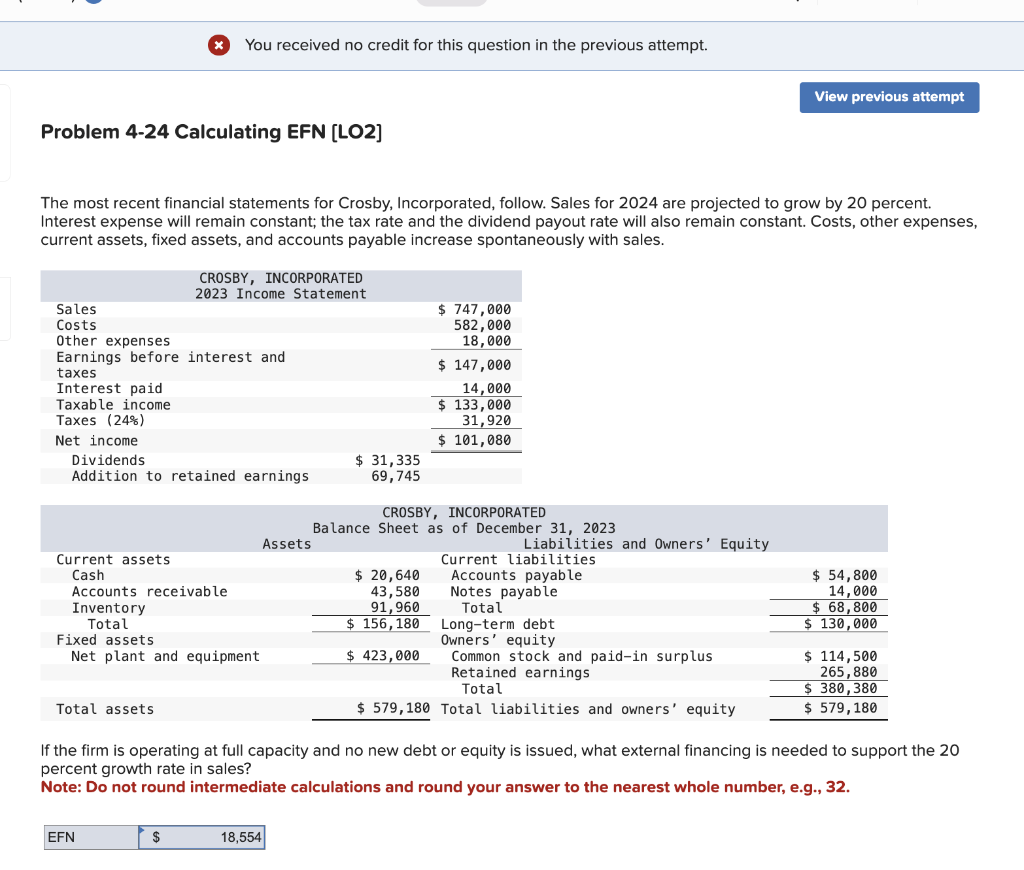 © You received no credit for this question in the previous attempt.
Problem 4-24 Calculating EFN [LO2]
The most recent financial statements for Crosby, Incorporated, follow. Sales for 2024 are projected to grow by 20 percent.
Interest expense will remain constant; the tax rate and the dividend payout rate will also remain constant. Costs, other expenses,
current assets, fixed assets, and accounts payable increase spontaneously with sales.
CROSBY, INCORPORATED
2023 Income Statement
Sales $ 747,000
Costs 582,000
Other expenses 18,000
Earnings before interest and
taxes $ 147,000
Interest paid 14,000
Taxable income $133,000
Taxes (24%) 31,920
Net income $ 101,080
Dividends $ 31,335
Addition to retained earnings 69,745
CROSBY, INCORPORATED
Balance Sheet as of December 31, 2023
Assets Liabilities and Owners’ Equity
Current assets Current liabilities
Cash $20,640 Accounts payable $ 54,800
Accounts receivable 43,580 Notes payable 14,000
Inventory 91,960 Total $ 68,800
Total $156,180 Long-term debt $ 130,000
Fixed assets Owners’ equity
Net plant and equipment $423,000 Common stock and paid-in surplus $ 114,500
Retained earnings 265,880
Total $ 380,380
Total assets $ 579,180 Total liabilities and owners’ equity $ 579,180
If the firm is operating at full capacity and no new debt or equity is issued, what external financing is needed to support the 20
percent growth rate in sales?
Note: Do not round intermediate calculations and round your answer to the nearest whole number, e.g., 32.
© You received no credit for this question in the previous attempt.
Problem 4-24 Calculating EFN [LO2]
The most recent financial statements for Crosby, Incorporated, follow. Sales for 2024 are projected to grow by 20 percent.
Interest expense will remain constant; the tax rate and the dividend payout rate will also remain constant. Costs, other expenses,
current assets, fixed assets, and accounts payable increase spontaneously with sales.
CROSBY, INCORPORATED
2023 Income Statement
Sales $ 747,000
Costs 582,000
Other expenses 18,000
Earnings before interest and
taxes $ 147,000
Interest paid 14,000
Taxable income $133,000
Taxes (24%) 31,920
Net income $ 101,080
Dividends $ 31,335
Addition to retained earnings 69,745
CROSBY, INCORPORATED
Balance Sheet as of December 31, 2023
Assets Liabilities and Owners’ Equity
Current assets Current liabilities
Cash $20,640 Accounts payable $ 54,800
Accounts receivable 43,580 Notes payable 14,000
Inventory 91,960 Total $ 68,800
Total $156,180 Long-term debt $ 130,000
Fixed assets Owners’ equity
Net plant and equipment $423,000 Common stock and paid-in surplus $ 114,500
Retained earnings 265,880
Total $ 380,380
Total assets $ 579,180 Total liabilities and owners’ equity $ 579,180
If the firm is operating at full capacity and no new debt or equity is issued, what external financing is needed to support the 20
percent growth rate in sales?
Note: Do not round intermediate calculations and round your answer to the nearest whole number, e.g., 32.
Asked by: Veera manikanta
Created at: 2025-10-07 20:00:41
Final Answer:
📢 Instructions:
- Ask anything relatd to above question only.
- For new Question goto :