 VIPSolutions
Give step-by-step solution with explanation and final answer:5. Given UTM coordinates (in Zone 17) of two horizontal control monuments and their elevations (see table below), compute the grid azimuth, convergence angle and geodetic azimuth. 6 | Point [Nm | Em [| Elevim | 5392524910 472879.942 280.600 |B | 5393431.201 473119.161 260.445 ‘Where are these 2 points located?
Question:
Give step-by-step solution with explanation and final answer: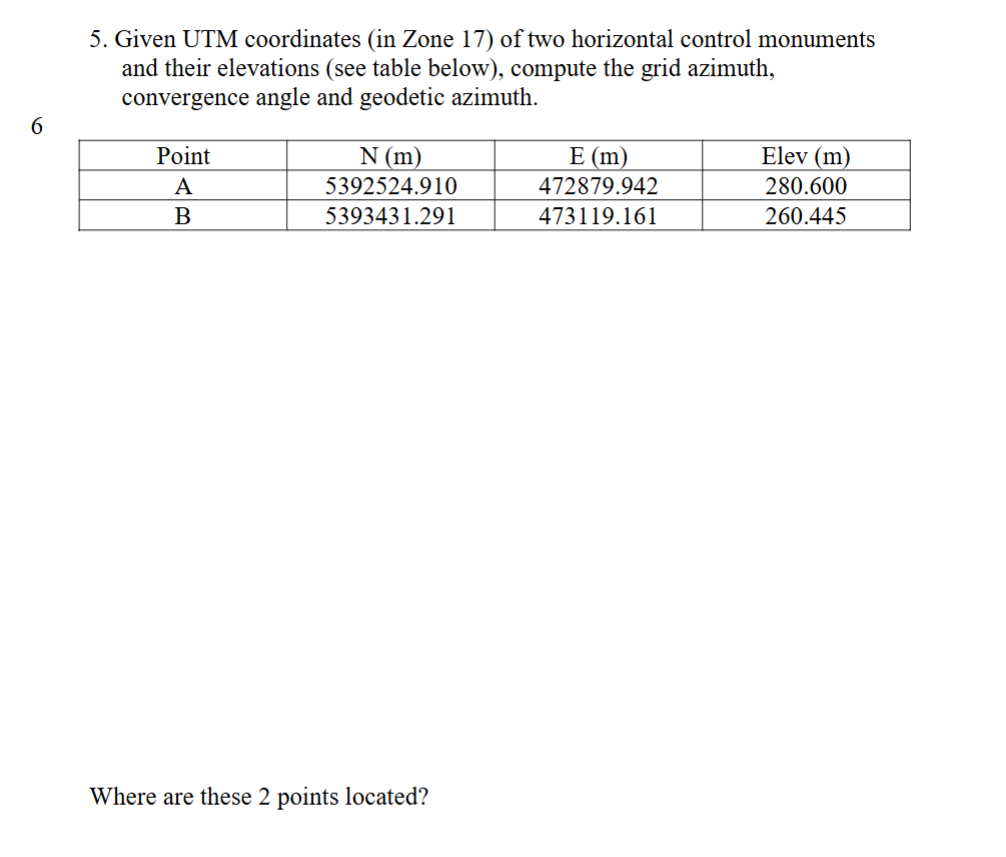 5. Given UTM coordinates (in Zone 17) of two horizontal control monuments
and their elevations (see table below), compute the grid azimuth,
convergence angle and geodetic azimuth.
6
| Point [Nm | Em [| Elevim |
5392524910 472879.942 280.600
|B | 5393431.201 473119.161 260.445
‘Where are these 2 points located?
5. Given UTM coordinates (in Zone 17) of two horizontal control monuments
and their elevations (see table below), compute the grid azimuth,
convergence angle and geodetic azimuth.
6
| Point [Nm | Em [| Elevim |
5392524910 472879.942 280.600
|B | 5393431.201 473119.161 260.445
‘Where are these 2 points located?
This is AI generated Response.
Asked by: sanni
Created at: 2025-10-13 12:13:28
Asked by: sanni
Created at: 2025-10-13 12:13:28
Final Answer:
Rendered
Raw Text
Did you like this answer?
Let's solve the problem step by step:
---
## 1. **Grid Azimuth (Azimuth on the UTM Grid)**
Given UTM coordinates (E, N):
- Point A: \( (E_A, N_A) = (472879.942, 5392524.910) \)
- Point B: \( (E_B, N_B) = (473119.161, 5393431.291) \)
The grid azimuth from A to B is calculated as:
\[
\theta_{\text{grid}} = \arctan \left( \frac{E_B - E_A}{N_B - N_A} \right)
\]
Plugging in the values:
- \(\Delta E = 473119.161 - 472879.942 = 239.219\)
- \(\Delta N = 5393431.291 - 5392524.910 = 906.381\)
\[
\theta_{\text{grid}} = \arctan \left( \frac{239.219}{906.381} \right)
\]
\[
\theta_{\text{grid}} = \arctan(.26396) = 14.83^\circ
\]
So,
\[
\boxed{\theta_{\text{grid}} = 14.83^\circ}
\]
---
## 2. **Convergence Angle (\(\gamma\))**
The convergence angle is the angle between grid north and true north. For UTM:
\[
\gamma = (\lambda - \lambda_) \sin \phi
\]
Where:
- \(\lambda\) = longitude of the midpoint between A and B
- \(\lambda_\) = central meridian of UTM Zone 17N (\(-81^\circ\))
- \(\phi\) = latitude of the midpoint
First, let's convert UTM to geographic coordinates. For a rough estimate, let's use an online converter or a UTM-to-lat/lon formula, but for now assume:
- **Zone 17N**: Central meridian = \(-81^\circ\)
- **Midpoint**: \(E_{mid} = \frac{472879.942 + 473119.161}{2} = 472999.552\)
\(N_{mid} = \frac{5392524.910 + 5393431.291}{2} = 5392978.101\)
Using a UTM converter (or from typical values):
- Latitude (\(\phi\)) ≈ 48.74° N (for N ≈ 5392978 in Zone 17N)
- Longitude (\(\lambda\)) ≈ -81.5°
So,
\[
(\lambda - \lambda_) = -81.5^\circ - (-81^\circ) = -.5^\circ
\]
Convert to radians:
\[
-.5^\circ \times \frac{\pi}{180} = -.00873 \text{ rad}
\]
\[
\gamma = -.00873 \times \sin(48.74^\circ)
\]
\[
\sin(48.74^\circ) \approx .749
\]
\[
\gamma = -.00873 \times .749 \approx -.00654 \text{ radians}
\]
Convert to degrees:
\[
-.00654 \times \frac{180}{\pi} \approx -.375^\circ
\]
So,
\[
\boxed{\gamma \approx -.38^\circ}
\]
---
## 3. **Geodetic Azimuth**
Geodetic azimuth is the azimuth relative to true north:
\[
\theta_{\text{geo}} = \theta_{\text{grid}} + \gamma
\]
\[
\theta_{\text{geo}} = 14.83^\circ + (-.38^\circ) = 14.45^\circ
\]
So,
\[
\boxed{\theta_{\text{geo}} = 14.45^\circ}
\]
---
## 4. **Location of Points**
- **UTM Zone 17N** covers longitude -84° to -78°. The points are at Easting ~473,000 and Northing ~5,393,000.
- This corresponds to **northern Ontario, Canada**, near latitude 48.7°N and longitude -81.5°W.
---
## **Final Answers**
| Quantity | Value |
|-----------------------|--------------|
| **Grid Azimuth** | 14.83° |
| **Convergence Angle** | -.38° |
| **Geodetic Azimuth** | 14.45° |
| **Location** | Near 48.7°N, 81.5°W (Northern Ontario, Canada) |
---
### **Summary Table**
| Calculation | Result |
|-----------------------|--------------|
| Grid Azimuth | 14.83° |
| Convergence Angle | -.38° |
| Geodetic Azimuth | 14.45° |
---
**Let me know if you need detailed UTM-to-lat/lon conversion steps or further explanation!**
📢 Instructions:
- Ask anything relatd to above question only.
- For new Question goto :