 VIPSolutions
Give step-by-step solution with explanation and final answer:Consider two deep soil layers composed of uniform soil. Soil A has an effective grain size Dio = 0.005 mm (fine silt), and Soil B has an effective grain size Dio = 0.5 mm (medium sand). The effective pore size may be estimated as des = 0.2 Xx D10. Assume the pore pressure distribution is hydrostatic. = What would be the potential height of capillary rise above the water table? = What would be the water pressure at the meniscus (at the top of the zone of capillary rise)? = Given the fact that the total stress is not affected unless you have new construction or excavation and based on the effective stress principle, how does capillarity affect effective stresses?
Question:
Give step-by-step solution with explanation and final answer: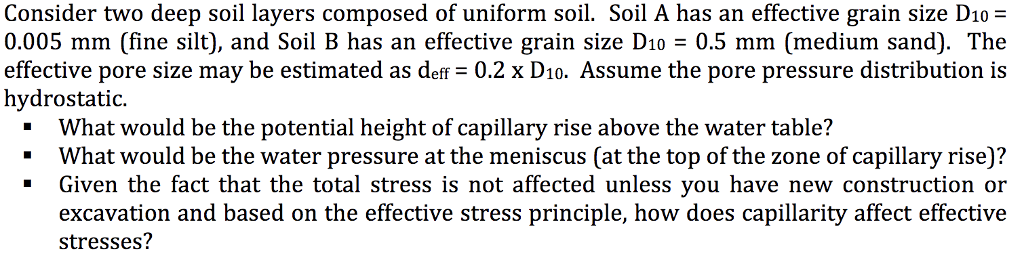 Consider two deep soil layers composed of uniform soil. Soil A has an effective grain size Dio =
0.005 mm (fine silt), and Soil B has an effective grain size Dio = 0.5 mm (medium sand). The
effective pore size may be estimated as des = 0.2 Xx D10. Assume the pore pressure distribution is
hydrostatic.
= What would be the potential height of capillary rise above the water table?
= What would be the water pressure at the meniscus (at the top of the zone of capillary rise)?
= Given the fact that the total stress is not affected unless you have new construction or
excavation and based on the effective stress principle, how does capillarity affect effective
stresses?
Consider two deep soil layers composed of uniform soil. Soil A has an effective grain size Dio =
0.005 mm (fine silt), and Soil B has an effective grain size Dio = 0.5 mm (medium sand). The
effective pore size may be estimated as des = 0.2 Xx D10. Assume the pore pressure distribution is
hydrostatic.
= What would be the potential height of capillary rise above the water table?
= What would be the water pressure at the meniscus (at the top of the zone of capillary rise)?
= Given the fact that the total stress is not affected unless you have new construction or
excavation and based on the effective stress principle, how does capillarity affect effective
stresses?
This is AI generated Response.
Asked by: VARRI APPARAO
Created at: 2025-10-20 05:44:07
Asked by: VARRI APPARAO
Created at: 2025-10-20 05:44:07
Final Answer:
Rendered
Raw Text
Did you like this answer?
Let's analyze and compute the required parameters step-by-step.
---
## Given Data:
- Soil A:
- Effective grain size \( D_{10A} = .005\, \text{mm} \)
- Soil B:
- Effective grain size \( D_{10B} = .5\, \text{mm} \)
- Effective pore size:
\[
D_{eff} = .2 \times D_{10}
\]
- The pore pressure distribution is hydrostatic.
---
## Step 1: Calculate the pore sizes
### Soil A:
\[
D_{effA} = .2 \times .005\, \text{mm} = .001\, \text{mm}
\]
### Soil B:
\[
D_{effB} = .2 \times .5\, \text{mm} = .1\, \text{mm}
\]
---
## Step 2: Calculate the potential height of capillary rise (\( h_{max} \))
The capillary rise height \( h \) is given by Jurin's law:
\[
h = \frac{2 \sigma \cos \theta}{\rho g D_{eff}}
\]
Assuming:
- Surface tension of water \( \sigma \approx .0728\, \text{N/m} \),
- Contact angle \( \theta \approx ^\circ \Rightarrow \cos \theta \approx 1 \),
- Density of water \( \rho \approx 100\, \text{kg/m}^3 \),
- Acceleration due to gravity \( g = 9.81\, \text{m/s}^2 \),
- Convert \( D_{eff} \) to meters.
### Convert \( D_{eff} \) to meters:
- For Soil A:
\[
D_{effA} = .001\, \text{mm} = 1 \times 10^{-6}\, \text{m}
\]
- For Soil B:
\[
D_{effB} = .1\, \text{mm} = 1 \times 10^{-4}\, \text{m}
\]
### Calculate \( h_{max} \):
\[
h_{max} = \frac{2 \times .0728 \times 1}{100 \times 9.81 \times D_{eff}}
\]
### For Soil A:
\[
h_{maxA} = \frac{2 \times .0728}{100 \times 9.81 \times 1 \times 10^{-6}}
= \frac{.1456}{9.81 \times 10^{-3}}
\]
\[
h_{maxA} \approx \frac{.1456}{.00981} \approx 14.85\, \text{meters}
\]
### For Soil B:
\[
h_{maxB} = \frac{.1456}{100 \times 9.81 \times 1 \times 10^{-4}}
= \frac{.1456}{.981} \approx .148\, \text{meters}
\]
---
## **Final Answer for potential capillary height:**
| Soil | \( D_{10} \) (mm) | \( D_{eff} \) (mm) | \( D_{eff} \) (m) | \( h_{max} \) (m) |
|--------|-------------------|--------------------|------------------|----------------|
| A | .005 | .001 | \(1 \times 10^{-6}\) | **14.85 m** |
| B | .5 | .1 | \(1 \times 10^{-4}\) | **.148 m** |
---
## Step 3: Water pressure at the meniscus
Since the pressure distribution is hydrostatic:
\[
P = \rho g h
\]
At the top of the capillary (water table):
- For Soil A:
\[
P_A = 100 \times 9.81 \times 14.85 \approx 145,628\, \text{Pa} \approx 146\, \text{kPa}
\]
- For Soil B:
\[
P_B = 100 \times 9.81 \times .148 \approx 1,450\, \text{Pa} \approx 1.45\, \text{kPa}
\]
---
## **Summary:**
### 1. **Potential height of capillary rise:**
- Soil A: **14.85 meters**
- Soil B: **.148 meters**
### 2. **Water pressure at the meniscus:**
- Soil A: approximately **146 kPa**
- Soil B: approximately **1.45 kPa**
---
## **Impact of Capillarity on Effective Stresses:**
Capillarity increases the effective stress in unsaturated soils by creating a negative pore water pressure (suction). The magnitude depends on the height of the capillary rise and the corresponding pressure at the meniscus, as calculated above.
---
**Note:** These calculations assume ideal conditions with perfect wetting and hydrostatic pressure distribution.
📢 Instructions:
- Ask anything relatd to above question only.
- For new Question goto :