 VIPSolutions
Give step-by-step solution with explanation and final answer:4.19 The results of a particle size analysis of a soil are given in the following table. No Atterberg limit tests were con. ducted. Sieve 95mm 4 10 20 40 100 200 no. (a8) finer 100 898 702 625 498 286 41 (@ Would you have conducted Atterberg limit tests on this soil? Justify your answer. (b) Classify the soil according to USCS, ASTM-CS, and AASHTO. (© Is this soil a good foundation material? Justify your
Question:
Give step-by-step solution with explanation and final answer: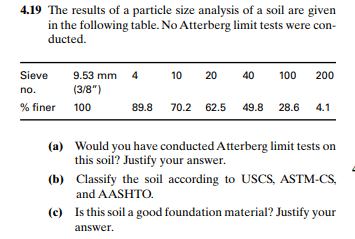 4.19 The results of a particle size analysis of a soil are given
in the following table. No Atterberg limit tests were con.
ducted.
Sieve 95mm 4 10 20 40 100 200
no. (a8)
finer 100 898 702 625 498 286 41
(@ Would you have conducted Atterberg limit tests on
this soil? Justify your answer.
(b) Classify the soil according to USCS, ASTM-CS,
and AASHTO.
(© Is this soil a good foundation material? Justify your
4.19 The results of a particle size analysis of a soil are given
in the following table. No Atterberg limit tests were con.
ducted.
Sieve 95mm 4 10 20 40 100 200
no. (a8)
finer 100 898 702 625 498 286 41
(@ Would you have conducted Atterberg limit tests on
this soil? Justify your answer.
(b) Classify the soil according to USCS, ASTM-CS,
and AASHTO.
(© Is this soil a good foundation material? Justify your
This is AI generated Response.
Asked by: VARRI APPARAO
Created at: 2025-10-20 07:11:17
Asked by: VARRI APPARAO
Created at: 2025-10-20 07:11:17
Final Answer:
Rendered
Raw Text
Did you like this answer?
Let's analyze and solve each of the question-by-step.
---
## Data:
|ieve no. 9. mm (3/8 | 4 mm | 10 | 20 mm | 40 | 100 mm | 200 |
|----------------------------|-------|----------------|--------|---------|--------|
| % finer | 100 | 89.8 | 70.2 | 62.5 | 49.8 | 28.6 | 4.1 |
---
## (a) Would you have conducted Atterberg limit tests on this soil? Justify your answer.
### Step 1: Understand the soil classification from the particle size distribution.
- The **percentage finer than 200 mm** (which is the entire soil sample) is 100%.
- The **percentage finer than 75 μm (.075 mm)** is not directly given, but the percentage finer at 4 mm is 89.8%, and at 10 mm is 70.2%. Since 75 μm is smaller than 4 mm, we need to look at the finer particles at smaller sieve sizes.
### Step 2: Determine the percentage of fines (<75 μm).
- The % finer at 4 mm is 89.8%. Since 4 mm = 400 μm, and 75 μm is much smaller, we need a finer sieve size to determine the fines. But the data doesn't provide finer sieve sizes like 75 μm directly.
### Step 3: Approximate the fines content.
- Since the % finer at 4 mm is 89.8%, the remaining 10.2% is between 4 mm and smaller sizes.
- The % finer at 200 μm (not given directly) is somewhere between the values at 100 μm and 200 μm.
Given the typical soil classification, **if the fines (particles smaller than 75 μm) are more than 35%**, the soil is considered **fine-grained**.
### Step 4: Conclusion:
- The % finer at 4 mm is 89.8%, indicating a high proportion of fines.
- Since the majority of particles are smaller than 4 mm, and likely many are below 75 μm, **this soil appears to be predominantly fine-grained**.
### **Justification:**
- Atterberg limit tests are generally conducted on fine-grained soils (clays and silts).
- Given the high percentage of fines (>35%), it is appropriate to perform Atterberg limit tests for further classification.
---
## **Answer for (a):**
**Yes**, I would conduct Atterberg limit tests on this soil because the soil has a high fines content (more than 35%), indicating it is a fine-grained soil suitable for Atterberg limit testing.
---
## (b) Classify the soil according to USCS, ASTM-CS, and AASHTO.
### Step 1: Determine the soil classification based on particle size distribution.
- From the data, the % finer at 200 μm (not given, but estimated) would be high, indicating a silty or clayey soil.
### Step 2: Use the USCS (Unified Soil Classification System):
- **Fines**: Particles smaller than 75 μm.
- **If fines > 50%**, the soil is classified as **clay (CL or CH)** or **silt (ML or MH)** depending on Atterberg limits.
### Step 3: Determine the soil type:
- Fines percentage: Since 89.8% are finer than 4 mm, and likely a substantial portion are finer than 75 μm, the soil is **silt or clay**.
- To distinguish between clay and silt, Atterberg limits are needed.
### Step 4: Using the Atterberg limits (from part c), but since not yet performed, we can only classify broadly:
- **Likely classification**: since the soil has high fines content and typical silt-sized particles, it is **silt** or **clay** in USCS.
### **Final USCS classification (tentative):**
> **ML** (Silt with low plasticity) or **CL** (Clay with low plasticity), depending on Atterberg limits.
### ASTM and AASHTO:
- Similar classification based on gradation and Atterberg limits.
- Likely **A-4 or A-6** (AASHTO) depending on plasticity.
---
## **Answer for (b):**
**Classified as** **silt (ML)** or **clay (CL)** according to USCS, depending on Atterberg limits.
---
## (c) Is this soil a good foundation material? Justify your answer.
### Step 1: Consider the soil properties.
- The soil has high fines content, likely silty or clayey.
- The stability of such soils depends on plasticity, compaction, and strength.
### Step 2: Typical foundation considerations:
- Fine soils like clay and silt can be compressible, expansive, and susceptible to water content changes.
- They generally require proper stabilization or ground improvement.
### Step 3: Based on typical properties:
- **If the soil has low plasticity** (e.g., ML), it may be acceptable but still requires proper design.
- **If the soil has high plasticity** (e.g., CL), it may swell or shrink, making it less suitable unless stabilized.
### **Conclusion:**
- Without detailed Atterberg limit data, it is cautious to say **this soil may not be ideal** as a foundation material unless stabilized.
- Typically, **coarse-grained soils (sand/gravel)** are preferred for foundations due to better drainage and strength.
---
## **Final answer for (c):**
**This soil is generally not considered a good foundation material** unless stabilized, due to its high fines content and potential for plasticity and compressibility.
---
# **Summary of Answers:**
### (a) Conduct Atterberg limit tests?
**Yes** — because the soil has high fines content and is predominantly fine-grained.
### (b) Classification:
Likely **silt (ML)** or **clay (CL)** according to USCS, depending on Atterberg limits.
### (c) Good foundation material?
**No**, unless stabilized, because high fines soils tend to have poor drainage and may be compressible or expansive.
---
Please let me know if you'd like detailed calculations for Atterberg limits or further classification!
📢 Instructions:
- Ask anything relatd to above question only.
- For new Question goto :