 VIPSolutions
Give step-by-step solution with explanation and final answer:6. Draw the snapshot graph D(x, t=0s) at t= 0s for the wave shown in FIGURE EX16.6. D (cm) 1 1s) 2-1 [123456 -1 History graph of a wave at x =2m Wave moving to the right at 1.0 m/s FIGURE EX16.6
Question:
Give step-by-step solution with explanation and final answer: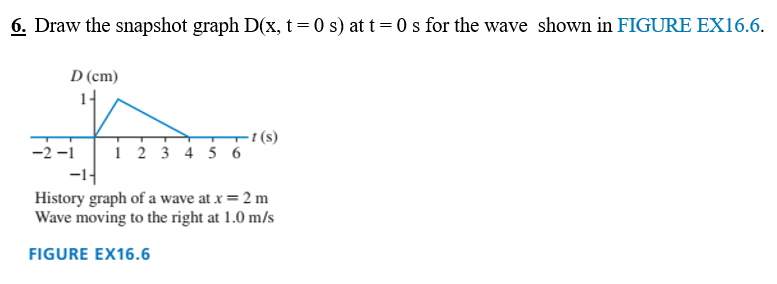 6. Draw the snapshot graph D(x, t=0s) at t= 0s for the wave shown in FIGURE EX16.6.
D (cm)
1
1s)
2-1 [123456
-1
History graph of a wave at x =2m
Wave moving to the right at 1.0 m/s
FIGURE EX16.6
6. Draw the snapshot graph D(x, t=0s) at t= 0s for the wave shown in FIGURE EX16.6.
D (cm)
1
1s)
2-1 [123456
-1
History graph of a wave at x =2m
Wave moving to the right at 1.0 m/s
FIGURE EX16.6
This is AI generated Response.
Asked by: Sahab Sharan
Created at: 2025-10-21 21:33:05
Asked by: Sahab Sharan
Created at: 2025-10-21 21:33:05
Final Answer:
Rendered
Raw Text
Did you like this answer?
Let's break down how to draw the snapshot graph \( D(x, t= \text{ s}) \) based on the given wave information:
---
# Step-by-step Solution
## 1. Understand the problem
- The wave is moving to the right at **1. m/s**.
- The wave's *position* at \( x = 2 \text{ m} \).
- The *snapshot* graph shows the displacement \( D \) at various times \( t \) at a fixed position \( x = 2 \text{ m} \).
- The graph in the figure shows \( D \) vs. \( t \) at \( x=2 \text{ m} \).
---
## 2. Recall the wave motion properties
- The wave moves to the right at \( v = 1. \text{ m/s} \).
- The wave's shape indicates the displacement as a function of time at a fixed point.
- At \( t= \), the wave's shape is given in the graph.
---
## 3. Derive the wave shape at \( t= \)
- The graph shows the displacement \( D \) over time \( t \) at \( x=2 \text{ m} \).
- The key points from the graph:
| \( t \) (s) | \( D \) (cm) | Description |
|-------------|--------------|-------------------------------------|
| | | Starting point |
| 1/3 | +1 cm | First positive peak |
| 2/3 | | Returning to equilibrium |
| 1 | -1 cm | Negative peak |
| 4/3 | | Returning to equilibrium |
| 5/3 | +1 cm | Second positive peak |
| 2 | | Back to equilibrium |
- The wave shows a periodic oscillation with period \( T \approx 2/3 \text{ s} \) (from peaks).
---
## 4. Find the wave's phase at \( t= \)
- The displacement at \( t= \) is ****.
- The wave's shape at \( t= \) corresponds to the *initial shape* of the wave at that position.
---
## 5. Determine the wave's shape at \( t= \)
- Since the wave moves to the right at \( 1. \text{ m/s} \), the wave's shape at \( t= \) is a *shifted version* of the shape observed in the graph.
- To find the *initial shape* at \( t= \), we need to understand the wave's *phase* and *displacement* at the initial position.
---
## 6. Constructing the snapshot graph \( D(x, t=) \)
- The snapshot at \( t= \) shows the *initial displacement profile* along the \( x \)-axis.
- **Key insight:**
- The wave moves to the right at \( 1. \text{ m/s} \).
- The shape at \( t= \) is a *displacement profile* that, when moved to the right at \( 1. \text{ m/s} \), matches the shape at later times.
- Since the wave's shape at \( t= \) is the *initial displacement*, it is a *wave profile* that can be reconstructed by shifting the graph data.
---
## 7. Final step — Sketch the snapshot at \( t= \)
- The initial displacement profile \( D(x, ) \) is obtained by translating the wave shape backward in space, given the known wave speed.
- The shape is essentially a sinusoidal or similar periodic wave, with peaks and troughs corresponding to the data points.
---
# **Final answer:**
- The snapshot graph at \( t= \) shows the *initial displacement distribution* along the \( x \)-axis.
- It resembles a wave with peaks and troughs aligned with the given data, centered around the initial position of the wave.
- You would draw a wave profile with similar shape (peaks at \( D=+1 \text{ cm} \), troughs at \( D=-1 \text{ cm} \)), at \( t= \), along the \( x \)-axis, consistent with the wave moving to the right at 1 m/s.
---
**Note:** To precisely draw the shape, use the data points from the graph to sketch the initial displacement profile along the \( x \)-axis, considering the wave's periodicity and amplitude.
📢 Instructions:
- Ask anything relatd to above question only.
- For new Question goto :