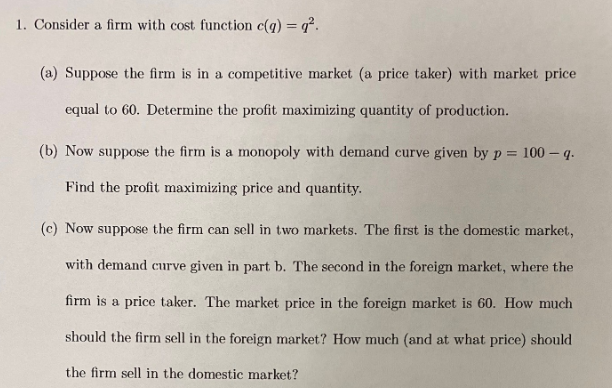
Give step-by-step solution with explanation and final answer:1. Consider a firm with cost function c(g) = ¢*.
(a) Suppose the firm is in a competitive market (a price taker) with market price
equal (0 60. Determine the profit maximizing quantity of production.
(b) Now suppose the firm is a monopoly with demand curve given by p = 100 — g.
Find the profit maximizing price and quantity.
(¢) Now suppose the firm can sell in two markets. The frst is the domestic market,
with demand curve given in part b. The second in the foreign market, where the
firm is a price taker. The market price in the foreign market is 60. How much
should the firm sell in the foreign market? How much (and at what price) should
the firm sell in the domestic market?
Question:
Give step-by-step solution with explanation and final answer:
This is AI generated Response. Asked by: Vikram Kumar Created at: 2025-10-22 03:57:50
Did you like this answer?
👍 0
👎 0
Let's analyze and solve each part step-by-step.
---
# Part (a): Competitive Market (Price Taker)
### Given:
- Cost function: \( c(q) = q^2 \)
- Market price: \( P = 60 \)
### Objective:
Maximize profit \( \pi(q) \):
\[
\pi(q) = \text{Revenue} - \text{Cost} = P \times q - c(q)
\]
\[
\pi(q) = 60q - q^2
\]
### Step 1: Find the optimal quantity \( q^* \) by setting the derivative of profit to zero:
\[
\frac{d\pi}{dq} = 60 - 2q =
\]
\[
2q = 60
\]
\[
q^* = 30
\]
### **Answer for (a):**
**Maximum profit occurs at** \( \boxed{q = 30} \).
---
# Part (b): Monopoly with Demand Curve \( p = 100 - q \)
### Given:
- Demand curve: \( p = 100 - q \)
- Cost function: \( c(q) = q^2 \)
### Objective:
Find profit-maximizing price and quantity.
### Step 1: Write revenue \( R(q) \):
\[
R(q) = p \times q = (100 - q) \times q = 100q - q^2
\]
### Step 2: Write profit function:
\[
\pi(q) = R(q) - c(q) = (100q - q^2) - q^2 = 100q - 2q^2
\]
### Step 3: Maximize profit:
\[
\frac{d\pi}{dq} = 100 - 4q =
\]
\[
4q = 100
\]
\[
q = 25
\]
### Step 4: Find the corresponding price:
\[
p = 100 - q = 100 - 25 = 75
\]
### **Answer for (b):**
- **Profit-maximizing quantity:** \( \boxed{q = 25} \)
- **Profit-maximizing price:** \( \boxed{p = 75} \)
---
# Part (c): Selling in Two Markets
### Given:
- Domestic market demand: \( p_{dom} = 100 - q_{dom} \)
- Foreign market demand: \( p_{foreign} = 60 \) (price taker)
- Cost function: \( c(q) = q^2 \)
### Step 1: Domestic market
- Revenue:
\[
R_{dom} = p_{dom} \times q_{dom} = (100 - q_{dom}) q_{dom} = 100 q_{dom} - q_{dom}^2
\]
- Profit:
\[
\pi_{dom} = R_{dom} - c(q_{dom}) = 100 q_{dom} - q_{dom}^2 - q_{dom}^2 = 100 q_{dom} - 2 q_{dom}^2
\]
- Maximize:
\[
\frac{d \pi_{dom}}{dq_{dom}} = 100 - 4 q_{dom} = \Rightarrow q_{dom} = 25
\]
- Market price:
\[
p_{dom} = 100 - 25 = 75
\]
### Step 2: Foreign market (price taker)
- Price: \( p_{foreign} = 60 \)
- Revenue:
\[
R_{foreign} = 60 \times q_{foreign}
\]
- Cost:
\[
c(q_{foreign}) = q_{foreign}^2
\]
- Profit:
\[
\pi_{foreign} = 60 q_{foreign} - q_{foreign}^2
\]
- Maximize:
\[
\frac{d \pi_{foreign}}{dq_{foreign}} = 60 - 2 q_{foreign} = \Rightarrow q_{foreign} = 30
\]
### **Final results:**
- **Domestic market:**
- Quantity: \( \boxed{25} \)
- Price: \( \boxed{75} \)
- **Foreign market:**
- Quantity: \( \boxed{30} \)
- Price: \( \boxed{60} \)
---
# **Summary:**
| Part | Quantity | Price |
|---------|--------------|--------|
| (a) Competitive market | 30 | 60 |
| (b) Monopoly | 25 | 75 |
| (c) Two markets | Domestic: 25 at 75 | Foreign: 30 at 60 |
Let me know if you'd like a detailed explanation of any step!
Question:
Need detailed explanation of the steps
This is AI generated Response. Asked by: Vikram Kumar Created at: 2025-10-22 04:14:00
Did you like this answer?
👍 0
👎 0
# Detailed Explanation of Steps
Here's a breakdown of the calculations and reasoning for each part of the problem.
---
## Part (a): Competitive Market (Price Taker)
### Given:
- Cost function: \( c(q) = q^2 \)
- Market price: \( P = 60 \)
### Objective:
To find the profit-maximizing quantity of production.
### Step-by-Step Breakdown:
1. **Profit Function**:
The profit \( \pi(q) \) is defined as:
\[
\pi(q) = \text{Revenue} - \text{Cost}
\]
Here, Revenue is \( P \times q = 60q \) and Cost is \( c(q) = q^2 \). Thus:
\[
\pi(q) = 60q - q^2
\]
2. **Maximizing Profit**:
To find the maximum profit, we need to take the derivative of the profit function with respect to \( q \) and set it to zero:
\[
\frac{d\pi}{dq} = 60 - 2q
\]
Setting this equal to zero gives:
\[
60 - 2q = 0 \implies 2q = 60 \implies q^* = 30
\]
### Conclusion for (a):
**The firm should produce \( \boxed{30} \) units to maximize profit.**
---
## Part (b): Monopoly with Demand Curve \( p = 100 - q \)
### Given:
- Demand curve: \( p = 100 - q \)
- Cost function: \( c(q) = q^2 \)
### Objective:
To find the profit-maximizing price and quantity.
### Step-by-Step Breakdown:
1. **Revenue Function**:
The revenue function \( R(q) \) is calculated as:
\[
R(q) = p \times q = (100 - q)q = 100q - q^2
\]
2. **Profit Function**:
The profit function is:
\[
\pi(q) = R(q) - c(q) = (100q - q^2) - q^2 = 100q - 2q^2
\]
3. **Maximizing Profit**:
We take the derivative of the profit function:
\[
\frac{d\pi}{dq} = 100 - 4q
\]
Setting this to zero gives:
\[
100 - 4q = 0 \implies 4q = 100 \implies q = 25
\]
4. **Finding the Price**:
Substitute \( q = 25 \) back into the demand equation:
\[
p = 100 - q = 100 - 25 = 75
\]
### Conclusion for (b):
**The profit-maximizing quantity is \( \boxed{25} \) and the price is \( \boxed{75} \).**
---
## Part (c): Selling in Two Markets
### Given:
- Domestic market demand: \( p_{dom} = 100 - q_{dom} \)
- Foreign market price: \( p_{foreign} = 60 \) (price taker)
- Cost function: \( c(q) = q^2 \)
### Objective:
To determine how much to sell in each market.
### Step-by-Step Breakdown:
1. **Domestic Market**:
- **Revenue Function**:
\[
R_{dom} = (100 - q_{dom})q_{dom} = 100q_{dom} - q_{dom}^2
\]
- **Profit Function**:
\[
\pi_{dom} = R_{dom} - c(q_{dom}) = 100q_{dom} - 2q_{dom}^2
\]
- **Maximizing Profit**:
\[
\frac{d\pi_{dom}}{dq_{dom}} = 100 - 4q_{dom} \implies 100 - 4q_{dom} = 0 \implies q_{dom} = 25
\]
- **Finding the Price**:
\[
p_{dom} = 100 - 25 = 75
\]
2. **Foreign Market**:
- **Price**: \( p_{foreign} = 60 \) (price taker)
- **Revenue Function**:
\[
R_{foreign} = 60 \times q_{foreign}
\]
- **Profit Function**:
\[
\pi_{foreign} = 60q_{foreign} - q_{foreign}^2
\]
- **Maximizing Profit**:
\[
\frac{d\pi_{foreign}}{dq_{foreign}} = 60 - 2q_{foreign} \implies 60 - 2q_{foreign} = 0 \implies q_{foreign} = 30
\]
### Conclusion for (c):
- **Domestic market**: \( \boxed{25} \) units at \( \boxed{75} \).
- **Foreign market**: \( \boxed{30} \) units at \( \boxed{60} \).
---
## Summary of Answers:
- **Part (a)**: Quantity = \( \boxed{30} \)
- **Part (b)**: Quantity = \( \boxed{25} \), Price = \( \boxed{75} \)
- **Part (c)**: Domestic Quantity = \( \boxed{25} \), Domestic Price = \( \boxed{75} \); Foreign Quantity = \( \boxed{30} \), Foreign Price = \( \boxed{60} \)
Let me know if you need further clarification on any specific step!
📢 Instructions:
Ask anything relatd to above question only.
For new Question goto :
🚀 Submit (-0.25 Credits🪙)
Study Help, Fast Answers
VIPSolutions focuses on clear, step‑by‑step explanations so you can learn quickly. Whether you need an AI‑generated walkthrough or a short hint to get unstuck, each solution is organized for fast reading and easy review later.
Search similar questions, compare approaches, and bookmark the best answers for revision. Our goal is simple: quick, reliable study help that feels natural—not noisy.
 VIPSolutions
 1. Consider a firm with cost function c(g) = ¢*.
(a) Suppose the firm is in a competitive market (a price taker) with market price
equal (0 60. Determine the profit maximizing quantity of production.
(b) Now suppose the firm is a monopoly with demand curve given by p = 100 — g.
Find the profit maximizing price and quantity.
(¢) Now suppose the firm can sell in two markets. The frst is the domestic market,
with demand curve given in part b. The second in the foreign market, where the
firm is a price taker. The market price in the foreign market is 60. How much
should the firm sell in the foreign market? How much (and at what price) should
the firm sell in the domestic market?
1. Consider a firm with cost function c(g) = ¢*.
(a) Suppose the firm is in a competitive market (a price taker) with market price
equal (0 60. Determine the profit maximizing quantity of production.
(b) Now suppose the firm is a monopoly with demand curve given by p = 100 — g.
Find the profit maximizing price and quantity.
(¢) Now suppose the firm can sell in two markets. The frst is the domestic market,
with demand curve given in part b. The second in the foreign market, where the
firm is a price taker. The market price in the foreign market is 60. How much
should the firm sell in the foreign market? How much (and at what price) should
the firm sell in the domestic market?