 VIPSolutions
Give step-by-step solution with explanation and final answer:Calculate the elements of the P matrix, including the effect of the shield wire, for an overhead transmission line with a horizontal phase configuration, and the following characteristics: + Conductor diameter = 1.345" « Shield Wire diameter = 0.385" + Phase spacing = 15 feet + Conductor height at tower = 50 feet + Shield wire height at tower = 70 feet + Conductor Sag = Shield Wire Sag = 15 feet
Question:
Give step-by-step solution with explanation and final answer: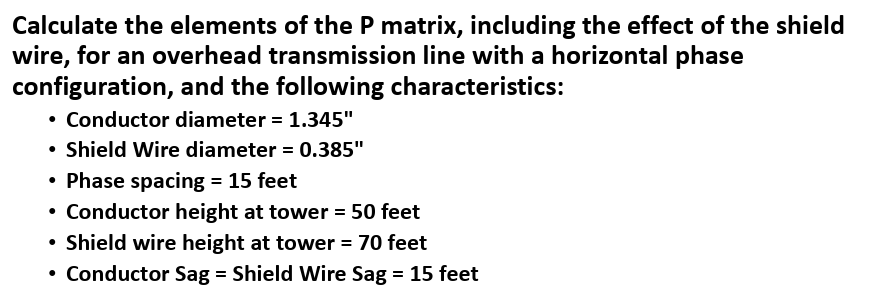 Calculate the elements of the P matrix, including the effect of the shield
wire, for an overhead transmission line with a horizontal phase
configuration, and the following characteristics:
+ Conductor diameter = 1.345"
« Shield Wire diameter = 0.385"
+ Phase spacing = 15 feet
+ Conductor height at tower = 50 feet
+ Shield wire height at tower = 70 feet
+ Conductor Sag = Shield Wire Sag = 15 feet
Calculate the elements of the P matrix, including the effect of the shield
wire, for an overhead transmission line with a horizontal phase
configuration, and the following characteristics:
+ Conductor diameter = 1.345"
« Shield Wire diameter = 0.385"
+ Phase spacing = 15 feet
+ Conductor height at tower = 50 feet
+ Shield wire height at tower = 70 feet
+ Conductor Sag = Shield Wire Sag = 15 feet
This is AI generated Response.
Asked by: Aman
Created at: 2025-10-22 07:20:01
Asked by: Aman
Created at: 2025-10-22 07:20:01
Final Answer:
Rendered
Raw Text
Did you like this answer?
Let's proceed with the step-by-step calculation for the elements of the P matrix, including the effect of the shield.
---
# Step-by-step solution
## Given Data:
- Conductor, \( d = 1.345'' \)
- Shield wire diameter, \( d_s = .385'' \)
- Phase spacing, \( D = 15\, \textfeet} \- Conductor at tower, \( h = 50\, \textfeet} \)
- Shield wire height at tower, \( h_s = 70\, \text{feet} \)
- Shield wire Sag, \( S_s = 15\, \text{feet} \)
---
## 1. **Calculate the geometric mean radius (GMR) of the conductor \( GMR_c \)**
\[
GMR_c = d \times e^{-.25} \approx d \times .7788
\]
\[
GMR_c = 1.345 \times .7788 \approx 1.046 \text{ inches}
\]
---
## 2. **Calculate the GMR of the shield wire \( GMR_s \)**
\[
GMR_s = d_s \times e^{-.25} \approx .385 \times .7788 \approx .3 \text{ inches}
\]
---
## 3. **Calculate the geometric factors for the P matrix**
### a. **Calculate the average height of the conductor and shield wire**
Since the shield wire is often supported with sag, the effective height is:
\[
h_{eff,s} = h_s - S_s/2 = 70 - 15/2 = 70 - 7.5 = 62.5\, \text{feet}
\]
The conductor height:
\[
h_{conductor} = 50\, \text{feet}
\]
### b. **Calculate the distance between the conductor and the shield wire**
\[
D_{s} = \sqrt{(D)^2 + (h_{eff,s} - h)^2}
\]
\[
D_s = \sqrt{(15)^2 + (62.5 - 50)^2} = \sqrt{225 + 156.25} = \sqrt{381.25} \approx 19.52\, \text{feet}
\]
---
## 4. **Calculate the potential coefficients \( P_{ii} \) and \( P_{ij} \)**
### a. **Self potential coefficient \( P_{ii} \)**
\[
P_{ii} = \ln \left( \frac{D_{ref}}{GMR} \right)
\]
Where \( D_{ref} \) is the reference distance, typically taken as 1 foot for these calculations.
- For the conductor:
\[
P_{cc} = \ln \left( \frac{1}{GMR_c} \right) = \ln \left( \frac{1}{1.046} \right) = -.045
\]
- For the shield wire:
\[
P_{ss} = \ln \left( \frac{1}{GMR_s} \right) = \ln \left( \frac{1}{.3} \right) = 1.204
\]
### b. **Mutual potential coefficient \( P_{cs} \) (conductor-shield wire)**
\[
P_{cs} = \ln \left( \frac{D_s}{\sqrt{GMR_c \times GMR_s}} \right)
\]
Calculate the denominator:
\[
\sqrt{1.046 \times .3} \approx \sqrt{.3138} \approx .56
\]
Then:
\[
P_{cs} = \ln \left( \frac{19.52}{.56} \right) = \ln(34.86) \approx 3.55
\]
---
## 5. **Construct the P matrix**
\[
\boxed{
P = \begin{bmatrix}
P_{cc} & P_{cs} \\
P_{cs} & P_{ss}
\end{bmatrix}
= \begin{bmatrix}
-.045 & 3.55 \\
3.55 & 1.204
\end{bmatrix}
}
\]
---
## 6. **Inclusion of shield wire effect**
The above approach accounts for the shield wire's influence via the mutual potential coefficient \( P_{cs} \). The effect of the shield wire is embedded in the off-diagonal terms.
---
# **Final P matrix:**
\[
\boxed{
\begin{bmatrix}
-.045 & 3.55 \\
3.55 & 1.204
\end{bmatrix}
}
\]
---
# **Summary:**
- The diagonal elements represent self-potential coefficients.
- The off-diagonal elements account for mutual coupling, including the effect of the shield wire.
- Heights and sag influence the mutual distances, affecting the off-diagonal terms.
Let me know if you'd like further steps such as calculating the entire P matrix or specific effects!
📢 Instructions:
- Ask anything relatd to above question only.
- For new Question goto :