This is AI generated Response.
Asked by: Vikram Kumar
Created at: 2025-10-24 23:52:09
Final Answer:
RenderedRaw Text
Did you like this answer?
Let's analyze and complete each part step-by-step.
---
# Step 1: Profit Maximization (No regulation)
- **Quantity (Subscriptions):** To maximize profit, the firm produces where revenue (MR equals marginal costMC).
- From the graph:
- MR curve intersects MC at approximately **6,000 subscriptions**.
- **Price (Dollars per subscription):** At this quantity, the price is on the demand curve (D), roughly **$40**.
### **First row:**
| **Pricing Mechanism** | **Quantity (Subscriptions)** | **Price (Dollars per subscription)** | **Profit/Profit Max** |
|-----------------------|------------------------------|-------------------------------------|---------------------|
| Profit Maximization | 6 | $40 | (not asked) |
---
# Step 2: Price equal to Marginal Cost (Regulation)
- **Price = MC:** From the graph, MC is the constant cost line at roughly **$10**.
- **Quantity:** To find the quantity where price = MC, look at the demand curve where price is about $10.
- - The quantity corresponding to a price of $10 is approximately **16,000 subscriptions**.
### **Second row:**
| **Pricing Mechanism** | **Quantity (Subscriptions)** | **Price (Dollars per subscription)** | **Profit/Profit Max** |
|-----------------------|------------------------------|-------------------------------------|---------------------|
| Marginal-Cost Pricing | 16 | $10 | (not asked) |
---
# Step 3: Price equal to Average Total Cost (ATC)
- **Price = ATC:** From the graph, ATC is roughly **$20**.
- **Quantity:** Find where the demand curve intersects the price of $20:
- The approximate quantity is **12,000 subscriptions**.
### **Third row:**
| **Pricing Mechanism** | **Quantity (Subscriptions)** | **Price (Dollars per subscription)** | **Profit/Profit Max** |
|-----------------------|------------------------------|-------------------------------------|---------------------|
| Average-Cost Pricing | 12 | $20 | (not asked) |
---
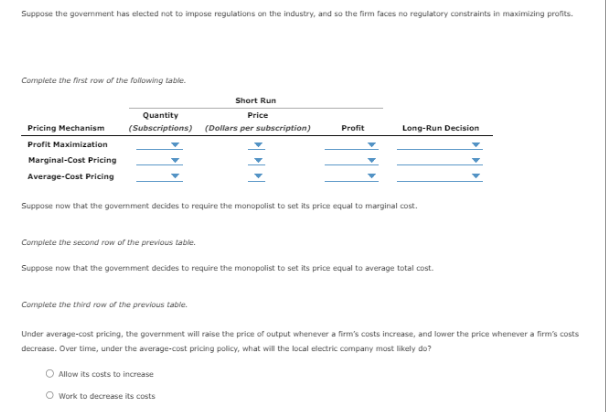
# Step 4: Under average-cost pricing, what will the electric company most likely do?
- Since the price is set at average total cost:
- If costs, ATC rises, leading to a higher price.
- If costs decrease, ATC falls, leading to a price.
- The company has an incentive to **work to decrease its costs** to maintain or improve profitability under this policy.
### **Final answer:**
- **Work to decrease its costs**
---
# **Summary table:**
| **Pricing Mechanism** | **Quantity (Subscriptions)** | **Price (Dollars per subscription)** | **Long-Run Decision** |
|-----------------------------------------------------|------------------------------|-------------------------------------|----------------------------------------------|
| Profit Maximization | 6 | $40 | (not asked) |
| **Marginal-Cost Pricing** | **16** | **$10** | (not asked) |
| **Average-Cost Pricing** | **12** | **$20** | **Work to decrease its costs** |
---
Let me know if you'd like further details!
Question:
maximizing profits,
This is AI generated Response.
Asked by: Vikram Kumar
Created at: 2025-10-25 00:14:31
Final Answer:
RenderedRaw Text
Did you like this answer?
# Step-by-Step Solution: Understanding Pricing Mechanisms
## Step 1: Profit Maximization (No Regulation)
- **Objective:** The firm maximizes profit where marginal revenue (MR) equals marginal cost (MC).
- **Quantity (Subscriptions):** The intersection of MR and MC occurs at approximately **6,000 subscriptions**.
- **Price (Dollars per subscription):** The corresponding price from the demand curve at this quantity is about **$40**.
### First Row:
| **Pricing Mechanism** | **Quantity (Subscriptions)** | **Price (Dollars per subscription)** |
|----------------------------|------------------------------|-------------------------------------|
| Profit Maximization | 6,000 | $40 |
---
## Step 2: Price Equal to Marginal Cost (Regulation)
- **Regulatory Requirement:** Set price equal to marginal cost.
- **Marginal Cost (MC):** From the graph, MC is approximately **$10**.
- **Quantity:** At this price, the quantity demanded from the demand curve is about **16,000 subscriptions**.
### Second Row:
| **Pricing Mechanism** | **Quantity (Subscriptions)** | **Price (Dollars per subscription)** |
|----------------------------|------------------------------|-------------------------------------|
| Marginal-Cost Pricing | 16,000 | $10 |
---
## Step 3: Price Equal to Average Total Cost (ATC)
- **Regulatory Requirement:** Set price equal to average total cost.
- **Average Total Cost (ATC):** ATC is roughly **$20**.
- **Quantity:** The quantity demanded at this price from the demand curve is about **12,000 subscriptions**.
### Third Row:
| **Pricing Mechanism** | **Quantity (Subscriptions)** | **Price (Dollars per subscription)** |
|----------------------------|------------------------------|-------------------------------------|
| Average-Cost Pricing | 12,000 | $20 |
---
## Step 4: Long-Term Behavior under Average-Cost Pricing
- **Incentives for the Electric Company:**
- Under average-cost pricing, the government raises the price if costs increase and lowers it if costs decrease.
- This creates an environment where the firm must manage its costs effectively to maintain profitability.
### Likely Action:
- The local electric company will most likely **work to decrease its costs** to remain competitive under the average-cost pricing policy.
### Final Answer:
- **Work to decrease its costs**
---
# Summary Table
| **Pricing Mechanism** | **Quantity (Subscriptions)** | **Price (Dollars per subscription)** | **Long-Run Decision** |
|-------------------------------|------------------------------|-------------------------------------|--------------------------------------------|
| Profit Maximization | 6,000 | $40 | (not applicable) |
| **Marginal-Cost Pricing** | **16,000** | **$10** | (not applicable) |
| **Average-Cost Pricing** | **12,000** | **$20** | **Work to decrease its costs** |
---
Let me know if you need further clarification on any of the steps!
VIPSolutions focuses on clear, step‑by‑step explanations so you can learn quickly. Whether you need an AI‑generated walkthrough or a short hint to get unstuck, each solution is organized for fast reading and easy review later.
Search similar questions, compare approaches, and bookmark the best answers for revision. Our goal is simple: quick, reliable study help that feels natural—not noisy.
 VIPSolutions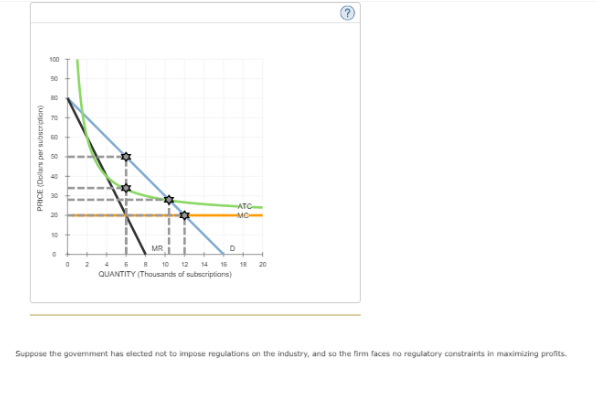
 Ce
EN
i:
i NS
Ef ae
NN
Suppor Ue government as ected nt 1 pas regulators 1 he usr, ad 0 he fm faces regulary Corrs in maining pots.
RR ——
Qnty ee
Pring Mecharism __(Susscrptions) (Dolls er subscription) prot tong Decision
Marginsi-cost pricing ~ ~ ~ ~
Aversge-con ric ~ ~ es
Suppose com a he goverment dice sree the orp est rice ed marr
J a ——
Suppose rom a he goverment dices sree the orepest ost rice es vera oa st.
PRR —
Under sergecost icin. he govern il a5 the pice of pt meer is costs creas, ad omer th ric where Gs costs
Gree Oar in, dete verges cg lc, wha wh ca crc compa mest iy 657
© Mowis cos to mess
© Work to secre scons
Ce
EN
i:
i NS
Ef ae
NN
Suppor Ue government as ected nt 1 pas regulators 1 he usr, ad 0 he fm faces regulary Corrs in maining pots.
RR ——
Qnty ee
Pring Mecharism __(Susscrptions) (Dolls er subscription) prot tong Decision
Marginsi-cost pricing ~ ~ ~ ~
Aversge-con ric ~ ~ es
Suppose com a he goverment dice sree the orp est rice ed marr
J a ——
Suppose rom a he goverment dices sree the orepest ost rice es vera oa st.
PRR —
Under sergecost icin. he govern il a5 the pice of pt meer is costs creas, ad omer th ric where Gs costs
Gree Oar in, dete verges cg lc, wha wh ca crc compa mest iy 657
© Mowis cos to mess
© Work to secre scons