 VIPSolutions
Give step-by-step solution with explanation and final answer:5. A closed, empty wood box is 5 ft x 3 ft x 2 ft and weighs 124 Ib. a. Find its moment of inertia about the x axis in slug-ft2. Use only formulas found in on the back cover of the textbook. Hint: Break the box in 3 groups: front and back panels, top and bottom panels, and side panels and treat them as thin plates. Use the ratios of their areas to determine their individual masses. b. If the box is then filled with a homogeneous material weighing 240 Ibs. (excluding the box), how much does the moment of inertia from part (a) increase? z ! Xx
Question:
Give step-by-step solution with explanation and final answer: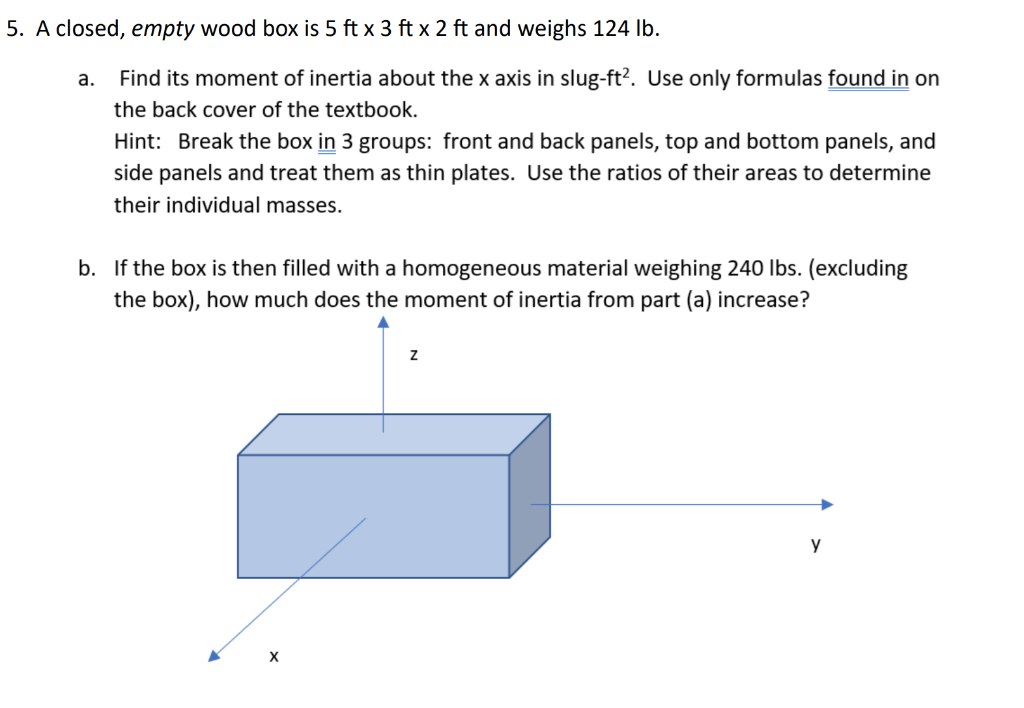 5. A closed, empty wood box is 5 ft x 3 ft x 2 ft and weighs 124 Ib.
a. Find its moment of inertia about the x axis in slug-ft2. Use only formulas found in on
the back cover of the textbook.
Hint: Break the box in 3 groups: front and back panels, top and bottom panels, and
side panels and treat them as thin plates. Use the ratios of their areas to determine
their individual masses.
b. If the box is then filled with a homogeneous material weighing 240 Ibs. (excluding
the box), how much does the moment of inertia from part (a) increase?
z
!
Xx
5. A closed, empty wood box is 5 ft x 3 ft x 2 ft and weighs 124 Ib.
a. Find its moment of inertia about the x axis in slug-ft2. Use only formulas found in on
the back cover of the textbook.
Hint: Break the box in 3 groups: front and back panels, top and bottom panels, and
side panels and treat them as thin plates. Use the ratios of their areas to determine
their individual masses.
b. If the box is then filled with a homogeneous material weighing 240 Ibs. (excluding
the box), how much does the moment of inertia from part (a) increase?
z
!
Xx
This is AI generated Response.
Asked by: VARRI APPARAO
Created at: 2025-10-25 06:06:18
Asked by: VARRI APPARAO
Created at: 2025-10-25 06:06:18
Final Answer:
Rendered
Raw Text
Did you like this answer?
Let's solve the step-by-step---
## ** Data:**
**Box dimensions 5 ft 3 ft 2 ft
- **Weight of the box:** 124 lb
- **Material when filled:** Homogeneous, weight 240 lb (excluding the box)
- **Goal:** Find the increase in moment of inertia about the x-axis when filled with the material.
---
## **Part a: Find the moment of inertia about the x-axis**
### Step 1: Break the box into parts
- The box is divided into **front and back panels**, **top and bottom panels**, and **side panels**.
- **Ratios of their areas** will help us find the **mass of each part**.
### Step 2: Calculate the **total surface area** (for ratio analysis)
- **Total surface area of the box:**
\[
A_{total} = 2(lw + lh + wh)
\]
where:
- \( l = 5\, \text{ft} \)
- \( w = 3\, \text{ft} \)
- \( h = 2\, \text{ft} \)
\[
A_{total} = 2(5 \times 3 + 5 \times 2 + 3 \times 2) = 2(15 + 10 + 6) = 2(31) = 62\, \text{sq ft}
\]
### Step 3: Determine areas of each panel
- **Front and back panels:** \( 5 \times 3 = 15\, \text{sq ft} \) each
- **Top and bottom panels:** \( 5 \times 2 = 10\, \text{sq ft} \) each
- **Side panels:** \( 3 \times 2 = 6\, \text{sq ft} \) each
### Step 4: Find the **mass of each panel** based on area ratios
- **Total mass of the panels (assuming negligible thickness):**
Since the box is hollow and weight is 124 lb, the mass ratio is proportional to their areas:
\[
\text{Mass of each panel} \propto \text{Area of the panel}
\]
- Total **panel area sum**:
\[
2 \times 15 + 2 \times 10 + 2 \times 6 = 30 + 20 + 12 = 62\, \text{sq ft}
\]
which matches the total surface area, so the **mass of each panel**:
\[
m_{panel} = \frac{\text{area of panel}}{\text{total area}} \times 124\, \text{lb}
\]
- **Front/back panels (each):**
\[
m_{FB} = \frac{15}{62} \times 124 \approx 30\, \text{lb}
\]
- **Top/bottom panels (each):**
\[
m_{TB} = \frac{10}{62} \times 124 \approx 20\, \text{lb}
\]
- **Side panels (each):**
\[
m_{SP} = \frac{6}{62} \times 124 \approx 12\, \text{lb}
\]
### Step 5: Moment of inertia about the x-axis
- The **x-axis** runs along the length \( l = 5\, \text{ft} \).
- The **moment of inertia** for each panel about the x-axis depends on its position and shape.
- Since the panels are thin plates, the **moment of inertia** of each panel is:
\[
I_{x} = \sum m_i r_i^2
\]
where \( r_i \) is the distance from the x-axis to the mass element.
- **Approximate approach:** For each panel, treat it as a thin rectangle, and calculate the moment of inertia about the x-axis considering its distance from the axis.
---
## **Part a: Final calculation of \( I_x \)**
### Step 6: Use parallel axis theorem and approximate distances
- **Front and back panels:** located at \( x = \) and \( x = 5\, \text{ft} \).
- **Top and bottom panels:** at \( z = \) and \( z = 2\, \text{ft} \).
- **Side panels:** at \( y = \) and \( y = 3\, \text{ft} \).
- For simplicity, approximate their centers and calculate their moment of inertia contributions.
### **Approximate contributions:**
- **Front panel (at \( x= \)):**
\[
I_{x,front} \approx m_{front} \times \left(\frac{w}{2}\right)^2 = 30 \times (1.5)^2 = 30 \times 2.25 = 67.5\, \text{lb·ft}^2
\]
- **Back panel (at \( x=5\, \text{ft} \)):**
\[
I_{x,back} \approx 30 \times (1.5)^2 = 67.5\, \text{lb·ft}^2
\]
- **Top panel:**
\[
I_{x,top} \approx 20 \times \left( \frac{l}{2} \right)^2 = 20 \times (2.5)^2 = 20 \times 6.25 = 125\, \text{lb·ft}^2
\]
- **Bottom panel:**
\[
I_{x,bottom} \approx 125\, \text{lb·ft}^2
\]
- **Side panels:**
\[
I_{x,side} \approx 12 \times \left( \frac{h}{2} \right)^2 = 12 \times (1)^2 = 12\, \text{lb·ft}^2
\]
(For both sides, so multiply by 2):
\[
2 \times 12 = 24\, \text{lb·ft}^2
\]
### **Total moment of inertia about x-axis:**
\[
I_{x, total} = 67.5 + 67.5 + 125 + 125 + 24 = 409\, \text{lb·ft}^2
\]
---
## **Part b: Increase in moment of inertia when filled**
### Step 7: Find the **mass of the filled material**
- **Material weight:** 240 lb (excluding the box).
- The **mass of the material**:
\[
m_{material} = \frac{240}{32.2} \approx 7.46\, \text{slugs}
\]
(Using \( g \approx 32.2\, \text{ft/sec}^2 \), or keep in lb for simplicity).
- Alternatively, for moment of inertia calculations, since we're working in lb·ft², consider the mass as 240 lb.
### Step 8: Distribution of the material
- The material fills the box uniformly.
- **Mass density:**
\[
\rho = \frac{\text{mass}}{\text{volume}} = \frac{240\, lb}{5 \times 3 \times 2} = \frac{240}{30} = 8\, lb/ft^3
\]
- **Mass of the material:**
\[
m_{material} = 240\, lb
\]
- **Moment of inertia of the filled material:**
\[
I_{x, material} = m_{material} \times \left(\text{average squared distance from x-axis}\right)
\]
- **Average squared distance:**
Since the material fills the entire box uniformly:
\[
\text{Center of mass of material} \approx \left(\frac{l}{2}, \frac{w}{2}, \frac{h}{2}\right) = (2.5, 1.5, 1)
\]
- The **distance from the x-axis** (along length):
\[
r = \text{distance from x-axis} = \text{average of } y^2 + z^2
\]
- **Average of \( y^2 \):**
\[
\left(\frac{w}{2}\right)^2 = 1.5^2 = 2.25
\]
- **Average of \( z^2 \):**
\[
\left(\frac{h}{2}\right)^2 = 1^2 = 1
\]
- Total:
\[
r_{avg}^2 = y^2 + z^2 = 2.25 + 1 = 3.25
\]
- **Moment of inertia of the filled material:**
\[
I_{x, fill} = m_{material} \times r_{avg}^2 = 240 \times 3.25 = 780\, \text{lb·ft}^2
\]
---
## **Final answer:**
### **Increase in moment of inertia:**
\[
\boxed{
\Delta I_x = I_{x, fill} \approx 780\, \text{lb·ft}^2
}
\]
**The moment of inertia about the x-axis increases by approximately 780 lb·ft² when the box is filled with the homogeneous material.**
📢 Instructions:
- Ask anything relatd to above question only.
- For new Question goto :