 VIPSolutions
Give step-by-step solution with explanation and final answer:QUESTION 2 - Breach and Reliance Ned owns a farm. At the start of the growing season, Ned plans to plant cor, and signs a contract with a local pilot, Rebeces, to cropdust the field to protect it from insects. Ned agrees to pay Rebecca § 3,000 after the cropdusting is completed. Corn is fairy resilient: Ned's crops wil be worth $33,000 i Rebecca cropdusts the field, and 527,000 if she doesnt. After signing this contract, however, Ned considers whether instead of com, he. should plant something more valuable, but more susceptible to insects: « If Ned plants wheat instead of com, his crops will be worth $45,000 if Rebecca cropdusts the field, and 515,000 if she doesn’ + If Ned plants soybeans instead of com, his crops will be worth $50,000 if Rebecca cropdusts the field, but worthless if she doesn't Rebecca i reasonably dependable, but there's always a chance that something goes wrong and she doesn't end up cropdusting Ned's field Planting wheat or soybeans are forms of reliance: they're “investments” that cost more f Rebecca breaches the contract but pays off if she performs. (a) Suppose that with probabilty two - thirds, Rebecca will be able to cropdust Ned's fields, ‘and with probably one - third she worit. What is the efficient crop for Ned to plant? Suppose that if Rebecca breaches the contract and fails to cropdust Ned's field, she will owe him expectation damages. (b) If Ned plants com; how much would he benefit from performance of the contract? How much would expectation damages be? (¢) If Ned plans wheat, how much would he benefit from performance? How much would expectation damages be? What if Ned plans soybeans? (d) Suppose that since Rebecca expected Ned to plant con, if she fails to cropdust the field, expectation damages would be limited to what Ned would have lost if he had planted corn. What crop would Ned choose to plant? ( ) Now suppose instead that whatever crop Ned plants, if Rebecca fails to cropdust the field, shell owe Ned damages to over his actual loss. What crop would he choose to plant? (1) When is i eficient for Rebecca to breach the contract? Under the rule described in (d), is Rebecca likely to breach the contract as often as is efficient, more often, or less often? What about under the rule described in (€)? (g) Under the rule described in (d), would Rebecca invest the efficient ‘amount, more than that, or less than that in maintaining her irplane propery so shel be likely to be able to perform? What about under the rule described in (€)?
Question:
Give step-by-step solution with explanation and final answer: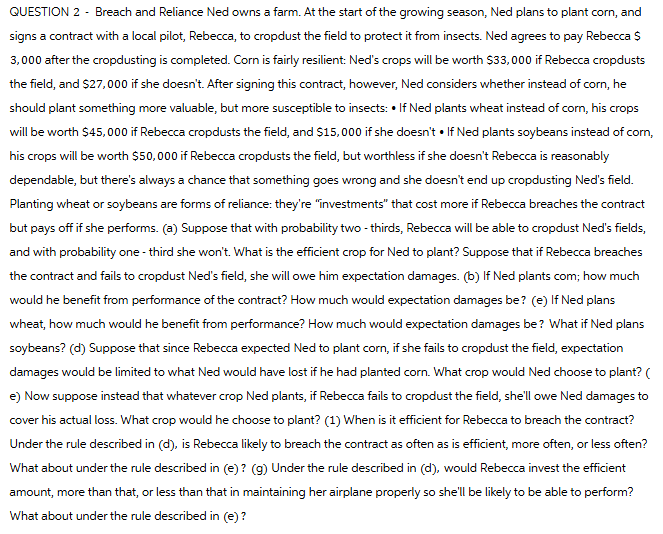 QUESTION 2 - Breach and Reliance Ned owns a farm. At the start of the growing season, Ned plans to plant cor, and
signs a contract with a local pilot, Rebeces, to cropdust the field to protect it from insects. Ned agrees to pay Rebecca §
3,000 after the cropdusting is completed. Corn is fairy resilient: Ned's crops wil be worth $33,000 i Rebecca cropdusts
the field, and 527,000 if she doesnt. After signing this contract, however, Ned considers whether instead of com, he.
should plant something more valuable, but more susceptible to insects: « If Ned plants wheat instead of com, his crops
will be worth $45,000 if Rebecca cropdusts the field, and 515,000 if she doesn’ + If Ned plants soybeans instead of com,
his crops will be worth $50,000 if Rebecca cropdusts the field, but worthless if she doesn't Rebecca i reasonably
dependable, but there's always a chance that something goes wrong and she doesn't end up cropdusting Ned's field
Planting wheat or soybeans are forms of reliance: they're “investments” that cost more f Rebecca breaches the contract
but pays off if she performs. (a) Suppose that with probabilty two - thirds, Rebecca will be able to cropdust Ned's fields,
‘and with probably one - third she worit. What is the efficient crop for Ned to plant? Suppose that if Rebecca breaches
the contract and fails to cropdust Ned's field, she will owe him expectation damages. (b) If Ned plants com; how much
would he benefit from performance of the contract? How much would expectation damages be? (¢) If Ned plans
wheat, how much would he benefit from performance? How much would expectation damages be? What if Ned plans
soybeans? (d) Suppose that since Rebecca expected Ned to plant con, if she fails to cropdust the field, expectation
damages would be limited to what Ned would have lost if he had planted corn. What crop would Ned choose to plant? (
) Now suppose instead that whatever crop Ned plants, if Rebecca fails to cropdust the field, shell owe Ned damages to
over his actual loss. What crop would he choose to plant? (1) When is i eficient for Rebecca to breach the contract?
Under the rule described in (d), is Rebecca likely to breach the contract as often as is efficient, more often, or less often?
What about under the rule described in (€)? (g) Under the rule described in (d), would Rebecca invest the efficient
‘amount, more than that, or less than that in maintaining her irplane propery so shel be likely to be able to perform?
What about under the rule described in (€)?
QUESTION 2 - Breach and Reliance Ned owns a farm. At the start of the growing season, Ned plans to plant cor, and
signs a contract with a local pilot, Rebeces, to cropdust the field to protect it from insects. Ned agrees to pay Rebecca §
3,000 after the cropdusting is completed. Corn is fairy resilient: Ned's crops wil be worth $33,000 i Rebecca cropdusts
the field, and 527,000 if she doesnt. After signing this contract, however, Ned considers whether instead of com, he.
should plant something more valuable, but more susceptible to insects: « If Ned plants wheat instead of com, his crops
will be worth $45,000 if Rebecca cropdusts the field, and 515,000 if she doesn’ + If Ned plants soybeans instead of com,
his crops will be worth $50,000 if Rebecca cropdusts the field, but worthless if she doesn't Rebecca i reasonably
dependable, but there's always a chance that something goes wrong and she doesn't end up cropdusting Ned's field
Planting wheat or soybeans are forms of reliance: they're “investments” that cost more f Rebecca breaches the contract
but pays off if she performs. (a) Suppose that with probabilty two - thirds, Rebecca will be able to cropdust Ned's fields,
‘and with probably one - third she worit. What is the efficient crop for Ned to plant? Suppose that if Rebecca breaches
the contract and fails to cropdust Ned's field, she will owe him expectation damages. (b) If Ned plants com; how much
would he benefit from performance of the contract? How much would expectation damages be? (¢) If Ned plans
wheat, how much would he benefit from performance? How much would expectation damages be? What if Ned plans
soybeans? (d) Suppose that since Rebecca expected Ned to plant con, if she fails to cropdust the field, expectation
damages would be limited to what Ned would have lost if he had planted corn. What crop would Ned choose to plant? (
) Now suppose instead that whatever crop Ned plants, if Rebecca fails to cropdust the field, shell owe Ned damages to
over his actual loss. What crop would he choose to plant? (1) When is i eficient for Rebecca to breach the contract?
Under the rule described in (d), is Rebecca likely to breach the contract as often as is efficient, more often, or less often?
What about under the rule described in (€)? (g) Under the rule described in (d), would Rebecca invest the efficient
‘amount, more than that, or less than that in maintaining her irplane propery so shel be likely to be able to perform?
What about under the rule described in (€)?
Asked by: Vikram Kumar
Created at: 2025-10-29 04:31:14
Final Answer:
Question:
Expected Value (EV) explain in 25 word,
Asked by: Vikram Kumar
Created at: 2025-10-29 04:36:16
Final Answer:
Question:
(b) If Ned Plants Corn Value with copdust: $33,000 Value without: $27,000 Benefit from performance: 33 , 000 − 33,000−27,000 = $6,000 Expectation damages if Rebecca breaches: $6,000 (c) If Ned Plants Wheat Value with copdust: $45,000 Value without: $15,000 Benefit from performance: 45 , 000 − 45,000−15,000 = $30,000 Expectation damages if Rebecca breaches: $30,000 (d) If Ned Plants Soybeans Value with copdust: $50,000 Value without: $ Benefit from performance: 50 , 000 − 50,000− = $50,000 Expectation damages if Rebecca breaches: $50,000 explanation in 50 words.
Asked by: Vikram Kumar
Created at: 2025-10-29 04:41:35
Final Answer:
Question:
(g) Under Rule in (e): Would Rebecca Invest Efficient Amount? Yes. If damages = actual loss, Rebecca internalizes the full benefit to Ned, so she will breach only if her cost exceeds the benefit—leads to efficient performance/breach. explanation in 50 words.
Asked by: Vikram Kumar
Created at: 2025-10-29 04:46:30
Final Answer:
📢 Instructions:
- Ask anything relatd to above question only.
- For new Question goto :