This is AI generated Response.
Asked by: M Murali
Created at: 2025-11-05 05:50:03
Final Answer:
RenderedRaw Text
Did you like this answer?
Let's break down solve each part step by step.
---
# **Part (a)**
**Given:**
- \( r(t) = e^{-\frac{10t}{T}}u(t) \)
- \( h_r(t) = \text{sinc}\left(\frac{\pi t}{T}\right) \)
- Find the continuous-time Fourier transform (CTFT) \(\hat{H}_r(j\Omega)\) where:
\[
\hat{H}_r(j\Omega) = H_r(j\Omega) \cdot R(j\Omega)
\]
### **Step 1: Fourier Transform of \(r(t)\)**
The Fourier transform of \( r(t) = e^{-\alpha t} u(t) \) is:
\[
R(j\Omega) = \int_{}^{\infty} e^{-\alpha t} e^{-j\Omega t} dt = \frac{1}{\alpha + j\Omega}
\]
where \( \alpha = 10/T \).
So,
\[
R(j\Omega) = \frac{1}{\frac{10}{T} + j\Omega}
\]
---
### **Step 2: Fourier Transform of \(h_r(t)\)**
The ideal reconstruction filter is:
\[
h_r(t) = \text{sinc}\left(\frac{\pi t}{T}\right)
\]
whose Fourier transform is:
\[
H_r(j\Omega) =
\begin{cases}
T, & |\Omega| \leq \frac{\pi}{T} \\
, & \text{otherwise}
\end{cases}
\]
---
### **Step 3: Combined Frequency Response**
\[
\hat{H}_r(j\Omega) = H_r(j\Omega) \cdot R(j\Omega) =
\begin{cases}
T \cdot \frac{1}{\frac{10}{T} + j\Omega}, & |\Omega| \leq \frac{\pi}{T} \\
, & \text{otherwise}
\end{cases}
\]
---
### **Step 4: Sketch \(|\hat{H}_r(j\Omega)|\)**
\[
|\hat{H}_r(j\Omega)| =
\begin{cases}
\frac{T}{\sqrt{\left(\frac{10}{T}\right)^2 + \Omega^2}}, & |\Omega| \leq \frac{\pi}{T} \\
, & \text{otherwise}
\end{cases}
\]
- This function is **maximum** at \( \Omega = \), then **decreases** as \( |\Omega| \) increases.
- It is not flat; it rolls off with frequency.
---
# **Part (b)**
### **Flat Response Requirement**
To have a flat frequency response \( |\hat{H}_r(j\Omega)| \) in \( -\frac{\pi}{T} \leq \Omega \leq \frac{\pi}{T} \):
\[
|\hat{H}_r(j\Omega)| = \text{constant}
\]
Given \( \hat{H}_r(j\Omega) = H_r(j\Omega) \cdot R(j\Omega) \), and \( H_r(j\Omega) \) is already ideal (rectangular):
- Therefore, \( R(j\Omega) \) must be **constant** (i.e., all-pass) in \( |\Omega| \leq \frac{\pi}{T} \).
### **What should \( r(t) \) be?**
The only signal whose Fourier transform is a constant (over all frequencies) is the **impulse**:
\[
r(t) = \delta(t)
\]
### **Corresponding Frequency Response**
\[
R(j\Omega) = 1
\]
### **Corresponding \( h_r(t) \)?**
\[
h_r(t) = \text{sinc}\left(\frac{\pi t}{T}\right)
\]
---
# **Part (c)**
### **Goal:**
Insert a filter \( h_d[n] \) in the discrete domain to **compensate** for the non-flatness of \( R(j\Omega) \).
### **Method:**
You want the overall system (including the discrete-time filter) to be flat in \( |\Omega| \leq \frac{\pi}{T} \).
Let \( H_d(e^{j\omega}) \) be the **DTFT** of \( h_d[n] \).
- CTFT: \( \Omega \)
- DTFT: \( \omega = \Omega T \)
#### The overall frequency response should be flat:
\[
H_d(e^{j\omega}) \cdot R(j\Omega) = 1, \quad (|\omega| \leq \pi)
\]
\[
H_d(e^{j\omega}) = \frac{1}{R(j\Omega)} = \frac{1}{R(j\omega/T)}
\]
Recall:
\[
R(j\Omega) = \frac{1}{\frac{10}{T} + j\Omega}
\]
So,
\[
H_d(e^{j\omega}) = \frac{10/T + j\omega/T}{1} = 10/T + j\omega/T
\]
This is the frequency response.
### **Find \( h_d[n] \):**
\( H_d(e^{j\omega}) = 10/T + j(\omega/T) \)
- The first term, \( 10/T \), is a scaled impulse.
- The second term, \( j\omega/T \), corresponds (by DTFT property) to the differentiation in time, i.e., the sequence \( n \).
But to be exact: the inverse DTFT of \( j\omega \) is \( n \) times a delta function, but since this is a linear function of \( \omega \), it suggests a **differentiator**.
**So:**
\[
h_d[n] = \frac{10}{T}\delta[n] + \frac{1}{T}\cdot d[n]
\]
Where \( d[n] \) is the impulse response of the discrete-time differentiator. For practical purposes, this can be approximated by \( d[n] = \delta[n] - \delta[n-1] \), or ideally, a better approximation of the differentiator in discrete time.
---
## **Summary of Answers**
### **(a)**
\[
\hat{H}_r(j\Omega) =
\begin{cases}
\frac{T}{\frac{10}{T} + j\Omega}, & |\Omega| \leq \frac{\pi}{T} \\
, & \text{otherwise}
\end{cases}
\]
### **(b)**
To be flat, \( R(j\Omega) = 1 \), so \( r(t) = \delta(t) \).
### **(c)**
\[
H_d(e^{j\omega}) = 10/T + j\omega/T
\]
Thus,
\[
h_d[n] = \frac{10}{T}\delta[n] + \frac{1}{T}d[n]
\]
where \( d[n] \) is the discrete-time differentiator (impulse response).
---
## **Final Answers**
1. **(a)** \( |\hat{H}_r(j\Omega)| = \frac{T}{\sqrt{(10/T)^2+\Omega^2}} \), which is not flat—sketch as a lowpass-like curve.
2. **(b)** \( r(t) = \delta(t) \) (impulse), so \( R(j\Omega) = 1 \).
3. **(c)** Use a discrete-time filter \( h_d[n] \) with frequency response \( H_d(e^{j\omega}) = 10/T + j\omega/T \), i.e., combine a scaled impulse and a differentiator.
Question:
Give me Each Step 50 Words Explaines Only Theory
This is AI generated Response.
Asked by: M Murali
Created at: 2025-11-05 05:50:45
Final Answer:
RenderedRaw Text
Did you like this answer?
# **Part (a) Theory**
The Fourier transform of a signal describes its frequency components. For \( r(t) = e^{-\frac{10t}{T}}u(t) \), the CTFT is derived using integration. The ideal reconstruction filter \( h_r(t) = \text{sinc}\left(\frac{\pi t}{T}\right) \) has a rectangular frequency response. Their product gives insight into the combined system behavior in frequency.
---
# **Part (b) Theory**
To achieve a flat frequency response in the desired range, the Fourier transform \( R(j\Omega) \) should be constant (i.e., all-pass). The only signal with this property is the impulse function \( \delta(t) \), which has a constant FT of 1. Thus, the ideal \( h_r(t) \) remains unchanged.
---
# **Part (c) Theory**
Inserting a filter \( h_d[n] \) in the discrete domain can compensate for non-flatness in the frequency response. The desired flat frequency response can be achieved by ensuring \( H_d(e^{j\omega}) \cdot R(j\Omega) = 1 \). This requires combining a constant and a differentiator in the discrete domain representation of the filter.
VIPSolutions focuses on clear, step‑by‑step explanations so you can learn quickly. Whether you need an AI‑generated walkthrough or a short hint to get unstuck, each solution is organized for fast reading and easy review later.
Search similar questions, compare approaches, and bookmark the best answers for revision. Our goal is simple: quick, reliable study help that feels natural—not noisy.
 VIPSolutions
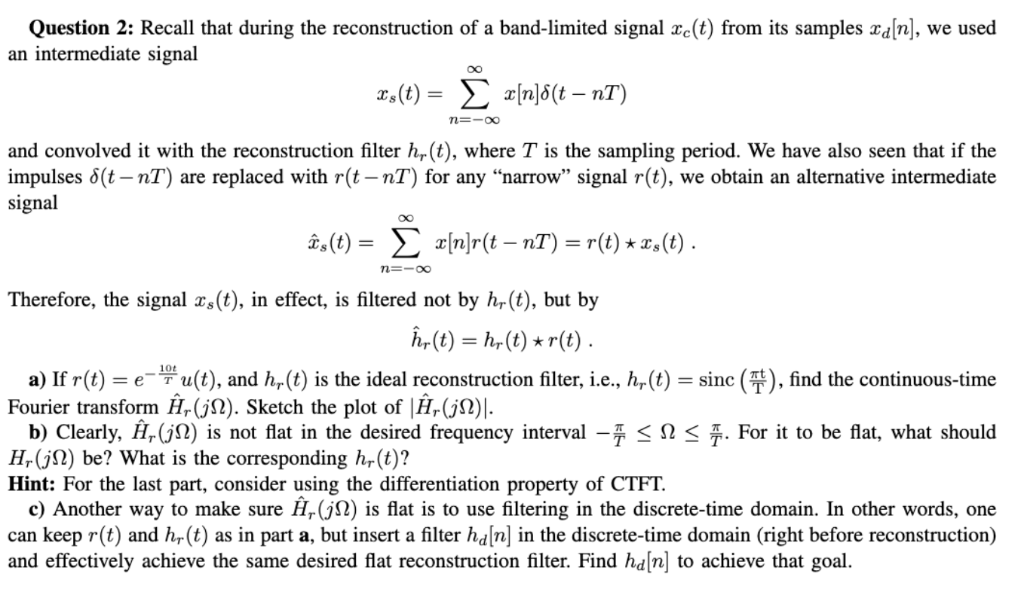 Question 2: Recall that during the reconstruction of a band-limited signal z(t) from its samples z4[n], we used
an intermediate signal
0
z(t) = Y_ a[n]d(t— nT)
n=—o0
and convolved it with the reconstruction filter h(t), where T' is the sampling period. We have also seen that if the
impulses &(t — nT’) are replaced with 7(t — nT) for any “narrow” signal r(t), we obtain an alternative intermediate
signal
oo
z(t) = Y alnlr(t— nT) =r(t) xz,(t) .
n=—o00
Therefore, the signal z(t), in effect, is filtered not by h(t), but by
he(t) = ho(t) x 7(t)
a) If (t) = e~ 7 u(t), and h(t) is the ideal reconstruction filter, i.c., h(t) = sinc (7+), find the continuous-time
Fourier transform H;(jQ2). Sketch the plot of |H,(j$)|.
b) Clearly, H,(j€) is not flat in the desired frequency interval —7 < Q < Z. For it to be flat, what should
H,(j) be? What is the corresponding h(t)?
Hint: For the last part, consider using the differentiation property of CTFT.
©) Another way to make sure HH, (jf) is flat is to use filtering in the discrete-time domain. In other words, one
can keep 7(t) and h,(t) as in part a, but insert a filter h4[n] in the discrete-time domain (right before reconstruction)
and effectively achieve the same desired flat reconstruction filter. Find ha[n] to achieve that goal.
Question 2: Recall that during the reconstruction of a band-limited signal z(t) from its samples z4[n], we used
an intermediate signal
0
z(t) = Y_ a[n]d(t— nT)
n=—o0
and convolved it with the reconstruction filter h(t), where T' is the sampling period. We have also seen that if the
impulses &(t — nT’) are replaced with 7(t — nT) for any “narrow” signal r(t), we obtain an alternative intermediate
signal
oo
z(t) = Y alnlr(t— nT) =r(t) xz,(t) .
n=—o00
Therefore, the signal z(t), in effect, is filtered not by h(t), but by
he(t) = ho(t) x 7(t)
a) If (t) = e~ 7 u(t), and h(t) is the ideal reconstruction filter, i.c., h(t) = sinc (7+), find the continuous-time
Fourier transform H;(jQ2). Sketch the plot of |H,(j$)|.
b) Clearly, H,(j€) is not flat in the desired frequency interval —7 < Q < Z. For it to be flat, what should
H,(j) be? What is the corresponding h(t)?
Hint: For the last part, consider using the differentiation property of CTFT.
©) Another way to make sure HH, (jf) is flat is to use filtering in the discrete-time domain. In other words, one
can keep 7(t) and h,(t) as in part a, but insert a filter h4[n] in the discrete-time domain (right before reconstruction)
and effectively achieve the same desired flat reconstruction filter. Find ha[n] to achieve that goal.