Give step-by-step solution with explanation and final answer:
1
.
Welfare effects of free trade in an exporting country The following problem analyzes the French market for radishes. The graph below shows the domestic supply and demand curves for radishes in France. Assume that France's government does not currently permit international trade in radishes. Use the black point
(
plus symbol
)
to denote the equilibrium price of one ton of radishes and the equilibrium quantity of radishes in France without international trade. Next, use the green triangle
(
triangle symbol
)
to shade in the area that represents consumer surplus in equilibrium. Finally, use the purple triangle
(
diamond symbol
)
to shade in the area that represents producer surplus in equilibrium. Based on the information from the previous graph, absent international trade total surplus is dash dollars. Question
2
.
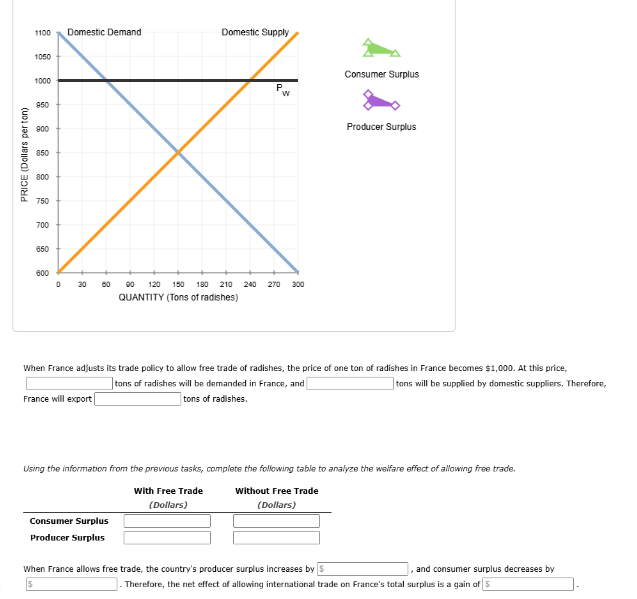
The following graph shows the same domestic supply and demand curves for radishes in France. Now, suppose that the French government changes its stance on international trade, deciding to allow free trade in radishes. The horizontal black line
(
PW
)
represents the world price of radishes at $
1
,
0
0
0
per ton. Assume that France's entry into the world market for radishes has no effect on the world price and there are no transportation or transaction costs associated with international trade in radishes. Also assume that domestic suppliers will satisfy domestic demand as much as possible before any exporting or importing takes place.
Use the green triangle
(
triangle symbol
)
to shade in the area representing consumer surplus, and then use the purple triangle
(
diamond symbol
)
to shade in the area representing producer surplus.
(
?
)
Consumer Surplus
Producer Surplus When France adjusts its trade policy to allow free trade of radishes, the price of one ton of radishes in France becomes
\
(
\
$
1
,
0
0
0
\
)
.
At this price, tons of radishes will be demanded in France, and tons will be supplied by domestic suppliers. Therefore,
France will export tons of radishes.
Using the information from the previous tasks, complete the following table to analyze the welfare effect of allowing free trade.
When France allows free trade, the country's producer surplus increases by
,
and consumer surplus decreases by
.
Therefore, the net effect of allowing international trade on France's total surplus is a gain ofI —— [—
wo hi
[E—
fa f—
gw oar sus
[rR
aed on the formation fo th rvs rsh, abn radon ade tal sus sf].
[R— f—
- Comms
[ =
Fo Proscar Suge
cu os hans
ne Fret i a oy owe de de, ike ae of shes Foc eames 5.0. isk,
I [plo [rr
ore —
sah tate tres sk, ots lon bl st raft lon onc.
[RO
prion prio
Er ———]
eo el —
hn Fre los ee. es snes ET, ind crass ess
; tr, tr el shri rar 1 For at i
Question:
Give step-by-step solution with explanation and final answer:
1
.
Welfare effects of free trade in an exporting country The following problem analyzes the French market for radishes. The graph below shows the domestic supply and demand curves for radishes in France. Assume that France's government does not currently permit international trade in radishes. Use the black point
(
plus symbol
)
to denote the equilibrium price of one ton of radishes and the equilibrium quantity of radishes in France without international trade. Next, use the green triangle
(
triangle symbol
)
to shade in the area that represents consumer surplus in equilibrium. Finally, use the purple triangle
(
diamond symbol
)
to shade in the area that represents producer surplus in equilibrium. Based on the information from the previous graph, absent international trade total surplus is dash dollars. Question
2
.
The following graph shows the same domestic supply and demand curves for radishes in France. Now, suppose that the French government changes its stance on international trade, deciding to allow free trade in radishes. The horizontal black line
(
PW
)
represents the world price of radishes at $
1
,
0
0
0
per ton. Assume that France's entry into the world market for radishes has no effect on the world price and there are no transportation or transaction costs associated with international trade in radishes. Also assume that domestic suppliers will satisfy domestic demand as much as possible before any exporting or importing takes place.
Use the green triangle
(
triangle symbol
)
to shade in the area representing consumer surplus, and then use the purple triangle
(
diamond symbol
)
to shade in the area representing producer surplus.
(
?
)
Consumer Surplus
Producer Surplus When France adjusts its trade policy to allow free trade of radishes, the price of one ton of radishes in France becomes
\
(
\
$
1
,
0
0
0
\
)
.
At this price, tons of radishes will be demanded in France, and tons will be supplied by domestic suppliers. Therefore,
France will export tons of radishes.
Using the information from the previous tasks, complete the following table to analyze the welfare effect of allowing free trade.
When France allows free trade, the country's producer surplus increases by
,
and consumer surplus decreases by
.
Therefore, the net effect of allowing international trade on France's total surplus is a gain ofI —— [—
wo hi
[E—
fa f—
gw oar sus
[rR
aed on the formation fo th rvs rsh, abn radon ade tal sus sf].
[R— f—
- Comms
[ =
Fo Proscar Suge
cu os hans
ne Fret i a oy owe de de, ike ae of shes Foc eames 5.0. isk,
I [plo [rr
ore —
sah tate tres sk, ots lon bl st raft lon onc.
[RO
prion prio
Er ———]
eo el —
hn Fre los ee. es snes ET, ind crass ess
; tr, tr el shri rar 1 For at i
This is AI generated Response.
Asked by: Vikram Kumar
Created at: 2025-11-15 02:35:04
Thought Process:
RenderedRaw Text
**Calculating surplus in autarky and trade**
I start by calculating the price, which comes out to P = 850. Then, I determine the consumer surplus in autarky by finding the area of the triangle between the demand curve and that price down to a quantity of 150. The area results in 18,750 for both consumer and producer surpluses, giving a total surplus of 37,500. Moving to free trade with a world price of 1,000, France will likely export since the world price exceeds the autarky price. I need to analyze the demand at this new price.**Calculating domestic demand and surplus with trade**
So, I've calculated domestic demand at a price of 1,000, where Qd turns out to be 60 tons. For supply at that price, Qs comes out to 240 tons, leading to exports of 180 tons.
Next, I determine consumer surplus with trade, which is the area between the demand curve and price 1,000 up to Q=60, resulting in a consumer surplus of 3,000. The producer surplus is found from the area between price 1,000 and the supply curve up to Q=240, giving a producer surplus of 48,000. Thus, the total surplus with trade is 51,000.**Calculating gains from trade**
I start by checking the pre-trade surplus, which is 37,500. The gains from trade amount to 13,500. When looking at changes, producer surplus increases by 29,250 (from 48,000 to 18,750). However, consumer surplus decreases by 15,750 (from 18,750 to 3,000). Net gain equals 13,500, which I recognize represents the area of two triangles eliminating deadweight loss.
Next, I analyze the areas representing gains, noting the wedge between 850 and 1,000 across the quantities involved, leading me to 13,500. I’ll ensure to present a detailed, step-by-step explanation for clarity.**Filling in trade surplus details**
The first question asks for the total surplus absent international trade, which is 37,500. For the second question, I have the following numbers:
With free trade, consumer surplus (CS) is 3,000, while without it, CS is 18,750. Producer surplus (PS) with free trade stands at 48,000, compared to 18,750 without trade.
When France allows free trade, the price adjusts to 1,000, leading to a demand of 60 tons and a supply of 240 tons domestically. Thus, France will export 180 tons. I'll confirm the consistency of these numbers, and it seems that everything checks out. I’ll also provide a step-by-step explanation and the necessary formulas.**Preparing final response on trade**
First, I’ll recover the supply and demand equations from the graph intercepts: Supply is P = 600 + (5/3)Q, and Demand is P = 1100 - (5/3)Q. To find the equilibrium, I get Q* = 150 and P* = 850.
The consumer surplus in autarky is calculated as 18,750, and producer surplus is also 18,750, resulting in a total of 37,500.
When moving to free trade at a price of 1,000, domestic demand is 60 tons, supply is 240 tons, leading to exports of 180 tons. The consumer surplus in free trade is 3,000, while producer surplus increases to 48,000. In total, the net change is +13,500.
I’ll present these values with bullet points for clarity, ensuring no heavy formatting. Also, I’ll emphasize that the world price line crosses the axis at 1,000, marking consumption at 60 tons. That way, everything is clear and organized!
Final Answer:
RenderedRaw Text
Did you like this answer?
Step 1: Read the market curves from the graph
- Domestic demand goes from (Q=0, P=1100) to (Q=300, P=600): P = 1100 − (5/3)Q
- Domestic supply goes from (Q=0, P=600) to (Q=300, P=1100): P = 600 + (5/3)Q
Autarky (no trade)
- Equilibrium: set demand = supply
600 + (5/3)Q = 1100 − (5/3)Q → (10/3)Q = 500 → Q* = 150
P* = 600 + (5/3)(150) = 600 + 250 = 850
- Consumer surplus (triangle under demand above P* from Q=0 to 150):
CS_aut = 1/2 × 150 × (1100 − 850) = 1/2 × 150 × 250 = 18,750
- Producer surplus (triangle above supply below P* from Q=0 to 150):
PS_aut = 1/2 × 150 × (850 − 600) = 18,750
- Total surplus without trade:
TS_aut = 18,750 + 18,750 = 37,500
Answer to Question 1:
Based on the information from the previous graph, absent international trade total surplus is $37,500.
Step 2: Allow free trade with world price Pw = $1,000 (France is a potential exporter because Pw > P_aut)
- Quantity demanded at Pw:
1000 = 1100 − (5/3)Qd → (5/3)Qd = 100 → Qd = 60
- Quantity supplied at Pw:
1000 = 600 + (5/3)Qs → (5/3)Qs = 400 → Qs = 240
- Exports: Qs − Qd = 240 − 60 = 180 tons
Surpluses with free trade
- Consumer surplus:
CS_free = 1/2 × 60 × (1100 − 1000) = 1/2 × 60 × 100 = 3,000
- Producer surplus:
PS_free = 1/2 × 240 × (1000 − 600) = 1/2 × 240 × 400 = 48,000
- Total surplus with free trade:
TS_free = 3,000 + 48,000 = 51,000
Changes in surplus (exporting case)
- Producer surplus increases by: 48,000 − 18,750 = 29,250
- Consumer surplus decreases by: 18,750 − 3,000 = 15,750
- Net gain in total surplus: 51,000 − 37,500 = 13,500
Answers to Question 2:
- Consumer surplus with free trade: $3,000
- Producer surplus with free trade: $48,000
- Consumer surplus without free trade: $18,750
- Producer surplus without free trade: $18,750
- Price with free trade: $1,000
- Quantity demanded at $1,000: 60 tons
- Quantity supplied at $1,000: 240 tons
- Exports: 180 tons
- Producer surplus increases by $29,250, consumer surplus decreases by $15,750
- Net effect on total surplus: gain of $13,500
Final answers summarized:
- Autarky total surplus: $37,500
- With free trade: Qd = 60, Qs = 240, exports = 180
- CS_free = $3,000; PS_free = $48,000
- ΔPS = +$29,250; ΔCS = −$15,750; Net gain = +$13,500
Question:
Final answer each quetion
This is AI generated Response.
Asked by: Vikram Kumar
Created at: 2025-11-15 02:56:05
Final Answer:
RenderedRaw Text
Did you like this answer?
# Final Answers
## Question 1
Absence of international trade total surplus is **$37,500**.
## Question 2
- Price with free trade: **$1,000**
- Quantity demanded at $1,000: **60 tons**
- Quantity supplied at $1,000: **240 tons**
- Exports: **180 tons**
- Consumer surplus with free trade: **$3,000**
- Producer surplus with free trade: **$48,000**
- Producer surplus increases by: **$29,250**
- Consumer surplus decreases by: **$15,750**
- Net effect on total surplus: **gain of $13,500**.
Question:
Answer each question step by step along with explanation.
This is AI generated Response.
Asked by: Vikram Kumar
Created at: 2025-11-15 03:00:00
VIPSolutions focuses on clear, step‑by‑step explanations so you can learn quickly. Whether you need an AI‑generated walkthrough or a short hint to get unstuck, each solution is organized for fast reading and easy review later.
Search similar questions, compare approaches, and bookmark the best answers for revision. Our goal is simple: quick, reliable study help that feels natural—not noisy.
 VIPSolutions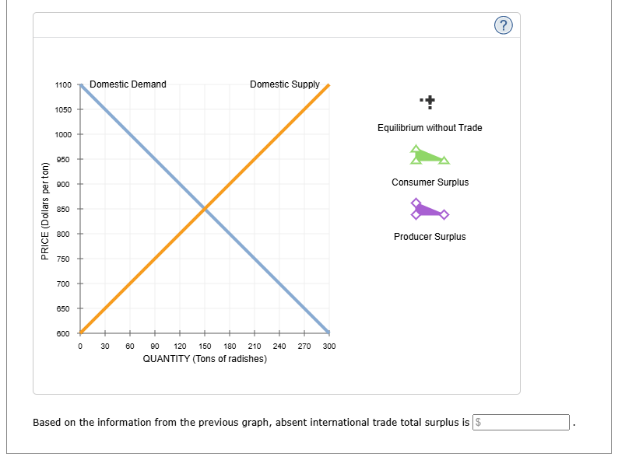
 I —— [—
wo hi
[E—
fa f—
gw oar sus
[rR
aed on the formation fo th rvs rsh, abn radon ade tal sus sf].
[R— f—
- Comms
[ =
Fo Proscar Suge
cu os hans
ne Fret i a oy owe de de, ike ae of shes Foc eames 5.0. isk,
I [plo [rr
ore —
sah tate tres sk, ots lon bl st raft lon onc.
[RO
prion prio
Er ———]
eo el —
hn Fre los ee. es snes ET, ind crass ess
; tr, tr el shri rar 1 For at i
I —— [—
wo hi
[E—
fa f—
gw oar sus
[rR
aed on the formation fo th rvs rsh, abn radon ade tal sus sf].
[R— f—
- Comms
[ =
Fo Proscar Suge
cu os hans
ne Fret i a oy owe de de, ike ae of shes Foc eames 5.0. isk,
I [plo [rr
ore —
sah tate tres sk, ots lon bl st raft lon onc.
[RO
prion prio
Er ———]
eo el —
hn Fre los ee. es snes ET, ind crass ess
; tr, tr el shri rar 1 For at i