 VIPSolutions
give the calculation step by step as like as full answer in 2 steps and explanation block in every steps. And final answer summary Definition of Parameters Solutions are reviewed by our quality team mainly based on 6 parameters: Relevancy, Completeness, Accuracy, Clarity, Structure, and Voice. Relevancy: This indicates how closely a solution aligns with the question asked. It evaluates whether the solution addresses the core aspects of the question and provides appropriate information. Completeness: This indicates how thoroughly the solution addresses various asks in the question. It evaluates whether the solution has all essential information like calculations, diagrams, procedural steps, & explanatory statements in the solution. Accuracy: It refers to how correct the provided solution is for the given question/s. This evaluates the correctness of the information/concept/method followed in the solution. Clarity: Clarity refers to how easily the solution can be understood by the student. This evaluates the language complexity, readability, and redundancy of a solution. Structure: Structure refers to how the solution is organized and presented in relation to the requirements of the question. This evaluates the necessity of steps and their effectiveness in helping the student grasp how to arrive at the solution. Voice: This refers to the language and tone of the solution. This primarily evaluates whether a solution sounds human or overly non-human (bot-like). don't use we, then,:.Kyle lays a mirror flat on the floor and aims a laser at the mirror. The laser beam reflects off the mirror and strikes an adjacent wall. The plane of the incident and reflected beams is perpendicular to the wall. The beam from the laser strikes the mirror at a distance a = 31.3 cm from the wall. The reflected beam strikes the wall at a height 5 = 38.5 cm above the surface of the mirror. Determine the angle of incidence ; at which the laser beam strikes the mirror.
Question:
give the calculation step by step as like as full answer in 2 steps and explanation block in every steps.
And final answer summary
Definition of Parameters
Solutions are reviewed by our quality team mainly based on 6 parameters: Relevancy, Completeness, Accuracy, Clarity, Structure, and Voice.
Relevancy: This indicates how closely a solution aligns with the question asked. It evaluates whether the solution addresses the core aspects of the question and provides appropriate information.
Completeness: This indicates how thoroughly the solution addresses various asks in the question. It evaluates whether the solution has all essential information like calculations, diagrams, procedural steps, & explanatory statements in the solution.
Accuracy: It refers to how correct the provided solution is for the given question/s. This evaluates the correctness of the information/concept/method followed in the solution.
Clarity: Clarity refers to how easily the solution can be understood by the student. This evaluates the language complexity, readability, and redundancy of a solution.
Structure: Structure refers to how the solution is organized and presented in relation to the requirements of the question. This evaluates the necessity of steps and their effectiveness in helping the student grasp how to arrive at the solution.
Voice: This refers to the language and tone of the solution. This primarily evaluates whether a solution sounds human or overly non-human (bot-like).
don't use we, then,:.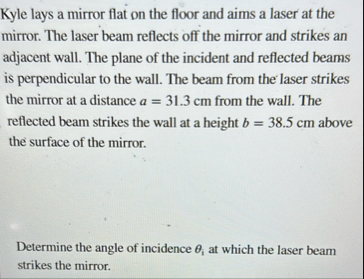 Kyle lays a mirror flat on the floor and aims a laser at the
mirror. The laser beam reflects off the mirror and strikes an
adjacent wall. The plane of the incident and reflected beams
is perpendicular to the wall. The beam from the laser strikes
the mirror at a distance a = 31.3 cm from the wall. The
reflected beam strikes the wall at a height 5 = 38.5 cm above
the surface of the mirror.
Determine the angle of incidence ; at which the laser beam
strikes the mirror.
Kyle lays a mirror flat on the floor and aims a laser at the
mirror. The laser beam reflects off the mirror and strikes an
adjacent wall. The plane of the incident and reflected beams
is perpendicular to the wall. The beam from the laser strikes
the mirror at a distance a = 31.3 cm from the wall. The
reflected beam strikes the wall at a height 5 = 38.5 cm above
the surface of the mirror.
Determine the angle of incidence ; at which the laser beam
strikes the mirror.
Asked by: sai
Created at: 2025-07-04 00:14:54
Final Answer:
📢 Instructions:
- Ask anything relatd to above question only.
- For new Question goto :