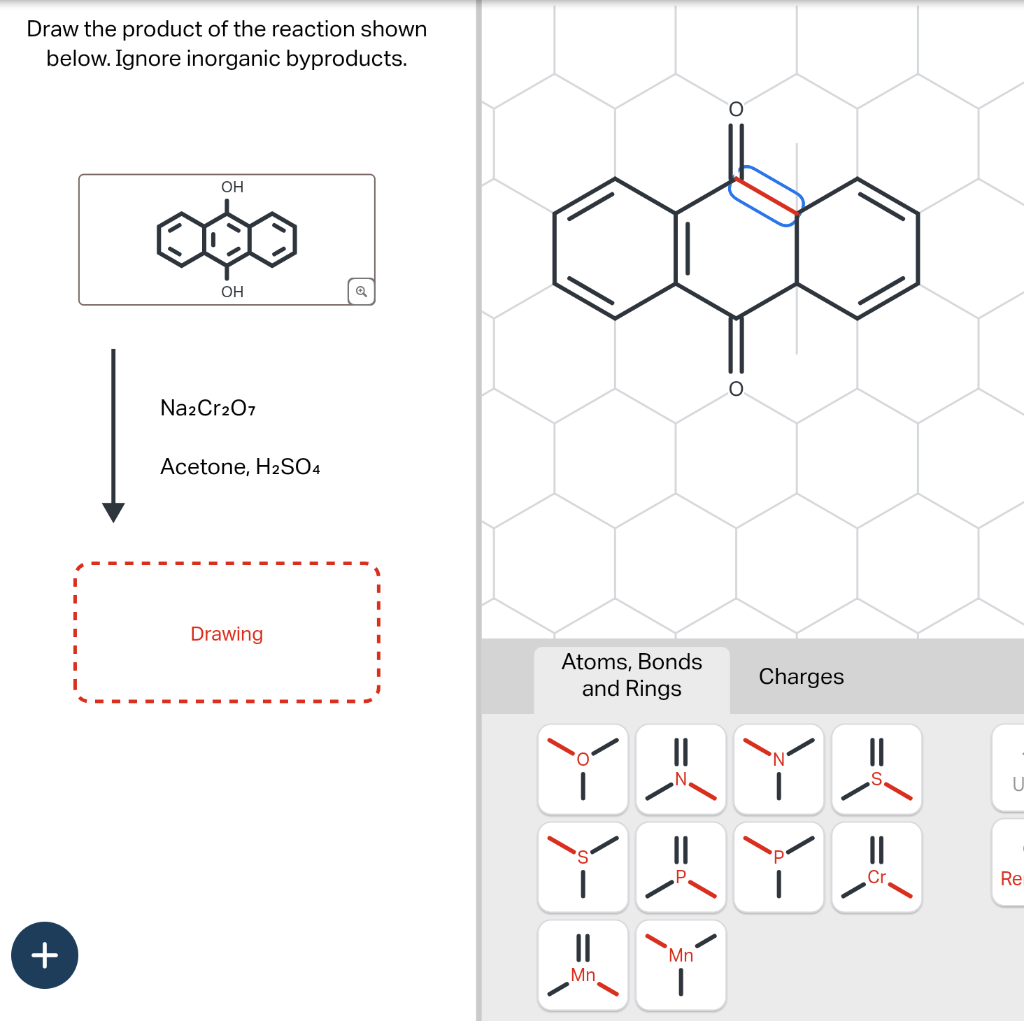
Act like a helpful tutor and exlain me :Draw the product of the reaction shown
below. Ignore inorganic byproducts.
[e)
OH
[e]
Na2Cr207
Acetone, H2S04
PY
' ]
' '
' '
H Drawing '
fH H Atoms, Bonds
a and Rings Charges
I | I i |
N S
I NI BPN u
NA |
De NE EPSON Re
nn Sw”
Mn, |
ZN
Question:
Act like a helpful tutor and exlain me :Draw the product of the reaction shown
below. Ignore inorganic byproducts.
[e)
OH
[e]
Na2Cr207
Acetone, H2S04
PY
' ]
' '
' '
H Drawing '
fH H Atoms, Bonds
a and Rings Charges
I | I i |
N S
I NI BPN u
NA |
De NE EPSON Re
nn Sw”
Mn, |
ZN
This is AI generated Response.
Asked by: Alok Kumar
Created at: 2026-02-01 04:33:40
Final Answer:
RenderedRaw Text
Did you like this answer?
## Explanation of the Reaction
Let's break down what is happening step by step:
### 1. **Reactant Identification**
The starting molecule is **1,2-dihydroxyanthracene** (also known as anthracene-1,2-diol).
- It has two hydroxyl (-OH) groups attached to adjacent carbons on the anthracene ring system.
### 2. **Reagents**
- **Na₂Cr₂O₇** (sodium dichromate) in **acidic solution (H₂SO₄)** is a **strong oxidizing agent**.
- The solvent is **acetone**, which doesn't interfere with the oxidation.
### 3. **Type of Reaction**
- **Oxidation of Diols:** Sodium dichromate will **oxidize both hydroxyl groups (-OH)** to carbonyl groups (=O).
- In aromatic diols (like this), both -OH groups on adjacent carbons are oxidized to **ketones** (C=O), and if possible, a quinone structure is formed.
### 4. **Product**
- The product is **anthraquinone** (specifically, 1,2-anthraquinone).
- Both -OH groups are converted to **C=O** groups on the aromatic ring.
### 5. **Structure Check**
- The image on the right shows a molecule where two ketone (=O) groups are attached to the anthracene ring at the same positions where the -OH groups were originally located.
- This is correct! The product is a **quinone** structure.
---
## **Summary Table**
| Step | What Happens? |
|---------------------|---------------------------------------------------|
| Starting material | 1,2-dihydroxyanthracene (anthracene-1,2-diol) |
| Reagent | Na₂Cr₂O₇, H₂SO₄ (strong oxidizer) |
| Reaction | Oxidation of both -OH groups to =O |
| Product | 1,2-anthraquinone (quinone structure) |
---
## **Why This Happens**
- **Na₂Cr₂O₇/H₂SO₄** is a strong oxidizer, and in aromatic systems, it often converts diols to quinones.
- The aromaticity is restored after oxidation, stabilizing the product.
---
## **Visual Explanation**
- **Left:** Anthracene ring with two -OH groups (adjacent)
- **Right (Product):** Anthracene ring with two =O groups (adjacent; forming a quinone)
---
**In summary:**
The reaction converts 1,2-dihydroxyanthracene to 1,2-anthraquinone by oxidizing the hydroxyl groups to ketones (C=O), using sodium dichromate and acid.
If you have any more questions or want to see the stepwise mechanism, let me know!
Question:
How is boiling point affected by elevation?
A distillate was collected between
7
8
-
8
2
°
C
at sea level. The reported boiling point was
8
0
°
C
.
Comment on the correctness of this report.
Explain the effects of polarity of molecules on boiling point.
The normal boiling point of toluene
(
at
7
6
0
torr
)
is
1
1
0
°
C
.
Use the boiling point nomograph
(
Figure ID
-
1
)
to determine the boiling point of toluene at
6
0
0
torr.
A liquid boils at
1
0
2
°
C
in a lab in Colorado Springs, where the ambient pressure is
6
0
0
torr. What is the corrected boiling point of the liquid?
This is AI generated Response.
Asked by: Alok Kumar
Created at: 2026-02-04 05:50:55
Final Answer:
RenderedRaw Text
Did you like this answer?
# Boiling Point and Elevation Effects
## 1. **Boiling Point at Different Elevations**
- **Effect of Elevation**: As elevation increases, atmospheric pressure decreases, resulting in a lower boiling point for liquids.
- **Example**: At sea level (760 torr), water boils at 100°C. In higher elevations, water will boil at a temperature lower than 100°C.
## 2. **Assessment of Distillation Report**
- **Reported Temperature**: A distillate was collected between 78-82°C with a reported boiling point of 80°C.
- **Comment on Correctness**:
- If this report was made at sea level, it seems reasonable since the boiling point is within the collected range.
- If made at higher elevation (lower pressure), the boiling point would be lower, making the report potentially inaccurate.
## 3. **Effects of Polarity on Boiling Point**
- **Polarity and Boiling Point**:
- Polar molecules generally have higher boiling points than non-polar molecules due to stronger intermolecular forces (like hydrogen bonding and dipole-dipole interactions).
- Non-polar molecules interact primarily through London dispersion forces, which are weaker.
## 4. **Boiling Point of Toluene at 600 Torr**
- **Normal Boiling Point of Toluene**: 110°C at 760 torr.
- **Using a Nomograph**:
- It typically shows that the boiling point decreases as pressure decreases.
- At 600 torr, the boiling point of toluene can be estimated to be approximately **95°C**.
## 5. **Corrected Boiling Point of a Liquid at 600 Torr**
- **Observed Boiling Point**: 102°C at 600 torr.
- **Corrected Boiling Point**: To determine the corrected boiling point at standard pressure (760 torr), you would typically:
- Compare the boiling points at the two pressures.
- For a more precise correction, you may use a boiling point elevation equation or a graph/nomograph.
- **Conclusion**: The boiling point at 760 torr would be higher than observed, indicating that 102°C is indeed lower than the standard boiling point.
---
## **Summary**
- Boiling point decreases with elevation due to lower pressure.
- The correctness of boiling point reports depends on the measurement conditions (elevation).
- Polarity influences boiling points, with polar molecules having higher boiling points.
- The boiling point of toluene decreases at lower pressures, and corrections can be made for observed boiling points at different pressures.
VIPSolutions focuses on clear, step‑by‑step explanations so you can learn quickly. Whether you need an AI‑generated walkthrough or a short hint to get unstuck, each solution is organized for fast reading and easy review later.
Search similar questions, compare approaches, and bookmark the best answers for revision. Our goal is simple: quick, reliable study help that feels natural—not noisy.
 VIPSolutions
 Draw the product of the reaction shown
below. Ignore inorganic byproducts.
[e)
OH
[e]
Na2Cr207
Acetone, H2S04
PY
' ]
' '
' '
H Drawing '
fH H Atoms, Bonds
a and Rings Charges
I | I i |
N S
I NI BPN u
NA |
De NE EPSON Re
nn Sw”
Mn, |
ZN
Draw the product of the reaction shown
below. Ignore inorganic byproducts.
[e)
OH
[e]
Na2Cr207
Acetone, H2S04
PY
' ]
' '
' '
H Drawing '
fH H Atoms, Bonds
a and Rings Charges
I | I i |
N S
I NI BPN u
NA |
De NE EPSON Re
nn Sw”
Mn, |
ZN