 VIPSolutions
Give step-by-step solution with explanation and final answer:3. For each of the following functions, determine if the function is an injection and determine if the function is a surjection. Justify all conclusions. * (a) f:Z — Z defined by f(x) = 3x + 1, forall x €Z. * (b) F:Q — Q defined by F(x) =3x + 1, forall x € Q. 3 (¢) g:R — R defined by g(x) = x3, forall x € R. (@) G:Q — Q defined by G(x) = x3 forall x € Go (e) k:R — R defined by k(x) =e’, forall x € R.
Question:
Give step-by-step solution with explanation and final answer: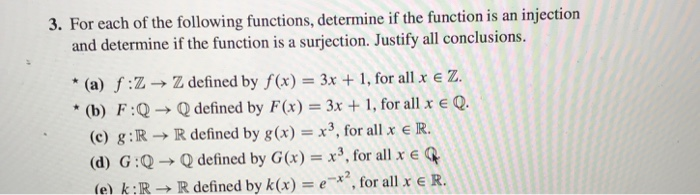 3. For each of the following functions, determine if the function is an injection
and determine if the function is a surjection. Justify all conclusions.
* (a) f:Z — Z defined by f(x) = 3x + 1, forall x €Z.
* (b) F:Q — Q defined by F(x) =3x + 1, forall x € Q.
3 (¢) g:R — R defined by g(x) = x3, forall x € R.
(@) G:Q — Q defined by G(x) = x3 forall x € Go
(e) k:R — R defined by k(x) =e’, forall x € R.
3. For each of the following functions, determine if the function is an injection
and determine if the function is a surjection. Justify all conclusions.
* (a) f:Z — Z defined by f(x) = 3x + 1, forall x €Z.
* (b) F:Q — Q defined by F(x) =3x + 1, forall x € Q.
3 (¢) g:R — R defined by g(x) = x3, forall x € R.
(@) G:Q — Q defined by G(x) = x3 forall x € Go
(e) k:R — R defined by k(x) =e’, forall x € R.
This is AI generated Response.
Asked by: gvr
Created at: 2025-06-17 05:39:55
Asked by: gvr
Created at: 2025-06-17 05:39:55
Final Answer:
Rendered
Raw Text
Did you like this answer?
Let's analyze each function for **injectivity** (one-to-one) and **surjectivity** (onto), including detailed explanations.
---
### (a) \( f : \mathbb{Z} \to \mathbb{Z} \) defined by \( f(x) = 3x + 1 \)
#### **Injective?**
Suppose \( f(x_1) = f(x_2) \):
\[
3x_1 + 1 = 3x_2 + 1 \implies 3x_1 = 3x_2 \implies x_1 = x_2
\]
**Conclusion:** \( f \) is **injective**.
#### **Surjective?**
We need to see if for every \( y \in \mathbb{Z} \), there is an \( x \in \mathbb{Z} \) such that \( y = 3x + 1 \).
\[
x = \frac{y-1}{3}
\]
But \( x \) is an integer only if \( y-1 \) is divisible by 3 (i.e., \( y \equiv 1 \pmod{3} \)). So not every integer is hit.
**Conclusion:** \( f \) is **not surjective**.
---
### (b) \( F : \mathbb{Q} \to \mathbb{Q} \) defined by \( F(x) = 3x + 1 \)
#### **Injective?**
Same as above:
\[
3x_1 + 1 = 3x_2 + 1 \implies x_1 = x_2
\]
**Conclusion:** \( F \) is **injective**.
#### **Surjective?**
Let \( y \in \mathbb{Q} \):
\[
x = \frac{y-1}{3}
\]
For any rational \( y \), \( x \) is also rational.
**Conclusion:** \( F \) is **surjective**.
---
### (c) \( g : \mathbb{R} \to \mathbb{R} \) defined by \( g(x) = x^3 \)
#### **Injective?**
\[
x_1^3 = x_2^3 \implies x_1 = x_2
\]
**Conclusion:** \( g \) is **injective**.
#### **Surjective?**
For any \( y \in \mathbb{R} \), \( x = \sqrt[3]{y} \) is real.
**Conclusion:** \( g \) is **surjective**.
---
### (d) \( G : \mathbb{Q} \to \mathbb{Q} \) defined by \( G(x) = x^3 \)
#### **Injective?**
If \( x_1^3 = x_2^3 \), then \( x_1 = x_2 \).
**Conclusion:** \( G \) is **injective**.
#### **Surjective?**
For any \( y \in \mathbb{Q} \), \( x = \sqrt[3]{y} \) is rational **if and only if** \( y \) is a rational cube. But all rationals do have rational cube roots (cube roots of rationals are rational). Thus, for any \( y = \frac{a}{b} \in \mathbb{Q} \), \( x = \sqrt[3]{\frac{a}{b}} = \frac{\sqrt[3]{a}}{\sqrt[3]{b}} \) is rational if \( a, b \) are cubes of integers, but not in general for all rationals. For example, \( y = 2 \), \( x = \sqrt[3]{2} \notin \mathbb{Q} \).
**Conclusion:** \( G \) is **injective but not surjective**.
---
### (e) \( k : \mathbb{R} \to \mathbb{R} \) defined by \( k(x) = e^{-x^2} \)
#### **Injective?**
Suppose \( k(x_1) = k(x_2) \):
\[
e^{-x_1^2} = e^{-x_2^2} \implies -x_1^2 = -x_2^2 \implies x_1^2 = x_2^2 \implies x_1 = x_2 \text{ or } x_1 = -x_2
\]
So not injective.
#### **Surjective?**
The range of \( k(x) \):
- \( k(x) > 0 \) for all \( x \).
- \( k(0) = 1 \), as \( |x| \to \infty \), \( k(x) \to 0 \).
- So \( \text{Image}(k) = (0, 1] \), not all of \( \mathbb{R} \).
**Conclusion:** \( k \) is **not injective** and **not surjective**.
---
## **Summary Table**
| Function | Injective? | Surjective? | Justification |
|----------|:----------:|:-----------:|--------------|
| (a) \( f \) | Yes | No | Only maps to integers congruent to 1 mod 3 |
| (b) \( F \) | Yes | Yes | All rationals are covered |
| (c) \( g \) | Yes | Yes | All reals are covered, strictly increasing |
| (d) \( G \) | Yes | No | Not all rationals are cubes of rationals |
| (e) \( k \) | No | No | Not one-to-one, range is \( (0,1] \) |
---
**If you need more detail for any part, let me know!**
Question:
i need detailed calculations of each part along with the final Answer
This is AI generated Response.
Asked by: gvr
Created at: 2025-06-17 05:44:23
Asked by: gvr
Created at: 2025-06-17 05:44:23
Final Answer:
Rendered
Raw Text
Did you like this answer?
Let's analyze each function step-by-step to determine whether it is injective (one-to-one) and surjective (onto). We'll include detailed calculations and reasoning for each.
---
### **(a) \(f : \mathbb{Z} \to \mathbb{Z}\) defined by \(f(x) = 3x + 1\)**
#### **Injectivity**
- **Definition:** \(f\) is injective if \(f(x_1) = f(x_2) \Rightarrow x_1 = x_2\).
- **Calculation:**
Suppose \(f(x_1) = f(x_2)\):
\[
3x_1 + 1 = 3x_2 + 1
\]
Subtract 1 from both sides:
\[
3x_1 = 3x_2
\]
Divide both sides by 3:
\[
x_1 = x_2
\]
- **Conclusion:** Since the only way for \(f(x_1) = f(x_2)\) is when \(x_1 = x_2\), **\(f\) is injective**.
---
#### **Surjectivity**
- **Definition:** \(f\) is surjective if for every \(y \in \mathbb{Z}\), there exists \(x \in \mathbb{Z}\) such that \(f(x) = y\).
- **Calculation:**
Given \(y \in \mathbb{Z}\), find \(x\):
\[
y = 3x + 1 \Rightarrow x = \frac{y - 1}{3}
\]
For \(x\) to be an integer, \(\frac{y - 1}{3}\) must be an integer.
- **Observation:** \(x\) is integer **only if** \(y - 1\) is divisible by 3.
- **Counterexample:** Take \(y = 2\):
\[
x = \frac{2 - 1}{3} = \frac{1}{3} \notin \mathbb{Z}
\]
Since \(y=2\) cannot be written as \(3x + 1\) with integer \(x\), \(f\) does **not** map onto all integers.
- **Conclusion:** \(f\) is **not surjective**.
---
### **(b) \(F : \mathbb{Q} \to \mathbb{Q}\) defined by \(F(x) = 3x + 1\)**
#### **Injectivity**
- Same as above:
\[
F(x_1) = F(x_2) \Rightarrow 3x_1 + 1 = 3x_2 + 1 \Rightarrow x_1 = x_2
\]
- **Conclusion:** \(F\) is **injective**.
#### **Surjectivity**
- For any \(y \in \mathbb{Q}\):
\[
x = \frac{y - 1}{3}
\]
- Since \(\frac{y - 1}{3}\) is rational for any rational \(y\), **every rational number** is hit.
- **Conclusion:** \(F\) is **surjective**.
---
### **(c) \(g : \mathbb{R} \to \mathbb{R}\) defined by \(g(x) = x^3\)**
#### **Injectivity**
- **Calculation:**
Suppose \(g(x_1) = g(x_2)\):
\[
x_1^3 = x_2^3
\]
- Cube function is strictly increasing over \(\mathbb{R}\):
\[
x_1^3 = x_2^3 \Rightarrow x_1 = x_2
\]
- **Conclusion:** \(g\) is **injective**.
#### **Surjectivity**
- For any \(y \in \mathbb{R}\),
\[
x = \sqrt[3]{y}
\]
- The cube root is always real, so:
\[
g(x) = y
\]
- **Conclusion:** \(g\) is **surjective**.
---
### **(d) \(G : \mathbb{Q} \to \mathbb{Q}\) defined by \(G(x) = x^3\)**
#### **Injectivity**
- Suppose \(G(x_1) = G(x_2)\):
\[
x_1^3 = x_2^3 \Rightarrow x_1 = x_2
\]
- **Conclusion:** \(G\) is **injective**.
#### **Surjectivity**
- For any \(y \in \mathbb{Q}\), the pre-image:
\[
x = \sqrt[3]{y}
\]
- **Question:** Is \(\sqrt[3]{y}\) always rational?
- **Answer:** Not necessarily. For example, take \(y=2\):
\[
x = \sqrt[3]{2} \notin \mathbb{Q}
\]
since 2 is not a perfect cube rational number.
- **Conclusion:** \(G\) is **not surjective** because not all rationals are cubes of rationals.
---
### **(e) \(k : \mathbb{R} \to \mathbb{R}\) defined by \(k(x) = e^{-x^2}\)**
#### **Injectivity**
- **Observation:**
\[
k(x) = e^{-x^2}
\]
- Since \(x^2 = (-x)^2\), for each \(x\),
\[
k(x) = k(-x)
\]
- **Implication:** \(k\) is **not injective** because \(k(x) = k(-x)\) for all \(x\), and \(x \neq -x\) unless \(x=0\).
- **Counterexample:**
\[
k(1) = e^{-1} = k(-1)
\]
- **Conclusion:** \(k\) is **not injective**.
#### **Surjectivity**
- Range of \(k(x)\):
\[
k(x) = e^{-x^2} \in (0, 1]
\]
- Because:
\[
e^{-x^2} > 0 \quad \text{and} \quad e^{0} = 1
\]
- As \(|x| \to \infty\), \(k(x) \to 0\).
- **Range:** \((0, 1]\). It does **not** cover negative real numbers or numbers greater than 1.
- **Conclusion:** \(k\) is **not surjective** onto \(\mathbb{R}\).
---
## **Final Summary:**
| Function | **Injective?** | **Surjective?** | **Explanation** |
|------------|:--------------:|:--------------:|-----------------|
| (a) \(f(x) = 3x + 1\) | **Yes** | **No** | Not all integers (only those congruent to 1 mod 3). |
| (b) \(F(x) = 3x + 1\) | **Yes** | **Yes** | All rationals covered. |
| (c) \(g(x) = x^3\) | **Yes** | **Yes** | Monotonically increasing, covers all reals. |
| (d) \(G(x) = x^3\) | **Yes** | **No** | Not all rationals are cubes of rationals. |
| (e) \(k(x) = e^{-x^2}\) | **No** | **No** | Symmetric about 0, range only in \((0,1]\). |
If you have further questions or need clarifications, feel free to ask!
Question:
i need only all parts final Answers
This is AI generated Response.
Asked by: gvr
Created at: 2025-06-17 05:51:30
Asked by: gvr
Created at: 2025-06-17 05:51:30
Final Answer:
Rendered
Raw Text
Did you like this answer?
Certainly! Here are the final answers for each part:
**(a)** The function \(f: \mathbb{Z} \to \mathbb{Z}\) defined by \(f(x) = 3x + 1\) is **injective** but **not surjective**.
**(b)** The function \(F: \mathbb{Q} \to \mathbb{Q}\) defined by \(F(x) = 3x + 1\) is **both injective and surjective** (bijective).
**(c)** The function \(g: \mathbb{R} \to \mathbb{R}\) defined by \(g(x) = x^3\) is **both injective and surjective** (bijective).
**(d)** The function \(G: \mathbb{Q} \to \mathbb{Q}\) defined by \(G(x) = x^3\) is **injective** but **not surjective**.
**(e)** The function \(k: \mathbb{R} \to \mathbb{R}\) defined by \(k(x) = e^{-x^2}\) is **neither injective nor surjective**.
📢 Instructions:
- Ask anything relatd to above question only.
- For new Question goto :