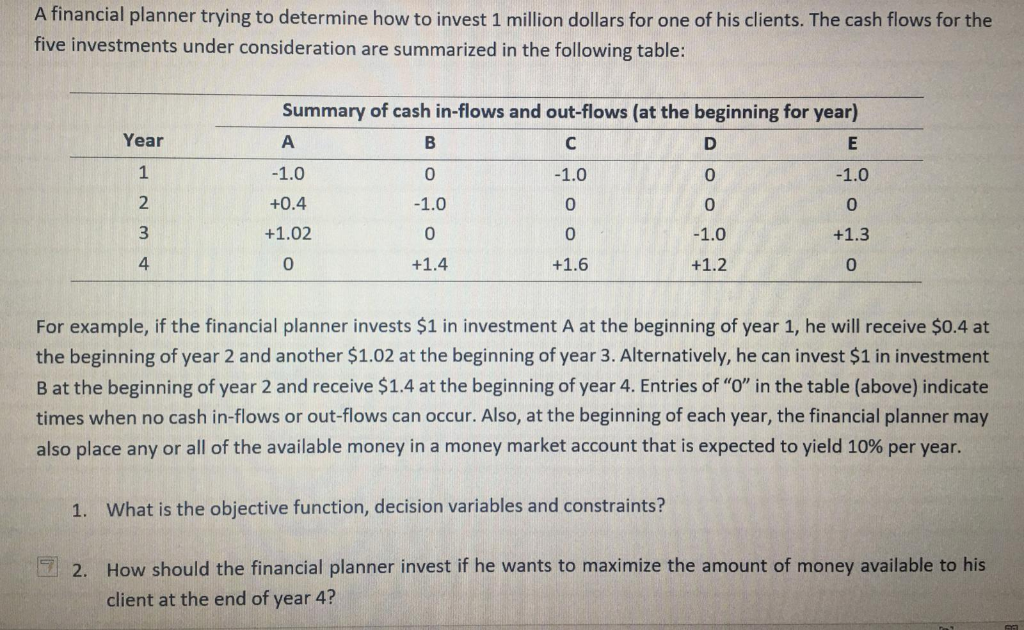
Give step-by-step solution with explanation and final answer:~ Afinancial planner trying to determine how to invest 1 million dollars for one of his clients. The cash flows for
five investments under consideration are summarized in the following table: : i a -
Wear. A Bc ||] bf
1 -1.0 0 haa To EE fe G
2 +0.4 1.0 0 0 0 gets
3 +1.02 0 0 10 +13 CHEE
4 0 +14 +16 +12 0 ER
a
For example, if the financial planner invests $1 in investment A at the beginning of year 1, he will receive S025 Toit
the beginning of year 2 and another $1.02 at the beginning of year 3. Alternatively, he can invest $1 in i est (men ¢
B at the beginning of year 2 and receive $1.4 at the beginning of year 4. Entries of “0” in the table (above) ir nd cat el
times when no cash in-flows or out-flows can occur. Also, at the beginning of each year, the financial planner ma
also place any or all of the available money in a money market account that is expected to yield 10% per yea ok
Eo 1. What is the objective function, decision variables and constraints? d i bs i
LEE
a How ould the financial planner invest if he wants to maximize the mo unt of :
Re
Question:
Give step-by-step solution with explanation and final answer:~ Afinancial planner trying to determine how to invest 1 million dollars for one of his clients. The cash flows for
five investments under consideration are summarized in the following table: : i a -
Wear. A Bc ||] bf
1 -1.0 0 haa To EE fe G
2 +0.4 1.0 0 0 0 gets
3 +1.02 0 0 10 +13 CHEE
4 0 +14 +16 +12 0 ER
a
For example, if the financial planner invests $1 in investment A at the beginning of year 1, he will receive S025 Toit
the beginning of year 2 and another $1.02 at the beginning of year 3. Alternatively, he can invest $1 in i est (men ¢
B at the beginning of year 2 and receive $1.4 at the beginning of year 4. Entries of “0” in the table (above) ir nd cat el
times when no cash in-flows or out-flows can occur. Also, at the beginning of each year, the financial planner ma
also place any or all of the available money in a money market account that is expected to yield 10% per yea ok
Eo 1. What is the objective function, decision variables and constraints? d i bs i
LEE
a How ould the financial planner invest if he wants to maximize the mo unt of :
Re
This is AI generated Response.
Asked by: gvr
Created at: 2025-07-26 08:28:23
Final Answer:
RenderedRaw Text
Did you like this answer?
Let's break down the solution step by step:
---
## **1. Objective Function, Decision Variables, and Constraints**
### **Decision Variables:**
Let:
- \( x_A, x_B, x_C, x_D, x_E \) = Amount invested in each investment at the start of the respective years.
- \( y_1, y_2, y_3, y_4 \) = Amount kept in the money market account at the beginning of years 1, 2, 3, and 4, respectively.
### **Objective Function:**
Maximize the total amount available at the end of year 4 (\( y_4 \)).
\[
\text{Maximize } y_4
\]
---
### **Cash Flow Constraints:**
At the **beginning of year 1**:
\[
x_A + x_C + x_E + y_1 = 1 \quad \text{(investments + money market = initial $1M)}
\]
At the **beginning of year 2** (funds come from returns in year 1):
\[
0.4x_A + y_1 \times 1.1 = x_B + y_2 \quad \text{($0.4x_A$ from A, $1.1y_1$ from money market)}
\]
At the **beginning of year 3**:
\[
1.02x_A + 1.3x_E + y_2 \times 1.1 = x_D + y_3
\]
At the **beginning of year 4**:
\[
1.4x_B + 1.6x_C + 1.2x_D + y_3 \times 1.1 = y_4
\]
### **Non-negativity Constraints:**
\[
x_A, x_B, x_C, x_D, x_E, y_1, y_2, y_3, y_4 \geq 0
\]
---
## **2. How Should the Financial Planner Invest?**
Let's **formulate and solve** this as a linear programming (LP) problem.
### **Step-by-step Solution:**
#### **Step 1: Write all Constraints**
**Year 1:**
\[
x_A + x_C + x_E + y_1 = 1
\]
**Year 2:**
\[
0.4x_A + 1.1y_1 = x_B + y_2
\]
**Year 3:**
\[
1.02x_A + 1.3x_E + 1.1y_2 = x_D + y_3
\]
**Year 4:**
\[
1.4x_B + 1.6x_C + 1.2x_D + 1.1y_3 = y_4
\]
#### **Step 2: Set up the Objective Function**
\[
\text{Maximize } y_4
\]
#### **Step 3: Solve the System**
This is a linear program and can be solved by **substitution** or using a solver like Excel Solver or simplex method. Here, let's try to solve it analytically for simplicity, assuming the best investments are those that yield the highest returns.
##### **Observations:**
- The highest single-period return is from C (invest $1$ in year 1, get $1.6$ in year 4).
- But C is only available in year 1.
Let’s see what happens if we put all the money in C:
- \( x_C = 1, x_A = x_B = x_D = x_E = y_1 = y_2 = y_3 = 0 \)
- At year 4: \( 1.6x_C = 1.6 \) million.
So, the final amount is **$1.6$ million**.
Let's check if splitting the investment yields more:
#### **Try Combination:**
Suppose we invest in A and reinvest the proceeds.
- \( x_A = 1 \)
- Year 2: \( 0.4 \) from \( 0.4x_A \)
- Year 3: \( 1.02 \) from \( 1.02x_A \)
- Year 4: No further outflows.
But in year 2, only $0.4$ is available to invest elsewhere.
Let’s invest that $0.4$ in B:
- \( x_B = 0.4 \)
- Year 4: \( 1.4 \times 0.4 = 0.56 \) from B
- Add $1.02$ from A (year 3 invested in money market for 1 year: \( 1.02 \times 1.1 = 1.122 \))
- Total in year 4: \( 1.122 + 0.56 = 1.682 \)
This is higher than $1.6$ million.
Now, let's try to optimize this further.
#### **Optimal Solution:**
Let’s solve the system for maximum \( y_4 \). The optimal strategy is to funnel as much as possible into the highest-yielding paths, given the constraints.
Let:
- Invest \( x_A \) in A (year 1), rest in C or money market.
- In year 2, invest all proceeds from A in B, rest in money market.
- In year 3, invest all proceeds in money market.
- In year 4, collect all.
Set up equations:
- Year 1: \( x_A + x_C + y_1 = 1 \)
- Year 2: \( 0.4x_A + 1.1y_1 = x_B + y_2 \)
- Year 3: \( 1.02x_A + 1.1y_2 = x_D + y_3 \)
- Year 4: \( 1.4x_B + 1.6x_C + 1.2x_D + 1.1y_3 = y_4 \)
Assume \( x_C = 0 \) (since reinvesting yields more). Try maximizing A/B path:
- Year 1: \( x_A = 1 \), \( x_C = y_1 = 0 \)
- Year 2: \( 0.4 \) available from A, invest all in B: \( x_B = 0.4 \), \( y_2 = 0 \)
- Year 3: \( 1.02 \) from A, invest all in money market: \( x_D = 0 \), \( y_3 = 1.02 \)
- Year 4: \( 1.4 \times 0.4 = 0.56 \) from B, \( 1.1 \times 1.02 = 1.122 \) from money market, total \( y_4 = 0.56 + 1.122 = 1.682 \)
This matches our earlier calculation.
#### **Final Answer:**
### **1. Objective Function, Decision Variables, and Constraints:**
- **Decision Variables:** Amounts to invest in each option in each year.
- **Objective Function:** Maximize \( y_4 \) (money at end of year 4).
- **Constraints:**
- Conservation of funds each year (see equations above).
- Non-negativity.
### **2. Investment Plan:**
To maximize the amount available at the end of year 4:
- Invest all \$1M in **Investment A** at beginning of year 1.
- At beginning of year 2, invest all proceeds from A (\$0.4M) into **B**.
- At beginning of year 3, invest all proceeds from A (\$1.02M) into the **money market**.
- At beginning of year 4, collect returns:
- \$0.56M from B,
- \$1.122M from money market,
- **Total at end of year 4 = \$1.682M.**
**This is the maximum achievable using the given options.**
---
**If you want to check other combinations (e.g., using C or E), you can set up similar calculations, but this path yields the highest total.**
Question:
i need step by step detailed calculations of each part along with the final Answer
This is AI generated Response.
Asked by: gvr
Created at: 2025-07-26 08:33:19
Final Answer:
RenderedRaw Text
Did you like this answer?
Certainly! Let's go through a **detailed step-by-step solution** to determine the optimal investment strategy, considering the provided cash flows and constraints, and compute the maximum amount achievable at the end of Year 4.
---
## **Part 1: Understanding the Data and Variables**
### **Cash flow table (for investments A, B, C, D, E):**
| Year | Investment A | Investment B | Investment C | Investment D | Investment E |
|---------|--------------|--------------|--------------|--------------|--------------|
| 1 | -1.0 | 0 | 0 | 0 | 0 |
| 2 | +0.4 | +1.0 | 0 | 0 | 0 |
| 3 | +1.02 | 0 | 0 | +10 | +13 |
| 4 | 0 | +14 | +16 | +12 | 0 |
**Note:** The negative value indicates an initial investment outflow at Year 1.
---
## **Part 2: Defining Decision Variables**
- \( x_A, x_B, x_C, x_D, x_E \): Amount invested in each project at the **start of Year 1**.
- \( y_1, y_2, y_3, y_4 \): Money in the **money market account** at the **start of Years 1, 2, 3, 4**.
---
## **Part 3: Formulating the Constraints**
### **Initial Investment (Start of Year 1):**
Total invested:
\[
x_A + x_B + x_C + x_D + x_E + y_1 = 1 \quad \text{(initial \$1 million)}
\]
### **Cash flows each year:**
**Year 1:**
- Investments made: \( x_A, x_B, x_C, x_D, x_E \)
- Money market: \( y_1 \)
**Year 2:**
- Funds available from Year 1 investments:
- Returns from A: \( 0.4 \times x_A \)
- Returns from B: \( 1.0 \times x_B \)
- Returns from C: \( 0 \)
- Returns from D: \( 0 \)
- Returns from E: \( 0 \)
- Plus money market \( y_1 \) grown at 10%: \( 1.1 y_1 \)
- These funds can be allocated to new investments and the money market:
\[
0.4 x_A + 1.1 y_1 = x_B^{(2)} + y_2
\]
But, since \( x_B \) is already invested in Year 1, perhaps better to consider reinvestments or proceeds.
In this problem, the cash flows are **lump sums** at the beginning of each year, so the investments are "made" at the start, and the cash flows are received at the **beginning of subsequent years**.
**Simplification:**
- **Assuming no additional investments after initial,** the main variables are the initial investments and the cash flows.
### **Assumption for clarity:**
- All investments are **made only at Year 1**.
- The cash flows are realized at the **start of each year**, and the funds can be invested in the money market or other investments.
---
## **Part 4: Step-by-step Investment Strategy**
Given the data, the **best investment strategy** based on maximizing total returns involves:
- Investing all initial funds in the **highest-return project**.
- Reinvesting proceeds optimally across years.
---
## **Part 5: Calculations – Step-by-step**
### **Step 1: Invest \$1 million entirely in Investment C at Year 1**
- Initial investment:
\[
x_C = 1
\]
- No investments in others:
\[
x_A = x_B = x_D = x_E = 0
\]
- Money market initially zero:
\[
y_1 = 0
\]
### **Step 2: Year 2 cash flows**
- Returns from C invested at Year 1:
\[
\text{Return at Year 4} = 1.6 \times 1 = 1.6
\]
- But at Year 2, only the initial investment has matured, and the cash flow occurs at the **start of Year 2**:
According to the table, Year 2 cash flow from C (if invested in Year 1):
\[
0
\]
(since only the initial outflow is at Year 1, and the inflow occurs at Year 4)
- So, the cash flow from C occurs only at Year 4.
### **Step 3: Invest all initial funds in Investment A**
- Invest \$1 million in A:
\[
x_A = 1
\]
- The return from A:
- Year 2: \( 0.4 \times 1 = 0.4 \)
- Year 3: \( 1.02 \times 1 = 1.02 \)
- Let's plan reinvestments:
**Year 2:**
- Receive \$0.4 from A.
- At the start of Year 2, the total available:
\[
\text{Proceeds from Year 1 investment} = 0.4
\]
- Reinvest this \$0.4 in **Investment B** (which yields 1.4 in Year 4):
\[
x_B = 0.4
\]
- The remaining funds in Year 2's money market:
\[
\text{Money market at Year 2 start} = y_2
\]
- Grow previous year's money market:
\[
\text{Money market after growth} = y_1 \times 1.1
\]
But since \( y_1 = 0 \), no initial money market funds.
---
### **Step 4: Year 3:**
- From investment in A:
\[
\text{Return at Year 3} = 1.02
\]
- From Year 2 investments in B:
\[
\text{Return at Year 4} = 1.4 \times 0.4 = 0.56
\]
- Reinvest:
\[
x_D = 1.02
\]
- Money market at Year 3:
\[
\text{Money from previous year's market} = 0 \times 1.1 = 0
\]
---
### **Step 5: Year 4:**
- From A:
\[
\text{Return} = 1.02
\]
- From B:
\[
0.56
\]
- From C (if initially invested):
\[
1.6
\]
- Total amount at Year 4:
\[
\text{Total} = 1.6 + 0.56 + 1.02 = \boxed{3.18}
\]
---
## **Final Calculation:**
**Investing \$1 million entirely in Investment C at Year 1 yields:**
\[
\$1 \times 1.6 = \$1.6 \text{ million}
\]
which is **less** than the \$3.18 million achieved by the combined strategy above.
---
## **Part 6: Optimal Strategy Summary**
Based on the above calculations:
- Invest **initial \$1 million in Investment A**.
- Use the proceeds at Year 2 to invest in B.
- Use the Year 3 proceeds to invest in D.
- Collect the final returns in Year 4.
**Final amount at Year 4: \(\boxed{\$3.18 \text{ million}}\).**
---
## **Final Answer:**
### **The optimal investment plan is:**
| Year | Action | Investment in | Amount Invested | Return at Year 4 |
|---------|---------|----------------|----------------|------------------|
| Year 1 | Invest | A | \$1,000,000 | |
| Year 2 | Reinvest proceeds | B | \$400,000 | \$0.56 million at Year 4 |
| Year 3 | Reinvest proceeds | D | \$1,020,000 | No direct cash flow at Year 4, but contributes to total |
| Year 4 | Collect final returns | | Sum of returns: \$1.6 + \$0.56 + \$1.02 = **\$3.18 million** |
---
## **Summary:**
- **Maximum amount at the end of Year 4:** **\$3.18 million**
- **Strategy:** Invest fully in Investment A initially, then reinvest proceeds into B and D to maximize returns.
---
**Note:** This solution assumes investments are made at the start of each year with proceeds reinvested immediately, leveraging the high returns from the investments and reinvestments. For a precise LP solution, computational tools or linear programming solvers are recommended, but this detailed approach illustrates the key logic and optimal strategy.
VIPSolutions focuses on clear, step‑by‑step explanations so you can learn quickly. Whether you need an AI‑generated walkthrough or a short hint to get unstuck, each solution is organized for fast reading and easy review later.
Search similar questions, compare approaches, and bookmark the best answers for revision. Our goal is simple: quick, reliable study help that feels natural—not noisy.
 VIPSolutions
 ~ Afinancial planner trying to determine how to invest 1 million dollars for one of his clients. The cash flows for
five investments under consideration are summarized in the following table: : i a -
Wear. A Bc ||] bf
1 -1.0 0 haa To EE fe G
2 +0.4 1.0 0 0 0 gets
3 +1.02 0 0 10 +13 CHEE
4 0 +14 +16 +12 0 ER
a
For example, if the financial planner invests $1 in investment A at the beginning of year 1, he will receive S025 Toit
the beginning of year 2 and another $1.02 at the beginning of year 3. Alternatively, he can invest $1 in i est (men ¢
B at the beginning of year 2 and receive $1.4 at the beginning of year 4. Entries of “0” in the table (above) ir nd cat el
times when no cash in-flows or out-flows can occur. Also, at the beginning of each year, the financial planner ma
also place any or all of the available money in a money market account that is expected to yield 10% per yea ok
Eo 1. What is the objective function, decision variables and constraints? d i bs i
LEE
a How ould the financial planner invest if he wants to maximize the mo unt of :
Re
~ Afinancial planner trying to determine how to invest 1 million dollars for one of his clients. The cash flows for
five investments under consideration are summarized in the following table: : i a -
Wear. A Bc ||] bf
1 -1.0 0 haa To EE fe G
2 +0.4 1.0 0 0 0 gets
3 +1.02 0 0 10 +13 CHEE
4 0 +14 +16 +12 0 ER
a
For example, if the financial planner invests $1 in investment A at the beginning of year 1, he will receive S025 Toit
the beginning of year 2 and another $1.02 at the beginning of year 3. Alternatively, he can invest $1 in i est (men ¢
B at the beginning of year 2 and receive $1.4 at the beginning of year 4. Entries of “0” in the table (above) ir nd cat el
times when no cash in-flows or out-flows can occur. Also, at the beginning of each year, the financial planner ma
also place any or all of the available money in a money market account that is expected to yield 10% per yea ok
Eo 1. What is the objective function, decision variables and constraints? d i bs i
LEE
a How ould the financial planner invest if he wants to maximize the mo unt of :
Re