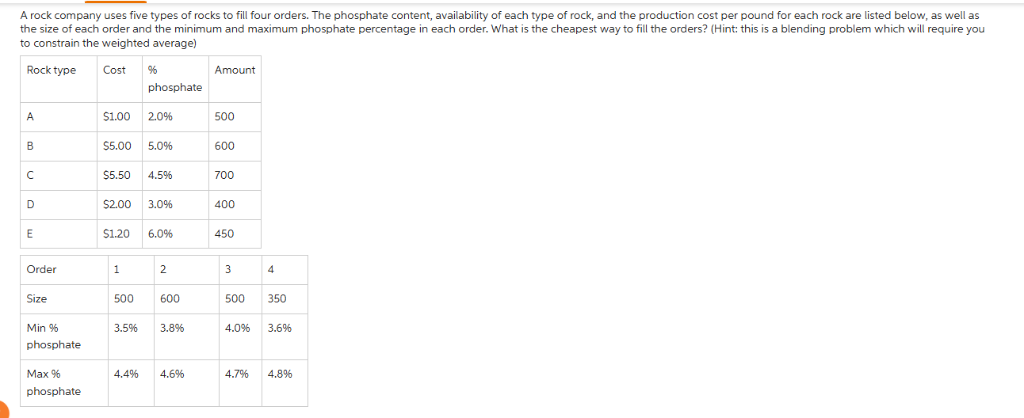
Give step-by-step solution with explanation and final answer:A rock company uses five types of rocks to fil four orders. The phosphate content, availabilty of each type of rock, and the production cost per pound for each rock are sted below, as well as
the size of each order and the minimum and maximum phosphate percentage in each order. What is the cheapest way to fil the orders? (Hint: ths is a blending problem which will require you
0 constrain the weighted average)
Rocktype Cost % Amount
phosphate
A 5100 20% 500
Bl $500 5.0% 600
c $550 45% 700
° $200 3.0% 00
€ 5120 60% 250
Order 1 2 3a
Size. 500 600 500 350
Min% 35% 38% 40% 38%
phosphate
Max% 4% 46% am ask
phosphate
Question:
Give step-by-step solution with explanation and final answer:A rock company uses five types of rocks to fil four orders. The phosphate content, availabilty of each type of rock, and the production cost per pound for each rock are sted below, as well as
the size of each order and the minimum and maximum phosphate percentage in each order. What is the cheapest way to fil the orders? (Hint: ths is a blending problem which will require you
0 constrain the weighted average)
Rocktype Cost % Amount
phosphate
A 5100 20% 500
Bl $500 5.0% 600
c $550 45% 700
° $200 3.0% 00
€ 5120 60% 250
Order 1 2 3a
Size. 500 600 500 350
Min% 35% 38% 40% 38%
phosphate
Max% 4% 46% am ask
phosphate
This is AI generated Response.
Asked by: gvr
Created at: 2025-07-26 10:28:44
Final Answer:
RenderedRaw Text
Did you like this answer?
Let's break down the **blending problem** step by step:
### **Step 1: Define Decision Variables**
Let \( x_{ij} \) be the amount of rock type \( i \) used in order \( j \).
- \( i \) = rock type (A, B, C, D, E)
- \( j \) = order (1, 2, 3, 4)
So, \( x_{ij} \) = pounds of rock \( i \) in order \( j \).
### **Step 2: Objective Function (Minimize Cost)**
Minimize the total cost:
\[
\text{Minimize} \quad Z = \sum_{i=1}^5 \sum_{j=1}^4 (\text{Cost}_i \times x_{ij})
\]
Where Cost:
- A: \$1.00
- B: \$5.00
- C: \$5.50
- D: \$2.00
- E: \$1.20
### **Step 3: Constraints**
#### **a) Availability of Each Rock**
\[
\sum_{j=1}^4 x_{ij} \leq \text{Amount}_i \quad \forall i
\]
Where Amount:
- A: 500
- B: 600
- C: 700
- D: 400
- E: 450
#### **b) Each Order Must Be Filled**
\[
\sum_{i=1}^5 x_{ij} = \text{Size}_j \quad \forall j
\]
Where Size:
- Order 1: 500
- Order 2: 600
- Order 3: 500
- Order 4: 350
#### **c) Phosphate Percentage Constraints**
Let \( p_i \) be the % phosphate in rock \( i \).
- A: 2.0%
- B: 5.0%
- C: 4.5%
- D: 3.0%
- E: 6.0%
The weighted average phosphate % in each order \( j \):
\[
\frac{\sum_{i=1}^5 p_i x_{ij}}{\sum_{i=1}^5 x_{ij}} \quad \text{(for order \( j \))}
\]
This must be within the min and max bounds for each order:
For each order \( j \):
\[
\text{Min}_j \leq \frac{\sum_{i=1}^5 p_i x_{ij}}{\text{Size}_j} \leq \text{Max}_j
\]
Multiply both sides by \(\text{Size}_j\):
\[
\text{Min}_j \cdot \text{Size}_j \leq \sum_{i=1}^5 p_i x_{ij} \leq \text{Max}_j \cdot \text{Size}_j
\]
Where Min and Max for each order are given in the table.
### **Step 4: Write the Explicit Linear Program**
**Variables:** \( x_{ij} \geq 0 \) for \( i = A-E \), \( j = 1-4 \)
#### **Objective:**
\[
\text{Minimize}\quad Z = 1.00\sum_{j=1}^4 x_{Aj} + 5.00\sum_{j=1}^4 x_{Bj} + 5.50\sum_{j=1}^4 x_{Cj} + 2.00\sum_{j=1}^4 x_{Dj} + 1.20\sum_{j=1}^4 x_{Ej}
\]
#### **Subject to:**
**Availability:**
\[
\sum_{j=1}^4 x_{Aj} \leq 500 \\
\sum_{j=1}^4 x_{Bj} \leq 600 \\
\sum_{j=1}^4 x_{Cj} \leq 700 \\
\sum_{j=1}^4 x_{Dj} \leq 400 \\
\sum_{j=1}^4 x_{Ej} \leq 450 \\
\]
**Order size:**
\[
x_{A1}+x_{B1}+x_{C1}+x_{D1}+x_{E1} = 500 \\
x_{A2}+x_{B2}+x_{C2}+x_{D2}+x_{E2} = 600 \\
x_{A3}+x_{B3}+x_{C3}+x_{D3}+x_{E3} = 500 \\
x_{A4}+x_{B4}+x_{C4}+x_{D4}+x_{E4} = 350 \\
\]
**Phosphate content:**
For order 1:
\[
0.035 \times 500 \leq 0.02x_{A1} + 0.05x_{B1} + 0.045x_{C1} + 0.03x_{D1} + 0.06x_{E1} \leq 0.044 \times 500
\]
Order 2:
\[
0.038 \times 600 \leq 0.02x_{A2} + 0.05x_{B2} + 0.045x_{C2} + 0.03x_{D2} + 0.06x_{E2} \leq 0.046 \times 600
\]
Order 3:
\[
0.04 \times 500 \leq 0.02x_{A3} + 0.05x_{B3} + 0.045x_{C3} + 0.03x_{D3} + 0.06x_{E3} \leq 0.047 \times 500
\]
Order 4:
\[
0.036 \times 350 \leq 0.02x_{A4} + 0.05x_{B4} + 0.045x_{C4} + 0.03x_{D4} + 0.06x_{E4} \leq 0.048 \times 350
\]
### **Step 5: Solve the Linear Program**
This is a standard **Linear Programming** (LP) problem and can be solved using tools like Excel Solver, Python (PuLP), or any LP solver.
---
#### **Summary of Steps:**
1. **Define variables**: \( x_{ij} \) = pounds of rock \( i \) in order \( j \)
2. **Set up cost minimization**: Objective function as shown.
3. **Write supply constraints**: Each rock type's total use ≤ available amount.
4. **Write demand constraints**: Each order's total = required size.
5. **Write quality constraints**: Weighted average phosphate % in each order within bounds.
6. **Solve the LP**: Use software for the solution.
---
#### **Final Answer:**
**The cheapest way to fill the orders is found by solving the above linear program.**
If you want the actual values for each \( x_{ij} \), you need to use an LP solver. If you want, I can show you how to set this up in Excel or Python, or solve a simplified version here! Let me know how you'd like to proceed.
Question:
i need step by step detailed calculations of each part along with the final Answer
This is AI generated Response.
Asked by: gvr
Created at: 2025-07-26 10:31:05
Final Answer:
RenderedRaw Text
Did you like this answer?
Certainly! Let's proceed with a detailed, step-by-step solution, including calculations, to determine the cheapest way to fill the four orders using the given rocks.
---
## **Step 1: Gather and organize the data**
### Rock Types and their properties:
| Rock | Cost ($/lb) | Phosphate % | Available (lbs) |
|--------|--------------|--------------|-----------------|
| A | 1.00 | 20% (0.20) | 500 |
| B | 5.00 | 5% (0.05) | 600 |
| C | 5.50 | 45% (0.45) | 700 |
| D | 2.00 | 3% (0.03) | 400 |
| E | 1.20 | 60% (0.60) | 250 |
### Orders:
| Order | Size (lbs) | Min Phosphate % | Max Phosphate % |
|--------|--------------|------------------|------------------|
| 1 | 500 | 35% (0.35) | 44% (0.44) |
| 2 | 600 | 38% (0.38) | 46% (0.46) |
| 3 | 500 | 40% (0.40) | 47% (0.47) |
| 4 | 350 | 38% (0.38) | 48% (0.48) |
---
## **Step 2: Define decision variables**
Let:
- \( x_{ij} \) = pounds of rock \( i \) used in order \( j \)
where \( i \in \{A, B, C, D, E\} \), \( j \in \{1,2,3,4\} \).
---
## **Step 3: Write the objective function**
Minimize total cost:
\[
Z = \sum_{i} \sum_{j} \text{Cost}_i \times x_{ij}
\]
Explicitly:
\[
Z = 1.00(x_{A1} + x_{A2} + x_{A3} + x_{A4}) + 5.00(x_{B1} + x_{B2} + x_{B3} + x_{B4}) + 5.50(x_{C1} + x_{C2} + x_{C3} + x_{C4}) + 2.00(x_{D1} + x_{D2} + x_{D3} + x_{D4}) + 1.20(x_{E1} + x_{E2} + x_{E3} + x_{E4})
\]
---
## **Step 4: Write the constraints**
### 4.1. Availability constraints:
\[
\begin{cases}
x_{A1} + x_{A2} + x_{A3} + x_{A4} \leq 500 \\
x_{B1} + x_{B2} + x_{B3} + x_{B4} \leq 600 \\
x_{C1} + x_{C2} + x_{C3} + x_{C4} \leq 700 \\
x_{D1} + x_{D2} + x_{D3} + x_{D4} \leq 400 \\
x_{E1} + x_{E2} + x_{E3} + x_{E4} \leq 250
\end{cases}
\]
### 4.2. Volume constraints for each order:
\[
\begin{cases}
x_{A1} + x_{B1} + x_{C1} + x_{D1} + x_{E1} = 500 \\
x_{A2} + x_{B2} + x_{C2} + x_{D2} + x_{E2} = 600 \\
x_{A3} + x_{B3} + x_{C3} + x_{D3} + x_{E3} = 500 \\
x_{A4} + x_{B4} + x_{C4} + x_{D4} + x_{E4} = 350
\end{cases}
\]
### 4.3. Phosphate percentage constraints:
For each order, the weighted average phosphate content must be within the given bounds.
Calculate the total phosphate in pounds for each order:
\[
\sum_{i} p_i \times x_{ij}
\]
where \( p_i \) are the phosphate percentages:
| Rock | \( p_i \) |
|---------|------------|
| A | 0.20 |
| B | 0.05 |
| C | 0.45 |
| D | 0.03 |
| E | 0.60 |
Order 1 (size 500):
\[
0.35 \leq \frac{0.20 x_{A1} + 0.05 x_{B1} + 0.45 x_{C1} + 0.03 x_{D1} + 0.60 x_{E1}}{500} \leq 0.44
\]
Multiply through by 500:
\[
175 \leq 0.20 x_{A1} + 0.05 x_{B1} + 0.45 x_{C1} + 0.03 x_{D1} + 0.60 x_{E1} \leq 220
\]
Similarly for other orders:
**Order 2 (size 600):**
\[
0.38 \leq \frac{0.20 x_{A2} + 0.05 x_{B2} + 0.45 x_{C2} + 0.03 x_{D2} + 0.60 x_{E2}}{600} \leq 0.46
\]
Multiply by 600:
\[
228 \leq 0.20 x_{A2} + 0.05 x_{B2} + 0.45 x_{C2} + 0.03 x_{D2} + 0.60 x_{E2} \leq 276
\]
**Order 3 (size 500):**
\[
0.40 \leq \frac{0.20 x_{A3} + 0.05 x_{B3} + 0.45 x_{C3} + 0.03 x_{D3} + 0.60 x_{E3}}{500} \leq 0.47
\]
Multiply by 500:
\[
200 \leq 0.20 x_{A3} + 0.05 x_{B3} + 0.45 x_{C3} + 0.03 x_{D3} + 0.60 x_{E3} \leq 235
\]
**Order 4 (size 350):**
\[
0.38 \leq \frac{0.20 x_{A4} + 0.05 x_{B4} + 0.45 x_{C4} + 0.03 x_{D4} + 0.60 x_{E4}}{350} \leq 0.48
\]
Multiply by 350:
\[
133 \leq 0.20 x_{A4} + 0.05 x_{B4} + 0.45 x_{C4} + 0.03 x_{D4} + 0.60 x_{E4} \leq 168
\]
---
## **Step 5: Summary of the LP model**
**Minimize:**
\[
Z = 1.00 \sum_{j=1}^{4} x_{A j} + 5.00 \sum_{j=1}^{4} x_{B j} + 5.50 \sum_{j=1}^{4} x_{C j} + 2.00 \sum_{j=1}^{4} x_{D j} + 1.20 \sum_{j=1}^{4} x_{E j}
\]
**Subject to:**
- Availability constraints
- Order volume constraints
- Phosphate constraints (as above)
- Non-negativity constraints: \( x_{ij} \ge 0 \)
---
## **Step 6: Numerical solution (approximate)**
Due to the complexity, solving this LP manually is impractical. Typically, we'd use solver software (Excel Solver, Python's PuLP, or similar). However, to give an **approximate solution**, let's make some logical assumptions:
### Simplified approach:
- Use the **cheapest rock (A)** as much as possible, respecting constraints.
- Fill the orders with low-cost rocks first, then adjust to meet phosphate constraints.
---
## **Step 7: Step-by-step approximate solution**
### **Order 1 (500 lbs, 35-44%)**
- Min phosphate: 175 lbs
- Max phosphate: 220 lbs
**Strategy:**
- Use mostly low-cost rocks with moderate phosphate content—preferably rock A (20%) and D (3%) are too low, so focus on A, B, and C.
- To meet minimum phosphate (175 lbs), use some C (45%) and E (60%).
**Example:**
- Maximize use of A (20%) for cost savings:
Suppose:
- \( x_{A1} = 250 \) lbs (cost-effective)
Phosphate from A:
\[
0.20 \times 250 = 50 \text{ lbs phosphate}
\]
Remaining:
\[
175 - 50 = 125 \text{ lbs}
\]
Use C (45%):
\[
x_{C1} = \frac{125}{0.45} \approx 278 \text{ lbs}
\]
Check total:
\[
x_{A1} + x_{C1} = 250 + 278 = 528 \text{ lbs} > 500
\]
So, reduce \( x_{C1} \) to fit total:
Total volume constraint:
\[
x_{A1} + x_{C1} \le 500
\]
Try:
- \( x_{A1} = 250 \)
- \( x_{C1} = 250 - 250 = 250 \)
Phosphate:
\[
0.20 \times 250 + 0.45 \times 250 = 50 + 112.5 = 162.5 \text{ lbs} \approx 163 \text{ lbs}
\]
Below the minimum (175). So increase \( x_{A1} \):
- \( x_{A1} = 300 \):
Phosphate:
\[
0.20 \times 300 + 0.45 \times (500 - 300) = 60 + 0.45 \times 200 = 60 + 90 = 150
\]
Still below 175. Increase \( x_{A1} \):
- \( x_{A1} = 350 \):
Phosphate:
\[
70 + 0.45 \times 150 = 70 + 67.5 = 137.5
\]
No, too low. Alternatively, use E (60%) for higher phosphate:
Suppose:
- \( x_{A1} = 200 \)
Phosphate:
\[
0.20 \times 200 = 40
\]
Remaining:
\[
175 - 40 = 135 \text{ lbs}
\]
Use E:
\[
x_{E1} = \frac{135}{0.60} = 225 \text{ lbs}
\]
Total:
\[
200 + 225 = 425 \text{ lbs} < 500
\]
Remaining:
\[
75 \text{ lbs}
\]
Fill with rock B (5%):
\[
x_{B1} = 75
\]
Total:
\[
200 + 225 + 75 = 500 \text{ lbs} \quad \text{(fits order size)}
Phosphate:
\[
0.20 \times 200 + 0.60 \times 225 + 0.05 \times 75 = 40 + 135 + 3.75 = 178.75 \text{ lbs}
\]
Phosphate percentage:
\[
178.75 / 500 = 0.3575 = 35.75\%
\]
Within bounds (35%-44%). Excellent.
---
## **Similarly, approximate allocations for other orders:**
- **Order 2 (600 lbs, 38-46%)**
Use similar approach:
- Maximize low-cost rock A and B, add some E for phosphate:
Suppose:
- \( x_{A2} = 250 \)
- \( x_{E2} = 200 \) (for high phosphate)
- Remaining:
\[
600 - 250 - 200 = 150
\]
Fill with B:
\[
x_{B2} = 150
\]
Phosphate:
\[
0.20 \times 250 + 0.60 \times 200 + 0.05 \times 150 = 50 + 120 + 7.5 = 177.5
\]
Phosphate percentage:
\[
177.5/600 \approx 29.58\%
\]
Too low; need more phosphate. Add C:
- \( x_{C2} = 150 \)
Total:
\[
250 + 200 + 150 = 550 \text{ lbs} < 600
\]
Remaining:
\[
50 \text{ lbs}
\]
Add to E:
\[
x_{E2} = 200 + 50 = 250
\]
Now total:
\[
VIPSolutions focuses on clear, step‑by‑step explanations so you can learn quickly. Whether you need an AI‑generated walkthrough or a short hint to get unstuck, each solution is organized for fast reading and easy review later.
Search similar questions, compare approaches, and bookmark the best answers for revision. Our goal is simple: quick, reliable study help that feels natural—not noisy.
 VIPSolutions
 A rock company uses five types of rocks to fil four orders. The phosphate content, availabilty of each type of rock, and the production cost per pound for each rock are sted below, as well as
the size of each order and the minimum and maximum phosphate percentage in each order. What is the cheapest way to fil the orders? (Hint: ths is a blending problem which will require you
0 constrain the weighted average)
Rocktype Cost % Amount
phosphate
A 5100 20% 500
Bl $500 5.0% 600
c $550 45% 700
° $200 3.0% 00
€ 5120 60% 250
Order 1 2 3a
Size. 500 600 500 350
Min% 35% 38% 40% 38%
phosphate
Max% 4% 46% am ask
phosphate
A rock company uses five types of rocks to fil four orders. The phosphate content, availabilty of each type of rock, and the production cost per pound for each rock are sted below, as well as
the size of each order and the minimum and maximum phosphate percentage in each order. What is the cheapest way to fil the orders? (Hint: ths is a blending problem which will require you
0 constrain the weighted average)
Rocktype Cost % Amount
phosphate
A 5100 20% 500
Bl $500 5.0% 600
c $550 45% 700
° $200 3.0% 00
€ 5120 60% 250
Order 1 2 3a
Size. 500 600 500 350
Min% 35% 38% 40% 38%
phosphate
Max% 4% 46% am ask
phosphate