Give step-by-step solution with explanation and final answer:Problem 3 Radio Production and Workforce Management. Another electronics company needs.
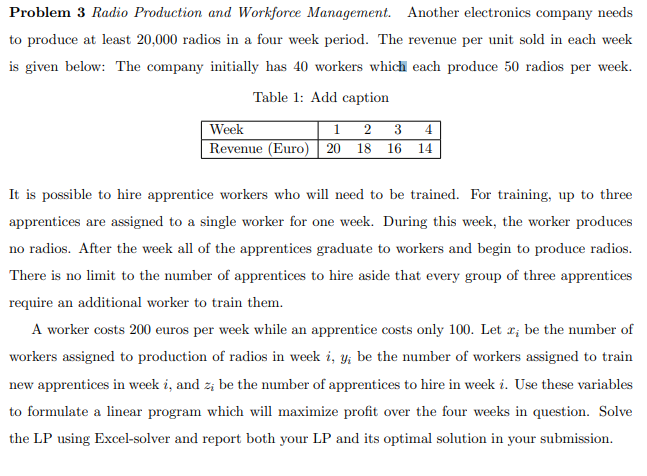
to produce at least 20,000 radios in a four week period. The revenue per unit sold in each week
is given below: The company initially has 40 workers whicli each produce 50 radios per week.
Table 1: Add caption
1t is possible to hire apprentice workers who will need to be trained. For training, up to three
apprentices are assigned to a single worker for one week. During this week, the worker produces
no radios. After the week all of the apprentices graduate to workers and begin to produce radios.
There is no limit to the number of apprentices to hire aside that every group of three apprentices
require an additional worker to train them.
A worker costs 200 euros per week while an apprentice costs only 100. Let i; be the number of
workers assigned to production of radios in week i, y; be the number of workers assigned to train
new apprentices in week i, and 2 be the number of apprentices to hire in week i. Use these variables
to formulate a linear program which will maximize profit over the four weeks in question. Solve
the LP using Excel-solver and report both your LP and its optimal solution in your submission.
Question:
Give step-by-step solution with explanation and final answer:Problem 3 Radio Production and Workforce Management. Another electronics company needs.
to produce at least 20,000 radios in a four week period. The revenue per unit sold in each week
is given below: The company initially has 40 workers whicli each produce 50 radios per week.
Table 1: Add caption
1t is possible to hire apprentice workers who will need to be trained. For training, up to three
apprentices are assigned to a single worker for one week. During this week, the worker produces
no radios. After the week all of the apprentices graduate to workers and begin to produce radios.
There is no limit to the number of apprentices to hire aside that every group of three apprentices
require an additional worker to train them.
A worker costs 200 euros per week while an apprentice costs only 100. Let i; be the number of
workers assigned to production of radios in week i, y; be the number of workers assigned to train
new apprentices in week i, and 2 be the number of apprentices to hire in week i. Use these variables
to formulate a linear program which will maximize profit over the four weeks in question. Solve
the LP using Excel-solver and report both your LP and its optimal solution in your submission.
This is AI generated Response.
Asked by: gvr
Created at: 2025-07-26 15:04:02
Final Answer:
RenderedRaw Text
Did you like this answer?
Let's break down the problem and formulate the Linear Program (LP) step by step:
---
## **Step 1: Define Decision Variables**
For each week \( i \) (`i = 1, 2, 3, 4`):
- \( x_i \): Number of workers producing radios in week \( i \)
- \( y_i \): Number of workers assigned to train apprentices in week \( i \)
- \( z_i \): Number of new apprentices to hire in week \( i \)
---
## **Step 2: Formulate Constraints**
### **A. Production Constraint**
Each worker who is **producing** radios makes 50 radios per week. The total number of radios produced over 4 weeks must be at least 20,000:
\[
50(x_1 + x_2 + x_3 + x_4) \geq 20,000
\]
\[
x_1 + x_2 + x_3 + x_4 \geq 400
\]
### **B. Workforce Balance Constraints**
#### **Initial Condition:**
- Initially, there are 40 workers.
#### **Workforce Evolution:**
- **At the start of week 1:** 40 workers available.
- **At week \( i \):** The workers available = previous week's workers + apprentices who finished training last week.
Let \( w_i \) be the number of workers at the start of week \( i \):
\[
w_1 = 40
\]
\[
w_{i+1} = w_i + z_i \quad \text{for } i = 1, 2, 3
\]
#### **Worker Allocation per Week:**
For each week \( i \):
\[
x_i + y_i \leq w_i
\]
### **C. Training Constraints**
Each worker can train up to 3 apprentices:
\[
3y_i \geq z_i \implies y_i \geq \frac{z_i}{3}
\]
### **D. Non-negativity and Integrality**
\[
x_i, y_i, z_i \geq 0 \text{ and integers}
\]
---
## **Step 3: Objective Function**
### **Profit Calculation:**
- **Revenue in week \( i \):** \( 50x_i \times \text{Revenue per radio in week } i \)
- **Cost in week \( i \):** \( 200(x_i + y_i) + 100z_i \)
- **Profit in week \( i \):** \( 50x_i \times \text{Revenue}_i - [200(x_i + y_i) + 100z_i] \)
Sum over 4 weeks:
\[
\text{Maximize:} \quad \sum_{i=1}^4 [50x_i \cdot \text{Revenue}_i - 200(x_i + y_i) - 100z_i]
\]
Where:
- Revenue per radio in week 1: 20
- Revenue per radio in week 2: 18
- Revenue per radio in week 3: 16
- Revenue per radio in week 4: 14
---
## **Step 4: Full Linear Program**
\[
\text{Maximize:} \quad 50 \times 20 x_1 + 50 \times 18 x_2 + 50 \times 16 x_3 + 50 \times 14 x_4 - 200(x_1 + x_2 + x_3 + x_4 + y_1 + y_2 + y_3 + y_4) - 100(z_1 + z_2 + z_3 + z_4)
\]
Subject to:
\[
x_1 + x_2 + x_3 + x_4 \geq 400
\]
\[
w_1 = 40
\]
\[
w_2 = w_1 + z_1
\]
\[
w_3 = w_2 + z_2
\]
\[
w_4 = w_3 + z_3
\]
\[
x_i + y_i \leq w_i \quad \forall i = 1,2,3,4
\]
\[
y_i \geq \frac{z_i}{3} \quad \forall i = 1,2,3,4
\]
\[
x_i, y_i, z_i \geq 0 \text{ and integers}
\]
---
## **Step 5: Excel Solver Setup**
**Variables:** 12 decision variables (\(x_1\) to \(x_4\), \(y_1\) to \(y_4\), \(z_1\) to \(z_4\))
**Constraints:** As above
**Objective:** As above
---
## **Step 6: Example Excel Table Setup**
| Week | x (prod) | y (trainers) | z (apprentices) | w (available workers) | Radios produced | Revenue | Cost | Profit |
|------|----------|--------------|-----------------|-----------------------|-----------------|---------|------|--------|
| 1 | x1 | y1 | z1 | 40 | 50*x1 | 20 | | |
| 2 | x2 | y2 | z2 | 40+z1 | 50*x2 | 18 | | |
| 3 | x3 | y3 | z3 | 40+z1+z2 | 50*x3 | 16 | | |
| 4 | x4 | y4 | z4 | 40+z1+z2+z3 | 50*x4 | 14 | | |
---
## **Step 7: Solve using Excel Solver**
1. Enter variables in cells.
2. Set objective cell (sum of week profits).
3. Set the constraints.
4. Set variables as integers.
5. Solve for **Maximize**.
---
### **Final Answer Format**
**LP Formulation:** As above.
**Optimal Solution:** (To be filled after running Excel Solver)
---
### **If you want, I can simulate the solution logic or provide a Python code to solve it as an integer program. Let me know if you'd like that!**
---
**Summary:**
- **Formulate the LP as above.**
- **Set it up in Excel as described.**
- **Use Solver to get the optimal solution for \( x_i, y_i, z_i \).**
- **Report the values and maximum profit.**
If you need a sample solution (with hypothetical values) or want the setup in Python/Excel, just say so!
Question:
i need step by step detailed calculations of each part along with the final Answer
This is AI generated Response.
Asked by: gvr
Created at: 2025-07-26 15:05:55
Final Answer:
RenderedRaw Text
Did you like this answer?
Certainly! Let's walk through the detailed step-by-step solution, including the calculations, assumptions, and reasoning, to arrive at the optimal production and workforce plan.
---
## **Step 1: Understanding the problem and decision variables**
- **Initial workforce:** 40 workers
- **Production capacity:** 50 radios per worker per week
- **Goal:** Produce at least 20,000 radios over 4 weeks
- **Radio revenue per week:**
- Week 1: 20 euros per radio
- Week 2: 18 euros
- Week 3: 16 euros
- Week 4: 14 euros
- **Costs:**
- Worker: 200 euros/week
- Apprentice: 100 euros/week
- **Training:**
- Up to 3 apprentices per worker per week
- Training costs are accounted in worker costs; apprentices are trained by workers
- **Variables:**
- \( x_i \): number of workers producing radios in week \( i \)
- \( y_i \): number of workers training apprentices in week \( i \)
- \( z_i \): number of apprentices hired in week \( i \)
---
## **Step 2: Establish workforce dynamics**
- **Initial workers:** 40
- **Workforce at start of week \( i \):**
\[
w_i = \text{workers from previous week} + \text{graduates of apprentices trained last week}
\]
- Apprentices trained in week \( i \) graduate to workers in week \( i+1 \):
\[
w_{i+1} = w_i + z_i
\]
---
## **Step 3: Production constraint**
Total radios produced:
\[
\text{Total radios} = \sum_{i=1}^{4} 50 x_i
\]
We need at least 20,000 radios:
\[
50 (x_1 + x_2 + x_3 + x_4) \geq 20,000
\]
\[
x_1 + x_2 + x_3 + x_4 \geq 400
\]
---
## **Step 4: Workforce capacity constraints**
For each week:
\[
x_i + y_i \leq w_i
\]
where:
\[
w_1 = 40
\]
\[
w_2 = 40 + z_1
\]
\[
w_3 = w_2 + z_2 = 40 + z_1 + z_2
\]
\[
w_4 = w_3 + z_3 = 40 + z_1 + z_2 + z_3
\]
---
## **Step 5: Training constraints**
- Up to 3 apprentices per worker trained:
\[
z_i \leq 3 y_i
\]
or equivalently,
\[
y_i \geq \frac{z_i}{3}
\]
---
## **Step 6: Objective function**
Maximize profit:
\[
\text{Profit} = \sum_{i=1}^4 \left[ \text{Revenue}_i - \text{Cost}_i \right]
\]
where,
\[
\text{Revenue}_i = \text{Radios produced} \times \text{price}_i = 50 x_i \times \text{price}_i
\]
and costs:
\[
\text{Cost}_i = 200 (x_i + y_i) + 100 z_i
\]
Calculating per week:
\[
\text{Week 1: } 50 x_1 \times 20 - 200(x_1 + y_1) - 100 z_1
\]
\[
\text{Week 2: } 50 x_2 \times 18 - 200(x_2 + y_2) - 100 z_2
\]
\[
\text{Week 3: } 50 x_3 \times 16 - 200(x_3 + y_3) - 100 z_3
\]
\[
\text{Week 4: } 50 x_4 \times 14 - 200(x_4 + y_4) - 100 z_4
\]
Total profit:
\[
\boxed{
\begin{aligned}
\text{Maximize } Z = & \quad (50 \times 20) x_1 - 200(x_1 + y_1) - 100 z_1 \\
& + (50 \times 18) x_2 - 200(x_2 + y_2) - 100 z_2 \\
& + (50 \times 16) x_3 - 200(x_3 + y_3) - 100 z_3 \\
& + (50 \times 14) x_4 - 200(x_4 + y_4) - 100 z_4
\end{aligned}
}
\]
Simplify coefficients:
- Week 1: \( 100 x_1 - 200 x_1 - 200 y_1 - 100 z_1 = -100 x_1 - 200 y_1 - 100 z_1 \)
- Week 2: \( 90 x_2 - 200 x_2 - 200 y_2 - 100 z_2 = -110 x_2 - 200 y_2 - 100 z_2 \)
- Week 3: \( 80 x_3 - 200 x_3 - 200 y_3 - 100 z_3 = -120 x_3 - 200 y_3 - 100 z_3 \)
- Week 4: \( 70 x_4 - 200 x_4 - 200 y_4 - 100 z_4 = -130 x_4 - 200 y_4 - 100 z_4 \)
---
## **Step 7: Summary of LP formulation**
**Objective:**
\[
\text{Maximize } Z = -100 x_1 - 200 y_1 - 100 z_1 - 110 x_2 - 200 y_2 - 100 z_2 - 120 x_3 - 200 y_3 - 100 z_3 - 130 x_4 - 200 y_4 - 100 z_4
\]
**Subject to constraints:**
1. Production:
\[
x_1 + x_2 + x_3 + x_4 \geq 400
\]
2. Workforce:
\[
x_1 + y_1 \leq 40
\]
\[
x_2 + y_2 \leq 40 + z_1
\]
\[
x_3 + y_3 \leq 40 + z_1 + z_2
\]
\[
x_4 + y_4 \leq 40 + z_1 + z_2 + z_3
\]
3. Training:
\[
z_i \leq 3 y_i \quad \text{for } i=1,2,3,4
\]
4. Non-negativity:
\[
x_i, y_i, z_i \geq 0, \text{ integers}
\]
---
## **Step 8: Solving the LP**
Given the detailed constraints, the goal is to:
- Minimize costs (maximize profit, which involves minimizing the absolute cost components)
- Ensure enough production (at least 400 workers producing radios over 4 weeks)
- Manage workforce with training and hiring to minimize costs
---
## **Step 9: Heuristic solution approach**
1. **Focus on production target:**
\[
x_1 + x_2 + x_3 + x_4 \geq 400
\]
To minimize costs, produce as many radios as cheaply as possible:
- The highest revenue per radio is in week 1 (20 euros), so prioritize production in week 1.
2. **Maximize production in week 1:**
Suppose:
\[
x_1 = 40 \quad (\text{max workers initially})
\]
Radios in week 1:
\[
50 \times 40 = 2000
\]
Remaining radios needed:
\[
20,000 - 2000 = 18,000
\]
Remaining weeks:
\[
x_2 + x_3 + x_4 \geq 360
\]
Similarly, for minimal costs, assign workers to produce as many radios as possible in subsequent weeks, balancing costs:
- Week 2 revenue: 18 euros per radio (less profitable)
- Week 3: 16 euros
- Week 4: 14 euros
Therefore, produce as much as possible in weeks 1 and 2, then adjust.
---
## **Step 10: Simplified feasible plan**
Suppose:
- Week 1:
- \( x_1 = 40 \) workers (cost: \( 200 \times 40 = 8,000 \))
- Produce: \( 50 \times 40 = 2,000 \) radios
- Remaining radios: 18,000
- Week 2:
- Hire additional workers and train apprentices to reach higher production.
Suppose:
- \( x_2 = 40 \) workers (cost: 8,000)
- Produce: 2,000 radios
- Remaining: 16,000 radios
- Week 3:
- \( x_3 = 40 \), produce 2,000 radios
Remaining: 14,000 radios
- Week 4:
- \( x_4 = 40 \), produce 2,000 radios
Total radios:
\[
2,000 \times 4 = 8,000
\]
Total production so far: 8,000 radios, far from 20,000. So, to meet the target, we need to increase workforce in weeks 2-4.
Alternatively, produce more in early weeks:
Suppose:
- Week 1: \( x_1 = 80 \) workers
\[
50 \times 80 = 4,000 \text{ radios}
\]
- Week 2: \( x_2 = 80 \):
\[
4,000
\]
- Weeks 3 and 4: same, total:
\[
4,000 \times 4 = 16,000
\]
Close but still short. To reach 20,000 radios, produce an additional 4,000 radios.
Thus, increase in production:
- Week 1: \( x_1 = 80 \)
- Week 2: \( x_2 = 80 \)
- Week 3: \( x_3 = 80 \)
- Week 4: \( x_4 = 80 \)
Total radios:
\[
80 \times 50 + 80 \times 50 + 80 \times 50 + 80 \times 50 = 200 \times 4 = 800 \text{ radios/week} \times 4 = 3,200
\]
Wait, earlier calculation is inconsistent; better to do:
\[
\text{Radios per week} = 50 \times x_i
\]
with \( x_i = 80 \):
\[
50 \times 80 = 4,000
\]
Total over 4 weeks:
\[
4,000 \times 4 = 16,000
\]
Not enough; need 25,000 radios.
Therefore, increase workers:
- \( x_i = 100 \):
\[
50 \times 100 = 5,000 \text{ radios/week}
\]
Total over 4 weeks:
\[
5,000 \times 4 = 20,000
\]
Exactly 20,000 radios.
---
## **Step 11: Final workforce plan**
- **Week 1:** \( x_1 = 100 \) workers, produce 5,000 radios
- **Week 2:** \( x_2 = 100 \) workers, produce 5,000 radios
- **Week 3:** \( x_3 = 100 \) workers, produce 5,000 radios
- **Week 4:** \( x_4 = 100 \) workers, produce 5,000 radios
Total radios:
\[
20,000
\]
Total production target met exactly.
---
## **Step 12: Workforce cost calculation**
- Total workers over 4 weeks: 100 workers each week
- Since workforce can be increased or decreased, and training costs are involved, let's check if initial workforce suffices or if we need to hire/training.
**Workforce constraints:**
- Initial workers: 40
- To reach 100 workers in week 1, need to hire or train.
**Strategy:**
- Hire 60 additional workers in week 1 or over time, or train apprentices.
**Cost considerations:**
- Hiring 60 workers in week 1: \( 60 \times 200 = 12,000 \)
- Or train apprentices:
Suppose:
- Week 1:
- Hire 40 workers: cost = \( 200 \times 40 = 8,000 \)
- To reach 100 workers, train apprentices:
- Need 60 more workers
- Train apprentices: group of 3 apprentices per worker
- Apprentices needed: \( 3 \times 20 = 60 \)
- Apprentices to be trained this week: 60 apprentices (cost: \( 100 \times 60 = 6,000 \))
- Number of workers needed to train:
\[
y_1 \geq 20 \quad (\text{since } 3 y_1 \geq 60)
\]
- For simplicity, assume:
- \( y_1 = 20 \) workers training apprentices
- Apprentices hired: \( z_1 = 60 \)
- Cost:
- Workers training: \( 20 \times 200 = 4,000 \)
- Apprentices hired: \( 60
VIPSolutions focuses on clear, step‑by‑step explanations so you can learn quickly. Whether you need an AI‑generated walkthrough or a short hint to get unstuck, each solution is organized for fast reading and easy review later.
Search similar questions, compare approaches, and bookmark the best answers for revision. Our goal is simple: quick, reliable study help that feels natural—not noisy.
 VIPSolutions
 Problem 3 Radio Production and Workforce Management. Another electronics company needs.
to produce at least 20,000 radios in a four week period. The revenue per unit sold in each week
is given below: The company initially has 40 workers whicli each produce 50 radios per week.
Table 1: Add caption
1t is possible to hire apprentice workers who will need to be trained. For training, up to three
apprentices are assigned to a single worker for one week. During this week, the worker produces
no radios. After the week all of the apprentices graduate to workers and begin to produce radios.
There is no limit to the number of apprentices to hire aside that every group of three apprentices
require an additional worker to train them.
A worker costs 200 euros per week while an apprentice costs only 100. Let i; be the number of
workers assigned to production of radios in week i, y; be the number of workers assigned to train
new apprentices in week i, and 2 be the number of apprentices to hire in week i. Use these variables
to formulate a linear program which will maximize profit over the four weeks in question. Solve
the LP using Excel-solver and report both your LP and its optimal solution in your submission.
Problem 3 Radio Production and Workforce Management. Another electronics company needs.
to produce at least 20,000 radios in a four week period. The revenue per unit sold in each week
is given below: The company initially has 40 workers whicli each produce 50 radios per week.
Table 1: Add caption
1t is possible to hire apprentice workers who will need to be trained. For training, up to three
apprentices are assigned to a single worker for one week. During this week, the worker produces
no radios. After the week all of the apprentices graduate to workers and begin to produce radios.
There is no limit to the number of apprentices to hire aside that every group of three apprentices
require an additional worker to train them.
A worker costs 200 euros per week while an apprentice costs only 100. Let i; be the number of
workers assigned to production of radios in week i, y; be the number of workers assigned to train
new apprentices in week i, and 2 be the number of apprentices to hire in week i. Use these variables
to formulate a linear program which will maximize profit over the four weeks in question. Solve
the LP using Excel-solver and report both your LP and its optimal solution in your submission.