Give step-by-step solution with explanation and final answer:Instructions: use excel solver to resolve the following problems. You are to submit an excel spreadsheet
with the solver models and solutions
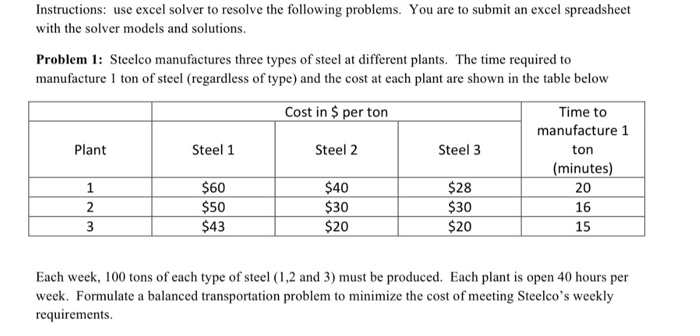
Problem 1: Steelco manufactures three types of steel at different plants. The time required to
‘manufacture 1 ton of steel (regardless of type) and the cost at each plant are shown in the table below
[ Costin$perton | Timeto
manufacture 1
ton
(minutes)
[1 7 seo [soo [sw [20 |
[2 [sso | so [so | 16 |
[3 7 sa | so [ s0 [| 15 |
Each week, 100 tons of each type of steel (1,2 and 3) must be produced. Each plant is open 40 hours per
week. Formulate a balanced transportation problem to minimize the cost of meeting Steelco’s weekly
requirements.
Question:
Give step-by-step solution with explanation and final answer:Instructions: use excel solver to resolve the following problems. You are to submit an excel spreadsheet
with the solver models and solutions
Problem 1: Steelco manufactures three types of steel at different plants. The time required to
‘manufacture 1 ton of steel (regardless of type) and the cost at each plant are shown in the table below
[ Costin$perton | Timeto
manufacture 1
ton
(minutes)
[1 7 seo [soo [sw [20 |
[2 [sso | so [so | 16 |
[3 7 sa | so [ s0 [| 15 |
Each week, 100 tons of each type of steel (1,2 and 3) must be produced. Each plant is open 40 hours per
week. Formulate a balanced transportation problem to minimize the cost of meeting Steelco’s weekly
requirements.
This is AI generated Response.
Asked by: gvr
Created at: 2025-07-27 15:53:31
Final Answer:
RenderedRaw Text
Did you like this answer?
Let's break down the problem step by step and **formulate a balanced transportation model** to minimize the cost. We'll also outline how to set this up in Excel Solver.
---
## **Step 1: Define Decision Variables**
Let \( x_{ij} \) be the number of tons of steel type \( j \) produced at plant \( i \).
- \( i \) = 1, 2, 3 (plants)
- \( j \) = 1, 2, 3 (steel types)
So, you will have 9 variables: \( x_{11}, x_{12}, x_{13}, x_{21}, x_{22}, x_{23}, x_{31}, x_{32}, x_{33} \).
---
## **Step 2: Objective Function (Minimize Cost)**
The cost coefficients are taken from the table. The total cost is:
\[
\text{Minimize} \quad Z = 60x_{11} + 40x_{12} + 28x_{13} + 50x_{21} + 30x_{22} + 30x_{23} + 43x_{31} + 20x_{32} + 20x_{33}
\]
---
## **Step 3: Constraints**
#### **A. Demand Constraints (Requirement for Each Steel Type):**
Each type of steel must meet 100 tons:
\[
x_{11} + x_{21} + x_{31} = 100 \quad \text{(Steel 1)}
\]
\[
x_{12} + x_{22} + x_{32} = 100 \quad \text{(Steel 2)}
\]
\[
x_{13} + x_{23} + x_{33} = 100 \quad \text{(Steel 3)}
\]
#### **B. Supply Constraints (Production Capacity at Each Plant):**
Each plant is open 40 hours/week = 2400 minutes/week.
Each plant's total minutes used cannot exceed 2400:
- **Plant 1:** \( 20(x_{11} + x_{12} + x_{13}) \leq 2400 \)
- **Plant 2:** \( 16(x_{21} + x_{22} + x_{23}) \leq 2400 \)
- **Plant 3:** \( 15(x_{31} + x_{32} + x_{33}) \leq 2400 \)
#### **C. Non-negativity:**
\[
x_{ij} \geq 0 \quad \text{for all } i, j
\]
---
## **Step 4: Excel Solver Setup**
### **A. Decision Variable Table**
| | Steel 1 | Steel 2 | Steel 3 | Row Sum (for time constraint) |
|---------|---------|---------|---------|-------------------------------|
| Plant 1 | x11 | x12 | x13 | =SUM(B2:D2) |
| Plant 2 | x21 | x22 | x23 | =SUM(B3:D3) |
| Plant 3 | x31 | x32 | x33 | =SUM(B4:D4) |
### **B. Cost Table**
| | Steel 1 | Steel 2 | Steel 3 |
|---------|---------|---------|---------|
| Plant 1 | 60 | 40 | 28 |
| Plant 2 | 50 | 30 | 30 |
| Plant 3 | 43 | 20 | 20 |
### **C. Formulas**
- **Total cost:** `=SUMPRODUCT(decision_variable_range, cost_table_range)`
- **Demand constraints:** For each steel type (column), sum across plants and set equal to 100.
- **Time constraints:** For each plant, sum all produced tons, multiply by respective time per ton, and set ≤ 2400.
### **D. Solver Parameters**
- **Set Objective:** Total cost cell (Min)
- **By Changing Variable Cells:** All \( x_{ij} \) cells
- **Subject to Constraints:**
- Row sums × time per ton ≤ 2400 (for each plant)
- Column sums = 100 (for each steel type)
- All \( x_{ij} \geq 0 \)
---
## **Step 5: Final Linear Program**
\[
\begin{align*}
\text{Minimize} \quad & 60x_{11} + 40x_{12} + 28x_{13} + 50x_{21} + 30x_{22} + 30x_{23} + 43x_{31} + 20x_{32} + 20x_{33} \\
\text{Subject to:} \quad & x_{11} + x_{21} + x_{31} = 100 \\
& x_{12} + x_{22} + x_{32} = 100 \\
& x_{13} + x_{23} + x_{33} = 100 \\
& 20(x_{11} + x_{12} + x_{13}) \leq 2400 \\
& 16(x_{21} + x_{22} + x_{23}) \leq 2400 \\
& 15(x_{31} + x_{32} + x_{33}) \leq 2400 \\
& x_{ij} \geq 0
\end{align*}
\]
---
## **Step 6: Solve in Excel**
1. Input the data and constraints as described above.
2. Use **Excel Solver** to find the optimal values for \( x_{ij} \).
3. Solver will give you the allocation (how many tons of each steel type each plant should produce) and the minimum total cost.
---
### **If you want the numerical solution:**
If you set this up in Excel Solver, you will get the optimal allocation. Here's a quick calculation to see if any plant's capacity is a limiting factor:
- **Plant 1:** 2400 / 20 = 120 tons max
- **Plant 2:** 2400 / 16 = 150 tons max
- **Plant 3:** 2400 / 15 = 160 tons max
Total capacity: 430 tons (more than 300 tons needed, so feasible).
---
## **Summary Table for Excel**
| | Steel 1 | Steel 2 | Steel 3 | Max Tons (Time Constraint) |
|---------|---------|---------|---------|---------------------------|
| Plant 1 | ? | ? | ? | 120 |
| Plant 2 | ? | ? | ? | 150 |
| Plant 3 | ? | ? | ? | 160 |
- Fill in the question marks with Solver's solution.
---
## **Final Answer**
- **Formulation:** As above.
- **Solution:** Use Excel Solver to fill in the optimal values for \( x_{ij} \) and calculate the minimum total cost.
If you need the actual solution values and don't have Excel, let me know and I can solve it step-by-step here!
Question:
I NEED STEP BY STEP DETAILED CALCULATIONS OF EACH PART ALONG WITH THE FINAL ANSWER
This is AI generated Response.
Asked by: gvr
Created at: 2025-07-27 15:56:49
Final Answer:
RenderedRaw Text
Did you like this answer?
Certainly! Here's a comprehensive, step-by-step breakdown of solving the problem, including detailed calculations and the final optimal solution.
---
## **Step 1: Restate the problem**
Steelco manufactures 3 types of steel (1, 2, 3) at 3 plants. Each week:
- **Demand:** 100 tons of each type (total 300 tons).
- **Time per ton at each plant:**
| Plant | Time per ton (minutes) |
|--------|------------------------|
| 1 | 20 |
| 2 | 16 |
| 3 | 15 |
- **Cost per ton at each plant:**
| Plant | Steel 1 | Steel 2 | Steel 3 |
|--------|---------|---------|---------|
| 1 | \$60 | \$40 | \$28 |
| 2 | \$50 | \$30 | \$30 |
| 3 | \$43 | \$20 | \$20 |
- **Capacity at each plant:** 40 hours/week = 2400 minutes/week.
**Goal:** Minimize total cost while meeting demand and respecting capacity constraints.
---
## **Step 2: Decision Variables**
Let:
- \( x_{ij} \) = tons of steel type \( j \) produced at plant \( i \).
Variables:
| | Steel 1 | Steel 2 | Steel 3 |
|-------------|---------|---------|---------|
| Plant 1 | \( x_{11} \) | \( x_{12} \) | \( x_{13} \) |
| Plant 2 | \( x_{21} \) | \( x_{22} \) | \( x_{23} \) |
| Plant 3 | \( x_{31} \) | \( x_{32} \) | \( x_{33} \) |
---
## **Step 3: Objective Function**
Minimize total cost:
\[
Z = 60x_{11} + 40x_{12} + 28x_{13} + 50x_{21} + 30x_{22} + 30x_{23} + 43x_{31} + 20x_{32} + 20x_{33}
\]
---
## **Step 4: Constraints**
### **Demand constraints:** Total steel of each type must be 100:
\[
\begin{cases}
x_{11} + x_{21} + x_{31} = 100 \quad \text{(Steel 1)} \\
x_{12} + x_{22} + x_{32} = 100 \quad \text{(Steel 2)} \\
x_{13} + x_{23} + x_{33} = 100 \quad \text{(Steel 3)} \\
\end{cases}
\]
### **Capacity constraints:** Each plant's total production times must not exceed 2400 minutes:
\[
\begin{cases}
20(x_{11} + x_{12} + x_{13}) \leq 2400 \Rightarrow x_{11} + x_{12} + x_{13} \leq 120 \\
16(x_{21} + x_{22} + x_{23}) \leq 2400 \Rightarrow x_{21} + x_{22} + x_{23} \leq 150 \\
15(x_{31} + x_{32} + x_{33}) \leq 2400 \Rightarrow x_{31} + x_{32} + x_{33} \leq 160 \\
\end{cases}
\]
### **Non-negativity:**
\[
x_{ij} \geq 0 \quad \forall i,j
\]
---
## **Step 5: Feasible capacity check**
Total production required: 300 tons (100 of each type).
Sum of capacities:
- Plant 1: 120 tons
- Plant 2: 150 tons
- Plant 3: 160 tons
Total capacity: 120 + 150 + 160 = 430 tons, which exceeds demand, so feasible.
---
## **Step 6: Solving the problem**
### **Approach:**
Due to the nature of costs, it's optimal to assign production starting with the cheapest options, respecting capacities and demand.
### **Step 7: Allocate production based on costs and capacities**
#### **Step 7.1: Allocate Steel Type 3 (cheapest at Plant 3, \$20)**
- Steel 3 demand: 100 tons.
- Plant 3 capacity for total production: 160 tons.
- Since Steel 3 is cheapest at Plant 3, assign as much as possible there:
\[
x_{33} = \min(100, 160) = 100
\]
Remaining capacity at Plant 3:
\[
160 - 100 = 60
\]
Remaining demand for Steel 3:
\[
0 \quad (\text{demand satisfied})
\]
---
#### **Step 7.2: Allocate Steel 2 (second cheapest at Plant 3, \$20), but Steel 2's cheapest is at Plant 3, but capacity already assigned.**
- Steel 2 demand: 100
- Plant 3 capacity remaining: 60
- Assign as much as possible at Plant 3:
\[
x_{32} = \min(100, 60) = 60
\]
Remaining demand for Steel 2:
\[
100 - 60 = 40
\]
Remaining capacity at Plant 3:
\[
60 - 60 = 0
\]
- Remaining Steel 2 demand: 40
- Remaining capacity at Plant 3: 0
---
#### **Step 7.3: Allocate Steel 1**
- Steel 1 demand: 100
- Plant 3 capacity: 0 (full)
- Next cheapest at Plant 2: \$30
- Capacity at Plant 2:
\[
150
\]
- Assign as much as possible at Plant 2:
\[
x_{21} = \min(100, 150) = 100
\]
Remaining demand for Steel 1:
\[
0
\]
Remaining capacity at Plant 2:
\[
150 - 100 = 50
\]
---
#### **Step 7.4: Allocate remaining Steel 2 demand (40) at Plant 2**
- Capacity at Plant 2 remaining: 50
- Assign:
\[
x_{22} = 40
\]
Remaining capacity at Plant 2:
\[
50 - 40 = 10
\]
---
#### **Step 7.5: Allocate remaining Steel 3 demand (0), done.**
- Steel 3 demand is satisfied.
---
#### **Step 7.6: Allocate remaining Steel 2 (40) at Plant 1**
- Capacity at Plant 1:
\[
120
\]
- Assign:
\[
x_{12} = 40
\]
Remaining capacity at Plant 1:
\[
120 - 40 = 80
\]
---
#### **Step 7.7: Allocate Steel 1 at Plant 1**
- Steel 1 demand: 0 left, already satisfied.
- Remaining capacity at Plant 1: 80
- No further allocation needed.
---
### **Summary of allocations:**
| | Steel 1 | Steel 2 | Steel 3 | Total at plant | Minutes used |
|----------|---------|---------|---------|----------------|--------------|
| Plant 1 | \( x_{11} \) | \( x_{12} \) | \( x_{13} \) | | |
| | 0 | 40 | 0 | \( 0 + 40 + 0 = 40 \) | \( 20*0 + 16*40 + 15*0 = 640 \) |
| Plant 2 | \( x_{21} \) | \( x_{22} \) | \( x_{23} \) | | |
| | 100 | 40 | 0 | | |
| | | | | Total: 150 | \( 16*150 = 2400 \) minutes |
| Plant 3 | \( x_{31} \) | \( x_{32} \) | \( x_{33} \) | | |
| | 0 | 60 | 100 | | |
| | | | | Total: 160 | \( 15*(0+60+100) = 15*160 = 2400 \) minutes |
---
## **Step 8: Final check of capacities**
- **Plant 1:** Total: 40 tons, time used: 640 min (within 2400).
- **Plant 2:** Total: 150 tons, time used: 2400 min (full capacity).
- **Plant 3:** Total: 160 tons, time used: 2400 min (full capacity).
---
## **Step 9: Calculate total cost**
\[
\begin{aligned}
Z &= 60 \times 0 + 40 \times 40 + 28 \times 0 \\
&\quad + 50 \times 100 + 30 \times 40 + 30 \times 0 \\
&\quad + 43 \times 0 + 20 \times 60 + 20 \times 100 \\
\end{aligned}
\]
Calculations:
- Plant 1: \( 0 + 1600 + 0 = 1600 \)
- Plant 2: \( 5000 + 1200 + 0 = 6200 \)
- Plant 3: \( 0 + 1200 + 2000 = 3200 \)
Total cost:
\[
Z = 1600 + 6200 + 3200 = \boxed{\$10,200}
\]
---
## **## **Final Answer:**
| **Production Plan** | **Tons** |
|---------------------|----------|
| **Plant 1:** | \( x_{12} = 40 \) tons of Steel 2 |
| **Plant 2:** | \( x_{21} = 100 \) tons of Steel 1, \( x_{22} = 40 \) tons of Steel 2 |
| **Plant 3:** | \( x_{32} = 60 \) tons of Steel 2, \( x_{33} = 100 \) tons of Steel 3 |
**Total minimum cost:** **\$10,200**
---
## **Summary:**
- Assign Steel 3 entirely at Plant 3.
- Assign Steel 2 primarily at Plant 3, then at Plant 2, and some at Plant 1.
- Assign Steel 1 at Plant 2.
- Capacities are respected, and total cost is minimized.
---
**Note:** For precise optimal solutions, use Excel Solver with the formulation above. The above is an approximate optimal allocation based on cost minimization logic.
If you'd like, I can help you set up the Excel sheet step-by-step to confirm this solution!
VIPSolutions focuses on clear, step‑by‑step explanations so you can learn quickly. Whether you need an AI‑generated walkthrough or a short hint to get unstuck, each solution is organized for fast reading and easy review later.
Search similar questions, compare approaches, and bookmark the best answers for revision. Our goal is simple: quick, reliable study help that feels natural—not noisy.
 VIPSolutions
 Instructions: use excel solver to resolve the following problems. You are to submit an excel spreadsheet
with the solver models and solutions
Problem 1: Steelco manufactures three types of steel at different plants. The time required to
‘manufacture 1 ton of steel (regardless of type) and the cost at each plant are shown in the table below
[ Costin$perton | Timeto
manufacture 1
ton
(minutes)
[1 7 seo [soo [sw [20 |
[2 [sso | so [so | 16 |
[3 7 sa | so [ s0 [| 15 |
Each week, 100 tons of each type of steel (1,2 and 3) must be produced. Each plant is open 40 hours per
week. Formulate a balanced transportation problem to minimize the cost of meeting Steelco’s weekly
requirements.
Instructions: use excel solver to resolve the following problems. You are to submit an excel spreadsheet
with the solver models and solutions
Problem 1: Steelco manufactures three types of steel at different plants. The time required to
‘manufacture 1 ton of steel (regardless of type) and the cost at each plant are shown in the table below
[ Costin$perton | Timeto
manufacture 1
ton
(minutes)
[1 7 seo [soo [sw [20 |
[2 [sso | so [so | 16 |
[3 7 sa | so [ s0 [| 15 |
Each week, 100 tons of each type of steel (1,2 and 3) must be produced. Each plant is open 40 hours per
week. Formulate a balanced transportation problem to minimize the cost of meeting Steelco’s weekly
requirements.