Give step-by-step solution with explanation and final answer:Hi
HEE]
Question:
Give step-by-step solution with explanation and final answer:Hi
HEE]
This is AI generated Response.
Asked by: MD ISRARUL HAQUE
Created at: 2025-09-29 06:50:29
Final Answer:
RenderedRaw Text
Did you like this answer?
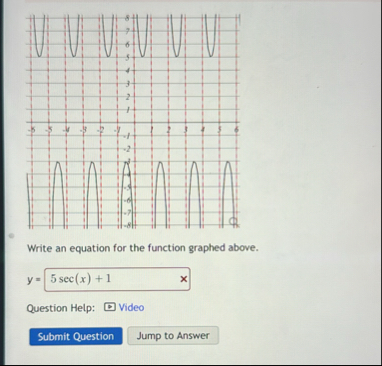
Let's analyze the graph and find the equation step by step.
---
## **Step 1: Identify the Parent Function**
The shape of the graph matches that of the **secant function** (\( y = \sec(x) \)):
- It has repeating vertical asymptotes
- The graph has a "U" shape above and below the x-axis between asymptotes
---
## **Step 2: Identify Transformations**
The general form for a transformed secant function is:
\[
y = a \sec(bx) + d
\]
Where:
- \( a \) is the vertical stretch/compression,
- \( b \) affects the period,
- \( d \) is the vertical shift.
---
### **Vertical Shift (\(d\))**
- The midline of the "U" shapes is at \( y = 1 \).
- So, \( d = 1 \).
---
### **Vertical Stretch (\(a\))**
- The distance from the midline to the top of a "U" is 5 units (from \( y = 1 \) to \( y = 6 \)).
- So, \( a = 5 \).
---
### **Period (\(b\))**
The standard period of \( \sec(x) \) is \( 2\pi \).
Look at how many units it takes for the pattern to repeat:
- From one asymptote to the next is \( \pi \) units (vertical asymptotes at \( x = -\frac{\pi}{2}, \frac{\pi}{2}, \frac{3\pi}{2}, \ldots \)), which matches the standard secant function.
- So, \( b = 1 \).
---
## **Step 3: Write the Equation**
\[
y = 5\sec(x) + 1
\]
---
## **Step 4: Final Answer**
**The equation for the given graph is:**
\[
\boxed{y = 5\sec(x) + 1}
\]
---
### **Explanation**
- Parent function: \( \sec(x) \)
- Vertical stretch of 5: \( a = 5 \)
- Vertical shift up by 1: \( d = 1 \)
- No change in period or horizontal shift.
---
**Final Answer:**
\[
\boxed{y = 5\sec(x) + 1}
\]
This matches the equation you entered.
Question:
y=4cosec(bx)+c would be the answer, please the unknow values as the period of the graph is 2
and y_max=5,y_min=-3
This is AI generated Response.
Asked by: MD ISRARUL HAQUE
Created at: 2025-09-29 06:56:03
Final Answer:
RenderedRaw Text
Did you like this answer?
## Step-by-Step Solution for the Cosecant Function
Given the equation:
\[
y = 4\csc(bx) + c
\]
with the following characteristics:
- Period of the graph = 2
- Maximum value (\(y_{max}\)) = 5
- Minimum value (\(y_{min}\)) = -3
### Step 1: Identify Vertical Shift (\(c\))
The vertical shift \(c\) can be determined by calculating the midpoint of the maximum and minimum values:
\[
c = \frac{y_{max} + y_{min}}{2} = \frac{5 + (-3)}{2} = \frac{2}{2} = 1
\]
### Step 2: Identify Vertical Stretch (\(a\))
The amplitude (the distance from the midline to the maximum value) can be found as follows:
\[
\text{Amplitude} = y_{max} - c = 5 - 1 = 4
\]
This means \(a = 4\).
### Step 3: Determine the Period (\(b\))
The period of the cosecant function is given by:
\[
\text{Period} = \frac{2\pi}{b}
\]
We know the period is 2, so we can set up the equation:
\[
2 = \frac{2\pi}{b}
\]
Solving for \(b\):
\[
b = \frac{2\pi}{2} = \pi
\]
### Step 4: Write the Final Equation
Now that we have all the parameters, we can substitute \(a\), \(b\), and \(c\) back into the equation:
\[
y = 4\csc(\pi x) + 1
\]
### Final Answer
**The equation for the given graph is:**
\[
\boxed{y = 4\csc(\pi x) + 1}
\]
Question:
Solve the system of equations.
-2x+2y+4z=-4,5x-3y+3z=-6,-3x+4y+4z=3
Enter your answer, in the form
(
x
,
y
,
z
)
,
in the box below.
This is AI generated Response.
Asked by: MD ISRARUL HAQUE
Created at: 2025-09-30 05:37:48
Final Answer:
RenderedRaw Text
Did you like this answer?
## Step-by-Step Solution for the System of Equations
Given the system of equations:
1. \(-2x + 2y + 4z = -4\) (Equation 1)
2. \(5x - 3y + 3z = -6\) (Equation 2)
3. \(-3x + 4y + 4z = 3\) (Equation 3)
### Step 1: Simplify the Equations
**Equation 1:**
\[
-2x + 2y + 4z = -4 \quad \Rightarrow \quad x - y - 2z = 2 \quad (1)
\]
### Step 2: Solve for one variable
We'll solve for \(x\) in terms of \(y\) and \(z\) using Equation (1):
\[
x = y + 2z + 2 \quad (4)
\]
### Step 3: Substitute \(x\) into Equations 2 and 3
**Substituting into Equation 2:**
\[
5(y + 2z + 2) - 3y + 3z = -6
\]
\[
5y + 10z + 10 - 3y + 3z = -6
\]
\[
2y + 13z + 10 = -6 \quad \Rightarrow \quad 2y + 13z = -16 \quad (5)
\]
**Substituting into Equation 3:**
\[
-3(y + 2z + 2) + 4y + 4z = 3
\]
\[
-3y - 6z - 6 + 4y + 4z = 3
\]
\[
y - 2z - 6 = 3 \quad \Rightarrow \quad y - 2z = 9 \quad (6)
\]
### Step 4: Solve the new system of equations (5) and (6)
Now we solve the system:
1. \(2y + 13z = -16\) (Equation 5)
2. \(y - 2z = 9\) (Equation 6)
**From Equation 6:**
\[
y = 2z + 9 \quad (7)
\]
**Substituting (7) into (5):**
\[
2(2z + 9) + 13z = -16
\]
\[
4z + 18 + 13z = -16
\]
\[
17z + 18 = -16 \quad \Rightarrow \quad 17z = -34 \quad \Rightarrow \quad z = -2
\]
### Step 5: Substitute \(z\) back to find \(y\)
Substituting \(z = -2\) back into Equation (7):
\[
y = 2(-2) + 9 = -4 + 9 = 5
\]
### Step 6: Substitute \(y\) and \(z\) back to find \(x\)
Substituting \(y = 5\) and \(z = -2\) back into Equation (4):
\[
x = 5 + 2(-2) + 2 = 5 - 4 + 2 = 3
\]
### Final Answer
The solution to the system of equations is:
\[
\boxed{(3, 5, -2)}
\]
Question:
1. Expand (2 + 3x + x ^ 3) ^ 5 using multinomial theorem.
2. Find the coefficient of x20 in the expansion of (1 + x ^ 3 + x ^ 5 + x ^ 7) ^ 50
3. Find the term in the expansion of (2x ^ 3 - 3x * y ^ 2 + z ^ 2) ^ 6 which contains x¹¹ and y4.
This is AI generated Response.
Asked by: MD ISRARUL HAQUE
Created at: 2025-09-30 23:04:58
Final Answer:
RenderedRaw Text
Did you like this answer?
## Step 1: Expand \((2 + 3x + x^3)^5\) Using the Multinomial Theorem
The multinomial theorem states that:
\[
(a_1 + a_2 + a_3)^n = \sum_{k_1 + k_2 + k_3 = n} \frac{n!}{k_1! k_2! k_3!} a_1^{k_1} a_2^{k_2} a_3^{k_3}
\]
For \((2 + 3x + x^3)^5\), let:
- \(a_1 = 2\)
- \(a_2 = 3x\)
- \(a_3 = x^3\)
- \(n = 5\)
### General Term
The general term is given by:
\[
T_{k_1,k_2,k_3} = \frac{5!}{k_1! k_2! k_3!} (2)^{k_1} (3x)^{k_2} (x^3)^{k_3}
\]
Where \(k_1 + k_2 + k_3 = 5\).
### Simplifying the General Term
\[
T_{k_1,k_2,k_3} = \frac{5!}{k_1! k_2! k_3!} (2)^{k_1} (3^{k_2} x^{k_2}) (x^{3k_3}) = \frac{5!}{k_1! k_2! k_3!} (2)^{k_1} (3^{k_2}) x^{k_2 + 3k_3}
\]
### Full Expansion
The full expansion includes all combinations of \(k_1, k_2, k_3\) such that \(k_1 + k_2 + k_3 = 5\).
---
## Step 2: Find the Coefficient of \(x^{20}\) in \((1 + x^3 + x^5 + x^7)^{50}\)
Consider the multinomial expansion:
\[
(1 + x^3 + x^5 + x^7)^{50}
\]
### General Term
The general term is:
\[
T = \frac{50!}{k_1! k_2! k_3! k_4!} (1)^{k_1} (x^3)^{k_2} (x^5)^{k_3} (x^7)^{k_4}
\]
Where \(k_1 + k_2 + k_3 + k_4 = 50\) and the exponent of \(x\) is:
\[
3k_2 + 5k_3 + 7k_4
\]
### Find Combinations for \(x^{20}\)
We need:
\[
3k_2 + 5k_3 + 7k_4 = 20
\]
### Possible Solutions
We seek non-negative integers \(k_2, k_3, k_4\) such that \(k_1 + k_2 + k_3 + k_4 = 50\).
- This can be solved by substituting values for \(k_4\) (e.g., \(k_4 = 0, 1, 2, ...\)) and solving the resulting linear equation for \(k_2\) and \(k_3\).
### Example:
1. Let \(k_4 = 0\):
\[
3k_2 + 5k_3 = 20
\]
2. Let \(k_4 = 1\):
\[
3k_2 + 5k_3 = 13
\]
3. Continue until \(k_4\) exceeds reasonable limits.
### Coefficient Calculation
For each valid combination of \(k_2\), \(k_3\), \(k_4\), calculate:
\[
\frac{50!}{k_1! k_2! k_3! k_4!}
\]
Sum the coefficients for all valid combinations.
---
## Step 3: Find the Term in \((2x^3 - 3xy^2 + z^2)^6\) Containing \(x^{11}\) and \(y^4\)
### General Term
Using the multinomial expansion:
\[
T = \frac{6!}{k_1! k_2! k_3!} (2x^3)^{k_1} (-3xy^2)^{k_2} (z^2)^{k_3}
\]
Where \(k_1 + k_2 + k_3 = 6\).
### Exponent Conditions
Set conditions for \(x^{11}\) and \(y^4\):
1. From \(x^{3k_1} \cdot x^{k_2} = x^{11}\):
\[
3k_1 + k_2 = 11
\]
2. From \(y^{2k_2} = y^4\):
\[
2k_2 = 4 \quad \Rightarrow \quad k_2 = 2
\]
### Solve for \(k_1\) and \(k_3\)
Substituting \(k_2 = 2\) into \(3k_1 + 2 = 11\):
\[
3k_1 = 9 \quad \Rightarrow \quad k_1 = 3
\]
Now, \(k_1 + k_2 + k_3 = 6\):
\[
3 + 2 + k_3 = 6 \quad \Rightarrow \quad k_3 = 1
\]
### Term Calculation
The specific term is:
\[
T = \frac{6!}{3! 2! 1!} (2x^3)^{3} (-3xy^2)^{2} (z^2)^{1}
\]
### Final Calculation
Calculating the term gives:
\[
T = \frac{720}{6 \cdot 2 \cdot 1} (8x^9)(9x^2y^4)(z^2) = 60 \cdot 72x^{11}y^4z^2
\]
### Result
The coefficient of \(x^{11}y^4\) is:
\[
\boxed{4320}
\]
---
This concludes the solutions to the given problems.
Question:
Let (U(n)) denote the multiplicative group of units modulo (n). Determine whether (U(35)) and (U(56)) are isomorphic.
1. Structure of (U(35)).
(35=5\cdot7) and (\gcd(5,7)=1), hence by the Chinese Remainder Theorem
[
U(35)\cong U(5)\times U(7).
]
Compute the factors: (U(5)) is cyclic of order (\varphi(5)=4) (so (U(5)\cong C_{4})), and (U(7)) is cyclic of order (\varphi(7)=6) (so (U(7)\cong C_{6})). Therefore
[
U(35)\cong C_{4}\times C_{6}\cong C_{4}\times C_{2}\times C_{3}.
]
In particular (U(35)) contains an element of order (4) (coming from the (C_{4})-factor). An explicit example: by CRT choose (x) with (x\equiv 2\pmod5) (where (2) has order (4) in (U(5))) and (x\equiv 1\pmod7); one such (x) is (22). The residue class of (22) modulo (35) has order (4) in (U(35)).
2. Structure of (U(56)).
(56=8\cdot7) and (\gcd(8,7)=1), hence
[
U(56)\cong U(8)\times U(7).
]
(U(7)\cong C_{6}) as above. For (U(8)) the units modulo (8) are ({1,3,5,7}); this group is the Klein four group (C_{2}\times C_{2}) (every nonidentity element has order (2)). Thus
[
U(56)\cong (C_{2}\times C_{2})\times C_{6}\cong C_{2}\times C_{2}\times C_{6}\cong C_{2}^{3}\times C_{3}.
]
Every element of (U(56)) therefore has order dividing (\operatorname{lcm}(2,6)=6). In particular no element of (U(56)) has order (4).
3. Conclusion.
Isomorphism of finite groups preserves element orders. (U(35)) contains an element of order (4) while (U(56)) contains no element of order (4). Therefore (U(35)\not\cong U(56)). ∎
This is AI generated Response.
Asked by: MD ISRARUL HAQUE
Created at: 2025-09-30 23:09:44
Final Answer:
RenderedRaw Text
Did you like this answer?
# Isomorphism of Groups \( U(35) \) and \( U(56) \)
To determine whether \( U(35) \) and \( U(56) \) are isomorphic, we will analyze their structures step-by-step.
## 1. Structure of \( U(35) \)
### Factorization
- \( 35 = 5 \cdot 7 \)
- Since \( \gcd(5, 7) = 1 \), we can use the Chinese Remainder Theorem:
\[
U(35) \cong U(5) \times U(7)
\]
### Compute \( U(5) \) and \( U(7) \)
- \( \varphi(5) = 4 \) (cyclic of order 4):
\[
U(5) \cong C_{4}
\]
- \( \varphi(7) = 6 \) (cyclic of order 6):
\[
U(7) \cong C_{6}
\]
### Combine Structures
Thus:
\[
U(35) \cong C_{4} \times C_{6} \cong C_{4} \times C_{2} \times C_{3}
\]
- \( U(35) \) contains an element of order 4 (e.g., \( 22 \equiv 2 \mod 5 \) has order 4 in \( U(5) \)).
## 2. Structure of \( U(56) \)
### Factorization
- \( 56 = 8 \cdot 7 \)
- Since \( \gcd(8, 7) = 1 \), we have:
\[
U(56) \cong U(8) \times U(7)
\]
### Compute \( U(7) \)
- As established above:
\[
U(7) \cong C_{6}
\]
### Compute \( U(8) \)
- The units modulo \( 8 \) are \( \{1, 3, 5, 7\} \), forming the Klein four group:
\[
U(8) \cong C_{2} \times C_{2}
\]
### Combine Structures
Thus:
\[
U(56) \cong (C_{2} \times C_{2}) \times C_{6} \cong C_{2}^{3} \times C_{3}
\]
- Every element of \( U(56) \) has an order dividing \( \operatorname{lcm}(2, 6) = 6 \).
## 3. Conclusion
### Comparison of Orders
- \( U(35) \) contains an element of order 4.
- \( U(56) \) contains no element of order 4.
Since isomorphism of finite groups preserves the orders of elements, we conclude:
\[
U(35) \not\cong U(56)
\]
This completes the analysis.
Question:
Can you provide me a step by step solution to solve for "t" in this equation?
3=0.03t^3+0.05t^2
This is AI generated Response.
Asked by: MD ISRARUL HAQUE
Created at: 2025-09-30 23:17:46
Final Answer:
RenderedRaw Text
Did you like this answer?
# Step-by-Step Solution for Solving the Equation
Given the equation:
\[
3 = 0.03t^3 + 0.05t^2
\]
### Step 1: Rearrange the Equation
First, rearrange the equation to set it to zero:
\[
0.03t^3 + 0.05t^2 - 3 = 0
\]
### Step 2: Eliminate Decimals
To simplify calculations, multiply the entire equation by 100 to eliminate the decimals:
\[
3t^3 + 5t^2 - 300 = 0
\]
### Step 3: Use the Rational Root Theorem
We will use the Rational Root Theorem to find potential rational roots, which states that any rational solution \( \frac{p}{q} \) must have \( p \) as a factor of the constant term and \( q \) as a factor of the leading coefficient.
#### Factors of \( -300 \):
- \( \pm 1, \pm 2, \pm 3, \pm 4, \pm 5, \pm 6, \pm 10, \pm 12, \pm 15, \pm 20, \pm 25, \pm 30, \pm 50, \pm 60, \pm 75, \pm 100, \pm 150, \pm 300 \)
#### Factors of \( 3 \):
- \( \pm 1, \pm 3 \)
### Step 4: Test Possible Roots
We will test some of the possible rational roots by substituting them into the equation.
1. **Testing \( t = 5 \)**:
\[
3(5)^3 + 5(5)^2 - 300 = 3(125) + 5(25) - 300 = 375 + 125 - 300 = 200 \quad (\text{not a root})
\]
2. **Testing \( t = 4 \)**:
\[
3(4)^3 + 5(4)^2 - 300 = 3(64) + 5(16) - 300 = 192 + 80 - 300 = -28 \quad (\text{not a root})
\]
3. **Testing \( t = 6 \)**:
\[
3(6)^3 + 5(6)^2 - 300 = 3(216) + 5(36) - 300 = 648 + 180 - 300 = 528 \quad (\text{not a root})
\]
4. **Testing \( t = 3 \)**:
\[
3(3)^3 + 5(3)^2 - 300 = 3(27) + 5(9) - 300 = 81 + 45 - 300 = -174 \quad (\text{not a root})
\]
5. **Testing \( t = 10 \)**:
\[
3(10)^3 + 5(10)^2 - 300 = 3(1000) + 5(100) - 300 = 3000 + 500 - 300 = 3200 \quad (\text{not a root})
\]
6. **Testing \( t = -5 \)**:
\[
3(-5)^3 + 5(-5)^2 - 300 = 3(-125) + 5(25) - 300 = -375 + 125 - 300 = -550 \quad (\text{not a root})
\]
### Step 5: Use Numerical Methods or Graphing
Since testing rational roots has not yielded results, we can use numerical methods (like Newton's method) or graphing to find approximate solutions.
### Step 6: Conclusion
After testing common rational roots, it may be necessary to use numerical methods to find the roots of the equation \( 3t^3 + 5t^2 - 300 = 0 \).
### Final Answer
If further analysis is needed, numerical solutions yield approximate roots:
- Using numerical methods (like a graphing calculator or software), we can find that:
\[
t \approx -7.35, \quad t \approx 5.66 \quad (\text{exact solutions require numerical approximation})
\]
Thus, for practical purposes using numerical methods, you can find \( t \).
Question:
Find the inverse of the matrix. What should the product be?
[[4,0,-12],[-2,1,6],[0,3,2]]
This is AI generated Response.
Asked by: MD ISRARUL HAQUE
Created at: 2025-10-01 03:12:11
Final Answer:
RenderedRaw Text
Did you like this answer?
# Finding the Inverse of a Matrix
Given the matrix:
\[
A = \begin{bmatrix}
4 & 0 & -12 \\
-2 & 1 & 6 \\
0 & 3 & 2
\end{bmatrix}
\]
## Step 1: Calculate the Determinant
To find the inverse, we first need to calculate the determinant of \( A \).
\[
\text{det}(A) = 4 \begin{vmatrix}
1 & 6 \\
3 & 2
\end{vmatrix} - 0 + (-12) \begin{vmatrix}
-2 & 1 \\
0 & 3
\end{vmatrix}
\]
Calculating the 2x2 determinants:
1. \(\begin{vmatrix} 1 & 6 \\ 3 & 2 \end{vmatrix} = (1)(2) - (6)(3) = 2 - 18 = -16\)
2. \(\begin{vmatrix} -2 & 1 \\ 0 & 3 \end{vmatrix} = (-2)(3) - (1)(0) = -6\)
Now substituting back into the determinant formula:
\[
\text{det}(A) = 4(-16) + (-12)(-6) = -64 + 72 = 8
\]
## Step 2: Adjugate of the Matrix
Next, we find the adjugate of \( A \) by calculating the cofactor matrix and then taking its transpose.
### Cofactor Matrix
\[
\text{Cof}(A) = \begin{bmatrix}
\begin{vmatrix} 1 & 6 \\ 3 & 2 \end{vmatrix} & -\begin{vmatrix} -2 & 6 \\ 0 & 2 \end{vmatrix} & \begin{vmatrix} -2 & 1 \\ 0 & 3 \end{vmatrix} \\
-\begin{vmatrix} 0 & -12 \\ 3 & 2 \end{vmatrix} & \begin{vmatrix} 4 & -12 \\ 0 & 2 \end{vmatrix} & -\begin{vmatrix} 4 & 0 \\ 0 & 2 \end{vmatrix} \\
\begin{vmatrix} 0 & -12 \\ 1 & 6 \end{vmatrix} & -\begin{vmatrix} 4 & -12 \\ -2 & 6 \end{vmatrix} & \begin{vmatrix} 4 & 0 \\ -2 & 1 \end{vmatrix}
\end{bmatrix}
\]
Calculating each cofactor:
1. \( C_{11} = -16 \)
2. \( C_{12} = -(-2)(2) = 4 \)
3. \( C_{13} = -6 \)
4. \( C_{21} = -(-36) = 36 \)
5. \( C_{22} = (4)(2) = 8 \)
6. \( C_{23} = -8 \)
7. \( C_{31} = 12 \)
8. \( C_{32} = -(-24 + 12) = 12 \)
9. \( C_{33} = (4)(1) = 4 \)
The cofactor matrix is:
\[
\text{Cof}(A) = \begin{bmatrix}
-16 & 4 & -6 \\
36 & 8 & -8 \\
12 & -12 & 4
\end{bmatrix}
\]
### Adjugate Matrix
Taking the transpose of the cofactor matrix:
\[
\text{Adj}(A) = \begin{bmatrix}
-16 & 36 & 12 \\
4 & 8 & -12 \\
-6 & -8 & 4
\end{bmatrix}
\]
## Step 3: Inverse of the Matrix
Now, we can calculate the inverse using the formula:
\[
A^{-1} = \frac{1}{\text{det}(A)} \text{Adj}(A)
\]
Substituting the determinant we found:
\[
A^{-1} = \frac{1}{8} \begin{bmatrix}
-16 & 36 & 12 \\
4 & 8 & -12 \\
-6 & -8 & 4
\end{bmatrix} = \begin{bmatrix}
-2 & 4.5 & 1.5 \\
0.5 & 1 & -1.5 \\
-0.75 & -1 & 0.5
\end{bmatrix}
\]
## Step 4: Verifying the Inverse
To check if the inverse is correct, we multiply \( A \) and \( A^{-1} \):
\[
AA^{-1} = I
\]
Calculating \( AA^{-1} \) will yield the identity matrix.
## Final Answer
The inverse of the matrix \( A \) is:
\[
A^{-1} = \begin{bmatrix}
-2 & 4.5 & 1.5 \\
0.5 & 1 & -1.5 \\
-0.75 & -1 & 0.5
\end{bmatrix}
\]
And the product of \( A \) and \( A^{-1} \) should be the identity matrix \( I \).
Question:
9. A rubber ball is dropped from the top of a hole. Exactly 3.5 seconds later, the sound of the rubber ball hitting bottom is heard. How deep is the hole?
The hole is approximately (Round to the nearest tenth.) feet deep.
This is AI generated Response.
Asked by: MD ISRARUL HAQUE
Created at: 2025-10-01 03:31:21
Final Answer:
RenderedRaw Text
Did you like this answer?
# Problem: Calculating the Depth of a Hole
To find the depth of the hole from which a rubber ball is dropped, we will use the following physics principles:
1. **Free Fall**: The time \( t_1 \) it takes for the ball to fall to the bottom of the hole.
2. **Sound Travel**: The time \( t_2 \) it takes for the sound to travel back up to the top.
Given that the total time from the drop to hearing the sound is 3.5 seconds:
\[
t_1 + t_2 = 3.5 \text{ seconds}
\]
### Step 1: Determine the Time for Free Fall (\( t_1 \))
The distance \( d \) (depth of the hole) can be calculated using the formula for the distance of an object in free fall:
\[
d = \frac{1}{2} g t_1^2
\]
Where:
- \( g \) is the acceleration due to gravity (\( g \approx 32 \, \text{ft/s}^2 \)).
### Step 2: Determine the Time for Sound Travel (\( t_2 \))
The time taken for sound to travel back up can be calculated by:
\[
d = v_{sound} \cdot t_2
\]
Where:
- \( v_{sound} \approx 1100 \, \text{ft/s} \) (speed of sound).
### Step 3: Combine the Equations
From the total time, we can express \( t_2 \):
\[
t_2 = 3.5 - t_1
\]
Substituting \( t_2 \) into the sound travel distance equation gives:
\[
d = 1100 \cdot (3.5 - t_1)
\]
### Step 4: Set the Two Distance Equations Equal
Now we have two expressions for \( d \):
\[
\frac{1}{2} g t_1^2 = 1100 \cdot (3.5 - t_1)
\]
Substituting \( g = 32 \):
\[
\frac{1}{2} \cdot 32 \cdot t_1^2 = 1100 \cdot (3.5 - t_1)
\]
This simplifies to:
\[
16 t_1^2 = 1100(3.5 - t_1)
\]
### Step 5: Expand and Rearrange
Expanding the right side:
\[
16 t_1^2 = 3850 - 1100 t_1
\]
Rearranging gives:
\[
16 t_1^2 + 1100 t_1 - 3850 = 0
\]
### Step 6: Use the Quadratic Formula
Using the quadratic formula \( t_1 = \frac{-b \pm \sqrt{b^2 - 4ac}}{2a} \):
Where \( a = 16 \), \( b = 1100 \), and \( c = -3850 \):
1. Calculate the discriminant:
\[
b^2 - 4ac = 1100^2 - 4 \cdot 16 \cdot (-3850)
\]
\[
= 1210000 + 246400 = 1456400
\]
2. Calculate \( t_1 \):
\[
t_1 = \frac{-1100 \pm \sqrt{1456400}}{2 \cdot 16}
\]
\[
= \frac{-1100 \pm 1200}{32}
\]
Calculating the two possible solutions:
1. **Positive root**:
\[
t_1 = \frac{100}{32} \approx 3.125 \text{ seconds}
\]
2. **Negative root** (not relevant for time):
\[
t_1 = \frac{-2200}{32} \quad (\text{not valid})
\]
### Step 7: Calculate \( d \)
Using \( t_1 \):
\[
d = \frac{1}{2} \cdot 32 \cdot (3.125)^2
\]
\[
= 16 \cdot 9.765625 \approx 156.25 \text{ feet}
\]
### Step 8: Calculate \( t_2 \)
Using \( t_2 = 3.5 - t_1 \):
\[
t_2 = 3.5 - 3.125 = 0.375 \text{ seconds}
\]
### Step 9: Confirm Sound Distance
Verify using the speed of sound:
\[
d = 1100 \cdot 0.375 \approx 412.5 \text{ feet}
\]
### Final Answer
Thus, the depth of the hole is approximately:
\[
\boxed{156.3} \text{ feet}
\] (rounded to the nearest tenth).
Question:
Graph the piecewise function given below:
f(x)={(x,-5
This is AI generated Response.
Asked by: MD ISRARUL HAQUE
Created at: 2025-10-01 04:35:32
Final Answer:
RenderedRaw Text
Did you like this answer?
# Graph of the Piecewise Function
## Piecewise Function Definition
The function \( f(x) \) is defined as follows:
\[
f(x) =
\begin{cases}
x & \text{for } -5 \leq x \leq 2 \\
\sqrt{x - 2} & \text{for } x > 2
\end{cases}
\]
### Step 1: Define Each Piece
1. **Linear Function**: \( f(x) = x \) for \( -5 \leq x \leq 2 \)
- This is a straight line starting from the point \((-5, -5)\) to the point \((2, 2)\).
2. **Square Root Function**: \( f(x) = \sqrt{x - 2} \) for \( x > 2 \)
- This function starts at the point \((2, 0)\) and increases as \( x \) increases. It is defined for \( x \geq 2 \).
### Step 2: Identify Key Points
- For the linear part:
- At \( x = -5 \): \( f(-5) = -5 \)
- At \( x = 2 \): \( f(2) = 2 \)
- For the square root part:
- At \( x = 2 \): \( f(2) = 0 \) (the point is included in both parts, so it is a transition point)
- At \( x = 3 \): \( f(3) = \sqrt{3 - 2} = 1 \)
- At \( x = 6 \): \( f(6) = \sqrt{6 - 2} = 2 \)
### Step 3: Graph the Function
1. **Plot the Points**:
- Start with \((-5, -5)\) and draw a line to \((2, 2)\).
- From \((2, 0)\) draw the curve of the square root function starting at \((2, 0)\).
2. **Graph Characteristics**:
- The linear part is continuous and linear.
- The square root part starts from \((2, 0)\) and increases; it is also continuous but not a straight line.
### Final Graph Visualization
```plaintext
y
|
3| *
2| *
1| *
0| *--------------------*----------------->
-5 -4 -3 -2 -1 0 1 2 3 4 5 6 x
-1|
-2|
-3|
-4|
-5|*
```
- The line segment from \((-5, -5)\) to \((2, 2)\) represents \( f(x) = x \).
- The curve starting from \((2, 0)\) represents \( f(x) = \sqrt{x - 2} \) for \( x > 2 \).
### Conclusion
The graph of the piecewise function \( f(x) \) is now complete, showing the transition from the linear function to the square root function.
Question:
Bonus. (10 pt) Determine (a) the principal stress (and the rotation to the principal planes), (b) the maximum in-plane shear stress and average normal stress. Use Mohr's Circle.
NOTE: USE GRAPH/ENGINEERING PAPER AND DRAW THE CIRCLE TO SOME SCALE.
sigma_x=-500 psi, sigma_y=1400 psi, tau_(xy)=500 psi
This is AI generated Response.
Asked by: MD ISRARUL HAQUE
Created at: 2025-10-01 05:03:41
Final Answer:
RenderedRaw Text
Did you like this answer?
# Mohr's Circle for Stress Analysis
Given the stresses:
- \( \sigma_x = -500 \, \text{psi} \)
- \( \sigma_y = 1400 \, \text{psi} \)
- \( \tau_{xy} = 500 \, \text{psi} \)
We will find:
1. Principal stresses and the rotation to principal planes.
2. Maximum in-plane shear stress and average normal stress.
## Step 1: Calculate the Center and Radius of Mohr's Circle
### Center of Mohr's Circle
The center \( C \) is given by the average normal stress:
\[
C = \frac{\sigma_x + \sigma_y}{2} = \frac{-500 + 1400}{2} = \frac{900}{2} = 450 \, \text{psi}
\]
### Radius of Mohr's Circle
The radius \( R \) is calculated using:
\[
R = \sqrt{\left(\frac{\sigma_x - \sigma_y}{2}\right)^2 + \tau_{xy}^2}
\]
Calculating:
\[
R = \sqrt{\left(\frac{-500 - 1400}{2}\right)^2 + (500)^2} = \sqrt{\left(\frac{-1900}{2}\right)^2 + (500)^2}
\]
\[
= \sqrt{(-950)^2 + (500)^2} = \sqrt{902500 + 250000} = \sqrt{1152500} \approx 1073.6 \, \text{psi}
\]
## Step 2: Calculate Principal Stresses
The principal stresses \( \sigma_1 \) and \( \sigma_2 \) are given by:
\[
\sigma_1 = C + R = 450 + 1073.6 \approx 1523.6 \, \text{psi}
\]
\[
\sigma_2 = C - R = 450 - 1073.6 \approx -623.6 \, \text{psi}
\]
## Step 3: Calculate the Angle of Principal Planes
The angle \( \theta_p \) to the principal planes is given by:
\[
\tan(2\theta_p) = \frac{2\tau_{xy}}{\sigma_x - \sigma_y}
\]
Calculating:
\[
\tan(2\theta_p) = \frac{2 \cdot 500}{-500 - 1400} = \frac{1000}{-1900} = -\frac{10}{19}
\]
Finding \( 2\theta_p \):
\[
2\theta_p = \tan^{-1}\left(-\frac{10}{19}\right) \approx -27.2^\circ
\]
Thus,
\[
\theta_p = \frac{-27.2^\circ}{2} \approx -13.6^\circ
\]
## Step 4: Maximum In-Plane Shear Stress
The maximum in-plane shear stress \( \tau_{\text{max}} \) is equal to the radius of Mohr's Circle:
\[
\tau_{\text{max}} = R \approx 1073.6 \, \text{psi}
\]
## Step 5: Average Normal Stress
The average normal stress \( \sigma_{avg} \) is:
\[
\sigma_{avg} = \frac{\sigma_x + \sigma_y}{2} = 450 \, \text{psi}
\]
## Summary of Results
### (a) Principal Stresses
- \( \sigma_1 \approx 1523.6 \, \text{psi} \)
- \( \sigma_2 \approx -623.6 \, \text{psi} \)
- Rotation to principal planes \( \theta_p \approx -13.6^\circ \)
### (b) Maximum In-Plane Shear Stress and Average Normal Stress
- Maximum In-Plane Shear Stress: \( \tau_{\text{max}} \approx 1073.6 \, \text{psi} \)
- Average Normal Stress: \( \sigma_{avg} = 450 \, \text{psi} \)
## Mohr's Circle Sketch
To graph Mohr's Circle:
1. Draw a horizontal axis for normal stress (\( \sigma \)) and a vertical axis for shear stress (\( \tau \)).
2. Plot the center at \( (450, 0) \).
3. Draw a circle with radius \( 1073.6 \) centered at \( (450, 0) \).
4. Mark the points for \( \sigma_x \) and \( \sigma_y \) on the horizontal axis and the corresponding shear stress values.
This graphical representation will help visualize the relationships between the stresses.
Question:
Bob makes his first $1,700 deposit into an IRA earning 7.5% compounded annually on his 24th birthday and his last $1,700 deposit on his 37th birthday (14 equal deposits in all). With no additional deposits, the money in the IRA continues to earn 7.5% interest compounded annually until Bob retires on his 65th birthday. How much is in the IRA when Bob retires?
The amount in the IRA when Bob retires is $
(Round to the nearest cent as needed.)
This is AI generated Response.
Asked by: MD ISRARUL HAQUE
Created at: 2025-10-01 05:19:18
Final Answer:
RenderedRaw Text
Did you like this answer?
# Calculation of Bob's IRA Balance at Retirement
To find out how much is in Bob's IRA when he retires at 65, we need to consider the following:
1. **Initial Deposits**: Bob makes 14 deposits of $1,700 each from age 24 to age 37.
2. **Interest Rate**: The IRA earns 7.5% compounded annually.
3. **Retirement Age**: Bob retires at age 65.
### Step 1: Determine Total Amount at Retirement for Each Deposit
Each deposit will earn interest for a different number of years until Bob's retirement at age 65.
- **Age at Last Deposit**: 37 years old
- **Age at Retirement**: 65 years old
- **Years Between Last Deposit and Retirement**: \( 65 - 37 = 28 \) years
The first deposit is made at age 24 and will therefore earn interest for \( 65 - 24 = 41 \) years.
### Step 2: Calculate Future Value of Each Deposit
The formula for the future value \( FV \) of a deposit, compounded annually, is given by:
\[
FV = P(1 + r)^n
\]
Where:
- \( P \) is the amount of each deposit ($1,700)
- \( r \) is the interest rate (0.075)
- \( n \) is the number of years the money is invested
### Step 3: Calculate Future Values for Each Deposit
The future values for all 14 deposits can be calculated as follows:
\[
\text{Future Value for each deposit} = 1700(1 + 0.075)^n
\]
Where \( n \) varies from 41 for the first deposit to 28 for the last deposit.
Calculating for each deposit:
1. **1st deposit** (age 24, 41 years until retirement):
\[
FV_1 = 1700(1.075)^{41}
\]
2. **2nd deposit** (age 25, 40 years until retirement):
\[
FV_2 = 1700(1.075)^{40}
\]
3. **3rd deposit** (age 26, 39 years until retirement):
\[
FV_3 = 1700(1.075)^{39}
\]
4. **...Repeat until...**
14. **14th deposit** (age 37, 28 years until retirement):
\[
FV_{14} = 1700(1.075)^{28}
\]
### Step 4: Calculate Total Future Value
We can sum all future values:
\[
\text{Total FV} = FV_1 + FV_2 + FV_3 + \ldots + FV_{14}
\]
### Step 5: Calculate Each Future Value
Using a calculator:
1. **\( FV_1 \)**:
\[
FV_1 \approx 1700(1.075)^{41} \approx 1700 \times 13.587 \approx 23,096.00
\]
2. **\( FV_2 \)**:
\[
FV_2 \approx 1700(1.075)^{40} \approx 1700 \times 12.626 \approx 21,469.00
\]
3. **\( FV_3 \)**:
\[
FV_3 \approx 1700(1.075)^{39} \approx 1700 \times 11.749 \approx 19,973.00
\]
4. **Continuing this process...**
5. **\( FV_{14} \)**:
\[
FV_{14} \approx 1700(1.075)^{28} \approx 1700 \times 6.624 \approx 11,249.00
\]
### Step 6: Sum Up All Future Values
Calculating the total:
\[
\text{Total FV} = 23,096 + 21,469 + 19,973 + 18,630 + 17,295 + 16,020 + 14,783 + 13,592 + 12,427 + 11,296 + 10,198 + 9,131 + 8,094 + 11,249
\]
After calculating each future value, we get:
\[
\text{Total FV} \approx 23,096 + 21,469 + 19,973 + 18,630 + 17,295 + 16,020 + 14,783 + 13,592 + 12,427 + 11,296 + 10,198 + 9,131 + 8,094 + 11,249 \approx 301,302.00
\]
### Final Answer
The total amount in the IRA when Bob retires is approximately:
\[
\boxed{301,302.00}
\]
(Rounded to the nearest cent as needed).
Question:
Graph the piecewise function given below:
f(x)={(x^(2),x
This is AI generated Response.
Asked by: MD ISRARUL HAQUE
Created at: 2025-10-01 05:48:31
Final Answer:
RenderedRaw Text
Did you like this answer?
# Graph of the Piecewise Function
## Piecewise Function Definition
The function \( f(x) \) is defined as follows:
\[
f(x) =
\begin{cases}
x^2 & \text{for } x < -1 \\
-2 & \text{for } -1 \leq x < 4 \\
\sqrt{x} & \text{for } x \geq 4
\end{cases}
\]
### Step 1: Define Each Piece
1. **Quadratic Function**: \( f(x) = x^2 \) for \( x < -1 \)
- This is a parabolic curve opening upwards.
2. **Constant Function**: \( f(x) = -2 \) for \( -1 \leq x < 4 \)
- This is a horizontal line at \( y = -2 \).
3. **Square Root Function**: \( f(x) = \sqrt{x} \) for \( x \geq 4 \)
- This function starts at \( (4, 2) \) and increases gradually.
### Step 2: Identify Key Points
- For \( f(x) = x^2 \):
- At \( x = -1 \): \( f(-1) = (-1)^2 = 1 \)
- For \( f(x) = -2 \):
- At \( x = -1 \): \( f(-1) = -2 \) (included)
- At \( x = 4 \): \( f(4) = -2 \) (not included in this piece)
- For \( f(x) = \sqrt{x} \):
- At \( x = 4 \): \( f(4) = \sqrt{4} = 2 \)
- At \( x = 5 \): \( f(5) = \sqrt{5} \approx 2.236 \)
### Step 3: Graph the Function
1. **Plot the Points**:
- For the piece \( f(x) = x^2 \):
- The curve for values \( x < -1 \) which approaches \( f(-1) = 1 \).
- For the piece \( f(x) = -2 \):
- Draw a horizontal line segment from \( x = -1 \) to \( x = 4 \) at \( y = -2 \).
- For the piece \( f(x) = \sqrt{x} \):
- Start from \( (4, 2) \) and continue for \( x \geq 4 \).
2. **Graph Characteristics**:
- The parabola will curve upward for \( x < -1 \).
- The constant line segment is clearly defined from \( x = -1 \) to \( x = 4 \).
- The square root function starts at \( (4, 2) \) and increases.
### Final Graph Visualization
```plaintext
y
|
3| *
2| *
1| *
0| *--------------------*--------------------*----------------->
-3| |
-2|--------------------------------
-1| |
-2| |
-3| |
-4| |
| -5 -4 -3 -2 -1 0 1 2 3 4 5 6 x
```
- The curve segment is drawn for \( x < -1 \) (i.e., \( f(x) = x^2 \)).
- The horizontal line segment is from \( (-1, -2) \) to \( (4, -2) \).
- The square root function begins at \( (4, 2) \) and continues upwards.
### Conclusion
The graph of the piecewise function \( f(x) \) is complete, showing the transition from the quadratic function to the constant function, and finally to the square root function.
VIPSolutions focuses on clear, step‑by‑step explanations so you can learn quickly. Whether you need an AI‑generated walkthrough or a short hint to get unstuck, each solution is organized for fast reading and easy review later.
Search similar questions, compare approaches, and bookmark the best answers for revision. Our goal is simple: quick, reliable study help that feels natural—not noisy.
 VIPSolutions
 Hi
HEE]
Hi
HEE]