now split the whole answer into 6 precise parts and include every step and show every calculation in detail divided into those 6 parts. For each of the 6 parts write a short and 'separate' 'theoretical explanation/reasoning' for that part in a separate paragraph at the end of that part. in the end, write a short final answer for all the partsPart II: Percent Difference (29 pts)
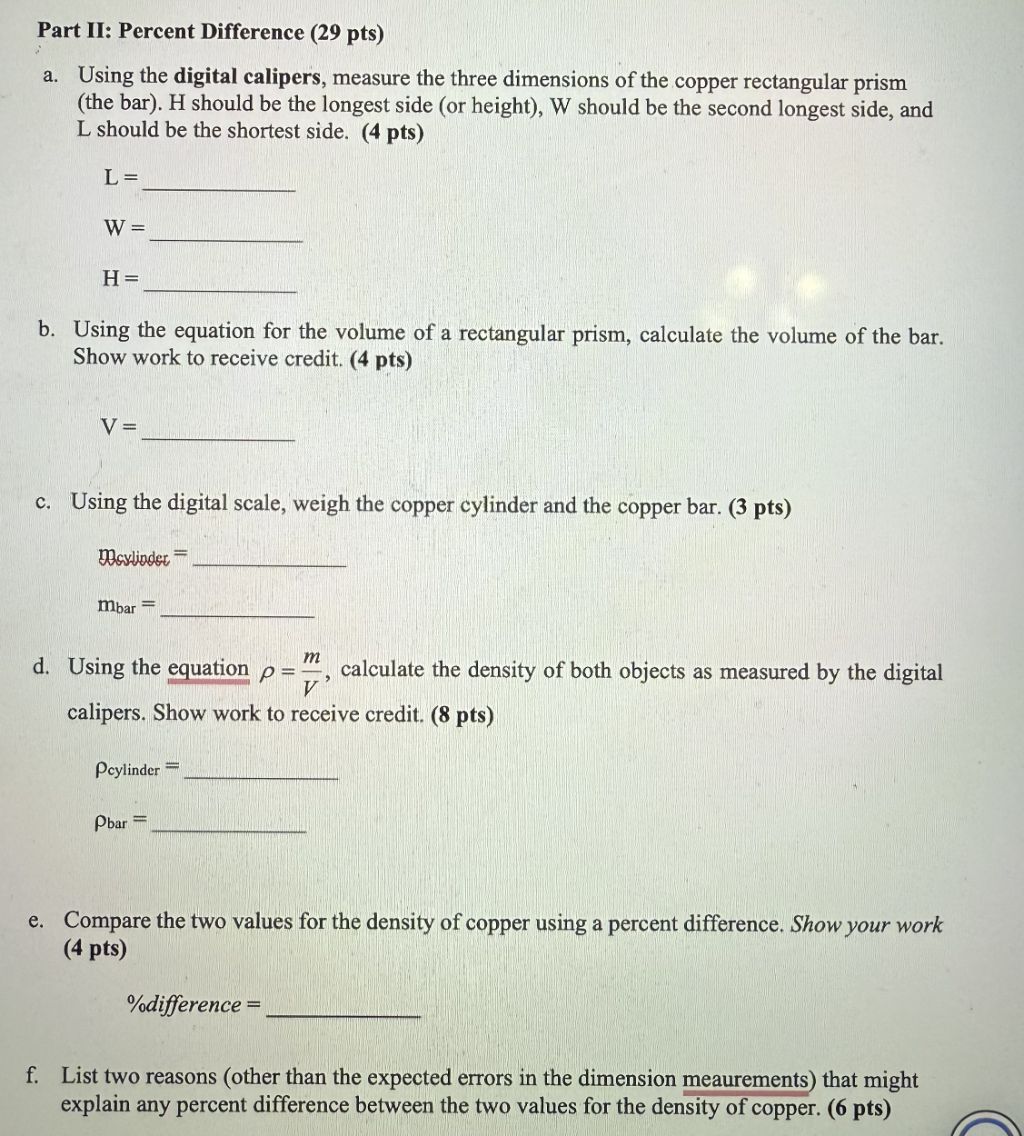
a. Using the digital calipers, measure the three dimensions of the copper rectangular prism
(the bar). H should be the longest side (or height), W should be the second longest side, and
L should be the shortest side. (4 pts)
ASS UNE)
NE
GET A
b. Using the equation for the volume of a rectangular prism, calculate the volume of the bar.
Show work to receive credit. (4 pts)
VEE
c. Using the digital scale, weigh the copper cylinder and the copper bar. (3 pts)
Wevlipder LLL LED
Mpar =
d. Using the equation p = 2) calculate the density of both objects as measured by the digital
i Hi
calipers. Show work to receive credit. (8 pts)
Peylinder =
Phar =
e. Compare the two values for the density of copper using a percent difference. Show your work
(4 pts)
Yedifference =
f. List two reasons (other than the expected errors in the dimension meaurements) that might
explain any percent difference between the two values for the density of copper. (6 pts) N
Question:
now split the whole answer into 6 precise parts and include every step and show every calculation in detail divided into those 6 parts. For each of the 6 parts write a short and 'separate' 'theoretical explanation/reasoning' for that part in a separate paragraph at the end of that part. in the end, write a short final answer for all the partsPart II: Percent Difference (29 pts)
a. Using the digital calipers, measure the three dimensions of the copper rectangular prism
(the bar). H should be the longest side (or height), W should be the second longest side, and
L should be the shortest side. (4 pts)
ASS UNE)
NE
GET A
b. Using the equation for the volume of a rectangular prism, calculate the volume of the bar.
Show work to receive credit. (4 pts)
VEE
c. Using the digital scale, weigh the copper cylinder and the copper bar. (3 pts)
Wevlipder LLL LED
Mpar =
d. Using the equation p = 2) calculate the density of both objects as measured by the digital
i Hi
calipers. Show work to receive credit. (8 pts)
Peylinder =
Phar =
e. Compare the two values for the density of copper using a percent difference. Show your work
(4 pts)
Yedifference =
f. List two reasons (other than the expected errors in the dimension meaurements) that might
explain any percent difference between the two values for the density of copper. (6 pts) N
This is AI generated Response.
Asked by: Atharva Sahu
Created at: 2025-06-19 02:08:01
Final Answer:
RenderedRaw Text
Did you like this answer?
Absolutely! Here is a detailed step-by-step breakdown of the solution to each part, including calculations and a theoretical explanation for each step, followed by a short final answer summarizing all the steps.
---
### **Part 1: Measuring the Dimensions of the Copper Bar**
**a. Using the digital calipers, measure the three dimensions of the copper rectangular prism (the bar). H should be the longest side (or height), W the second longest, and L the shortest.**
- **L = __________**
- **W = __________**
- **H = __________**
#### **Theoretical Explanation:**
Measuring the three dimensions (length, width, height) of the rectangular prism (the copper bar) is necessary to calculate its volume. Using digital calipers ensures precise measurements, which are crucial for accurate calculations in later steps.
---
### **Part 2: Calculating the Volume of the Bar**
**b. Using the equation for the volume of a rectangular prism, calculate the volume of the bar.**
**Formula:**
\[
V = L \times W \times H
\]
- **V = __________**
#### **Theoretical Explanation:**
The volume of a rectangular prism is given by the product of its length, width, and height. Knowing the volume is essential for determining the density, as density is defined as mass divided by volume.
---
### **Part 3: Measuring the Masses**
**c. Using the digital scale, weigh the copper cylinder and the copper bar.**
- **\( m_{cylinder} = \) __________**
- **\( m_{bar} = \) __________**
#### **Theoretical Explanation:**
Measuring the mass of both the copper cylinder and copper bar is essential for calculating density. A digital scale provides accurate mass measurements needed for precise density calculations.
---
### **Part 4: Calculating Densities**
**d. Using \(\rho = \frac{m}{V}\), calculate the density of both objects as measured by the digital calipers.**
**For the Cylinder:**
\[
\rho_{cylinder} = \frac{m_{cylinder}}{V_{cylinder}}
\]
**For the Bar:**
\[
\rho_{bar} = \frac{m_{bar}}{V_{bar}}
\]
- **\(\rho_{cylinder} =\) __________**
- **\(\rho_{bar} =\) __________**
#### **Theoretical Explanation:**
Density is defined as mass per unit volume. Calculating the density of both the cylinder and the bar allows comparison of experimental values and helps identify errors or inconsistencies in measurements or material uniformity.
---
### **Part 5: Calculating Percent Difference**
**e. Compare the two density values using percent difference.**
**Formula:**
\[
\% \text{difference} = \frac{|\rho_{cylinder} - \rho_{bar}|}{\frac{1}{2}(\rho_{cylinder} + \rho_{bar})} \times 100\%
\]
- **\(\% \text{difference} =\) __________**
#### **Theoretical Explanation:**
Percent difference quantifies the relative difference between two values, offering a normalized measure of how much the two density measurements deviate from each other relative to their average.
---
### **Part 6: Explanation of Percent Difference**
**f. List two reasons (other than expected errors in dimension measurements) that might explain any percent difference between the two values for the density of copper.**
**Possible Answers:**
1. **Material Impurities:** The copper samples might contain impurities or other metals, affecting the mass and thus the calculated density.
2. **Air Bubbles or Voids:** The presence of small air bubbles or internal voids in the samples can reduce the effective mass or increase the measured volume, skewing density values.
#### **Theoretical Explanation:**
Other factors besides measurement error can affect experimental results. Material purity and internal structure can both cause deviations from expected density values, resulting in a measurable percent difference even if all measurements are accurate.
---
## **Final Short Answer Summarizing All Parts:**
1. **Measured the bar's dimensions** using digital calipers for accurate volume calculation.
2. **Calculated the volume** of the bar using the formula for a rectangular prism.
3. **Measured the masses** of both the copper cylinder and bar using a digital scale.
4. **Calculated densities** for both samples using \(\rho = \frac{m}{V}\).
5. **Computed the percent difference** between the two density values to quantify experimental deviation.
6. **Identified possible sources** of error other than measurement inaccuracies, such as material impurities or internal voids.
These steps collectively allow for a thorough and systematic determination and comparison of density values for copper samples, highlighting both methodological rigor and potential sources of error in experimental physics.
VIPSolutions focuses on clear, step‑by‑step explanations so you can learn quickly. Whether you need an AI‑generated walkthrough or a short hint to get unstuck, each solution is organized for fast reading and easy review later.
Search similar questions, compare approaches, and bookmark the best answers for revision. Our goal is simple: quick, reliable study help that feels natural—not noisy.
 VIPSolutions
 Part II: Percent Difference (29 pts)
a. Using the digital calipers, measure the three dimensions of the copper rectangular prism
(the bar). H should be the longest side (or height), W should be the second longest side, and
L should be the shortest side. (4 pts)
ASS UNE)
NE
GET A
b. Using the equation for the volume of a rectangular prism, calculate the volume of the bar.
Show work to receive credit. (4 pts)
VEE
c. Using the digital scale, weigh the copper cylinder and the copper bar. (3 pts)
Wevlipder LLL LED
Mpar =
d. Using the equation p = 2) calculate the density of both objects as measured by the digital
i Hi
calipers. Show work to receive credit. (8 pts)
Peylinder =
Phar =
e. Compare the two values for the density of copper using a percent difference. Show your work
(4 pts)
Yedifference =
f. List two reasons (other than the expected errors in the dimension meaurements) that might
explain any percent difference between the two values for the density of copper. (6 pts) N
Part II: Percent Difference (29 pts)
a. Using the digital calipers, measure the three dimensions of the copper rectangular prism
(the bar). H should be the longest side (or height), W should be the second longest side, and
L should be the shortest side. (4 pts)
ASS UNE)
NE
GET A
b. Using the equation for the volume of a rectangular prism, calculate the volume of the bar.
Show work to receive credit. (4 pts)
VEE
c. Using the digital scale, weigh the copper cylinder and the copper bar. (3 pts)
Wevlipder LLL LED
Mpar =
d. Using the equation p = 2) calculate the density of both objects as measured by the digital
i Hi
calipers. Show work to receive credit. (8 pts)
Peylinder =
Phar =
e. Compare the two values for the density of copper using a percent difference. Show your work
(4 pts)
Yedifference =
f. List two reasons (other than the expected errors in the dimension meaurements) that might
explain any percent difference between the two values for the density of copper. (6 pts) N