 VIPSolutions
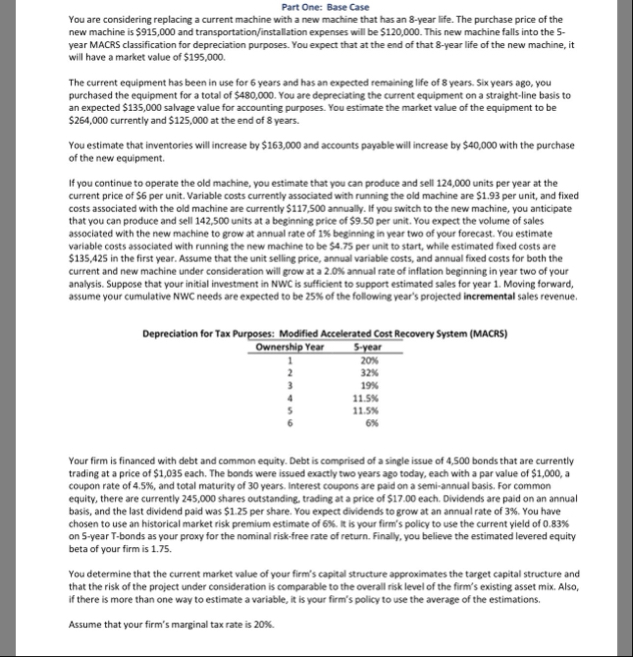
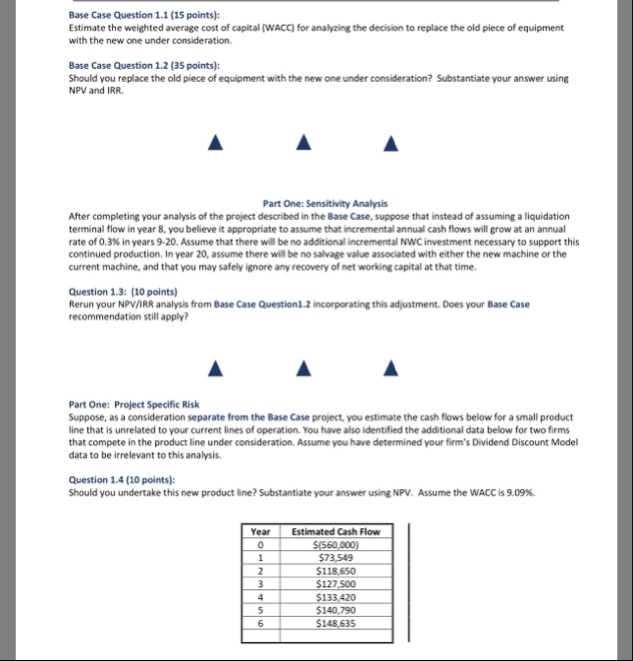
Part One: Base Case You are considering replacing a current machine with a new machine that has an 8 - year life. The purchase price of the new machine is $ 9 1 5 , 0 0 0 and transportation / installation expenses will be $ 1 2 0 , 0 0 0 . This new machine falls into the 5 year MACRS classification for depreciation purposes. You expect that at the end of that 8 - year life of the new machine, it will have a market value of $ 1 9 5 , 0 0 0 . The current equipment has been in use for 6 years and has an expected remaining life of 8 years. Six years ago, you purchased the equipment for a total of $ 4 8 0 , 0 0 0 . You are depreciating the current equipment on a straight - line basis to an expected $ 1 3 5 , 0 0 0 salvage value for accounting purposes. You estimate the market value of the equipment to be $ 2 6 4 , 0 0 0 currently and $ 1 2 5 , 0 0 0 at the end of 8 years. You estimate that inventories will increase by $ 1 6 3 , 0 0 0 and accounts payable will increase by $ 4 0 , 0 0 0 with the purchase of the new equipment. If you continue to operate the old machine, you estimate that you can produce and sell 1 2 4 , 0 0 0 units per year at the current price of $ 6 per unit. Variable costs currently associated with running the old machine are $ 1 . 9 3 per unit, and fixed costs associated with the old machine are currently $ 1 1 7 , 5 0 0 annually. If you switch to the new machine, you anticipate that you can produce and sell 1 4 2 , 5 0 0 units at a beginning price of $ 9 . 5 0 per unit. You expect the volume of sales associated with the new machine to grow at annual rate of 1 % beginning in year two of your forecast. You estimate variable costs associated with running the new machine to be $ 4 . 7 5 per unit to start, while estimated foxed costs are $ 1 3 5 , 4 2 5 in the first year. Assume that the unit selling price, annual variable costs, and annual fixed costs for both the current and new machine under consideration will grow at a 2 . 0 % annual rate of inflation beginning in year two of your analysis. Suppose that your initial investment in NWC is sufficient to support estimated sales for year 1 . Moving forward, assume your cumulative NWC needs are expected to be 2 5 % of the following year's projected incremental sales revenue. Depreciation for Tax Purposes: Modified Accelerated Cost Recovery System ( MACRS ) \ table [ [ Ownership Year, 5 - year ] , [ 1 , 2 0 %Part One: Base Case: Youre considering replacing 3 current machine with 3 new machin that ha an 8 year i. The purchase price of the new machine i $915,000 nd transportton/stataton expenses will be $120,000. Tis new machin fal to the 5 Year MACRS classification fo depreciation purposes. You expec hat at th end of that year fe of the new machine, it wi have 3 market value of $155,000. The corent equipment has been n us or 6 years nd has an expected remaining fe of 8 years. Sin years a0, you purchased the equipment or 3 total of $480,000. You are depreciating the curent equipment on a sraght Ine bass 10 an expected $135,000 savage valu for accounting purposes You estimate the market value of the equipment tobe $264,000 currently and $125,000 a the end of 8 years. You estimate that inventories wi increase by $163,000 and accounts payable wil increas by $40,000 with th purchase of the new eauprment you continue to operate the ld machine, you estimate tht you can produce and sll 124000 unis per year at the current rice of 6 par un. Variable costs currently ass0cated wih runing the old machin are $1.93 per uni, and fed. costs associated wth the od machine re currently $117,500 anual. f you switch to the new machin, you antic that you an produce an sel 142,500 ts at begining price of $9.50 per uh. You expect the volume of sales asioiated with the new machine to grow at annual rte of 1% begining = year twa of your forecast. You estimate ‘Variable costs asocited with runing the new machine o be 4.75 per un 1 tart, whi estimated fed costs are $135,426 in the ist yer. Assume tha the un sling pce, anual variable costs, and anal fed cots for both the current and new machine under consideration wil grow a a 2.0% annual rate of inflation beg ring in yea two of your naval Suppose that your tal investment in NWC 5 sufficient 0 suppers estimated sales for year 1 Movin formard, 2550me your cumulative NWC needs are expected to be 25% ofthe fokoweng rears projected Incremental als revenue. Depreciation fr Tax Purposes: Modified Accelerated Cost Recovery System (MACRS) OwnerihpYes 5-year 1 on 2 po H 19% i re 5 re H o Your rm is financed wih debt and common equity. Debt i comerised of 3 singe issue of 4500 bonds that are currently trading ata price of $1,035 each. The bods were issued exactly two years ag today, each witha par value of $1.000,2 Coupon ate of 4.5%, and etal maturity of 30 years terest coupons re pad on semi-annual bass. For common equity, tere are currently 245,000 shares outstanding. trading at a price of $17.00 each. Dwvidends are aid on an ann bas, nd the ast dividend pad ws $1.25 per share. You expect dwidends 10 grow a an anual rate of 3%. You have chosen to use an historical market isk premium estimate of €. 5 your fms plc use the current yield of 0 83% on .year bonds 35 your proc for the nominal ik re ate of recur. Fina, you beieve the estimated levered equity beta of your firms 175. You determine tht the current market value of your fs capt structure approxiates th target Hp srture and that the risk of the project under consideration s comparable to the overall risk evel of the fms existing asset mis. Alo, Ifthere is more than one way to estimate a variable, is you fire's poly 0 use the average of the estimations. Asam that you fms marginal tax ates 20%. Base Case Question 1.1 (15 poets): Estimate the weighed average cos of capa (WACC) for snlying the decison o replace th od piece of equipment withthe new ane under comeration ste Case Question 1.2 (35 points): Should you replace the od piece of equipment with the ew ane under consideration? Substantiate your answer wing NPV and RR Par One: Sensi Analysis Ate completing your analysis of the project described inthe Base Case, suppose that instead of assuming a luidtion terminal flowin yer 8, you bekeve i propriate to assume that cremental annual cash flows wil grow at an annual 1210 010.3% i years 9.20. Assume tha there wil be no addtional incremental WC ovement necessary 0 support hs continued production. nye 20, ssume there wil be no savage value associated with ether the new machine o the current machine, nd tht you may safely ignore any recovery of net working captal at tht time. Question 1.3: (10 points) Rerun your NPY/IRR anys rom Base Cas Question 2 incorpersting ths adjustment, Does your Base Cae recommendation stl app? Part One: Project Specic Risk Suppose, a. Consideration separate from the Base Cs project, you estimate the cash flows below fo a small product in hats unvelted 0 your current bnes of operation You have also dented the add tions data beow for two firms that compete inthe product ne under consideration Asume you have determined your fem’ Dnidend Discount Model data tobe relevant to this analysis. Question 1.4 (10 pants): Should you undertake this new product ine? Substantiate your answer using NPY. Assume the WACC 5 3.09%. [Year estimated Cash iow | [oT spoon | 1 sss EI —TT) 3 1271500 [eT sao) |e 1 swsms I
Question:
Part One: Base Case
You are considering replacing a current machine with a new machine that has an
8
-
year life. The purchase price of the new machine is $
9
1
5
,
0
0
0
and transportation
/
installation expenses will be $
1
2
0
,
0
0
0
.
This new machine falls into the
5
year MACRS classification for depreciation purposes. You expect that at the end of that
8
-
year life of the new machine, it will have a market value of $
1
9
5
,
0
0
0
.
The current equipment has been in use for
6
years and has an expected remaining life of
8
years. Six years ago, you purchased the equipment for a total of $
4
8
0
,
0
0
0
.
You are depreciating the current equipment on a straight
-
line basis to an expected $
1
3
5
,
0
0
0
salvage value for accounting purposes. You estimate the market value of the equipment to be $
2
6
4
,
0
0
0
currently and $
1
2
5
,
0
0
0
at the end of
8
years.
You estimate that inventories will increase by $
1
6
3
,
0
0
0
and accounts payable will increase by $
4
0
,
0
0
0
with the purchase of the new equipment.
If you continue to operate the old machine, you estimate that you can produce and sell
1
2
4
,
0
0
0
units per year at the current price of $
6
per unit. Variable costs currently associated with running the old machine are $
1
.
9
3
per unit, and fixed costs associated with the old machine are currently $
1
1
7
,
5
0
0
annually. If you switch to the new machine, you anticipate that you can produce and sell
1
4
2
,
5
0
0
units at a beginning price of $
9
.
5
0
per unit. You expect the volume of sales associated with the new machine to grow at annual rate of
1
%
beginning in year two of your forecast. You estimate variable costs associated with running the new machine to be $
4
.
7
5
per unit to start, while estimated foxed costs are $
1
3
5
,
4
2
5
in the first year. Assume that the unit selling price, annual variable costs, and annual fixed costs for both the current and new machine under consideration will grow at a
2
.
0
%
annual rate of inflation beginning in year two of your analysis. Suppose that your initial investment in NWC is sufficient to support estimated sales for year
1
.
Moving forward, assume your cumulative NWC needs are expected to be
2
5
%
of the following year's projected incremental sales revenue.
Depreciation for Tax Purposes: Modified Accelerated Cost Recovery System
(
MACRS
)
\
table
[
[
Ownership Year,
5
-
year
]
,
[
1
,
2
0
%
 Part One: Base Case:
Youre considering replacing 3 current machine with 3 new machin that ha an 8 year i. The purchase price of the
new machine i $915,000 nd transportton/stataton expenses will be $120,000. Tis new machin fal to the 5
Year MACRS classification fo depreciation purposes. You expec hat at th end of that year fe of the new machine, it
wi have 3 market value of $155,000.
The corent equipment has been n us or 6 years nd has an expected remaining fe of 8 years. Sin years a0, you
purchased the equipment or 3 total of $480,000. You are depreciating the curent equipment on a sraght Ine bass 10
an expected $135,000 savage valu for accounting purposes You estimate the market value of the equipment tobe
$264,000 currently and $125,000 a the end of 8 years.
You estimate that inventories wi increase by $163,000 and accounts payable wil increas by $40,000 with th purchase
of the new eauprment
you continue to operate the ld machine, you estimate tht you can produce and sll 124000 unis per year at the
current rice of 6 par un. Variable costs currently ass0cated wih runing the old machin are $1.93 per uni, and fed.
costs associated wth the od machine re currently $117,500 anual. f you switch to the new machin, you antic
that you an produce an sel 142,500 ts at begining price of $9.50 per uh. You expect the volume of sales
asioiated with the new machine to grow at annual rte of 1% begining = year twa of your forecast. You estimate
‘Variable costs asocited with runing the new machine o be 4.75 per un 1 tart, whi estimated fed costs are
$135,426 in the ist yer. Assume tha the un sling pce, anual variable costs, and anal fed cots for both the
current and new machine under consideration wil grow a a 2.0% annual rate of inflation beg ring in yea two of your
naval Suppose that your tal investment in NWC 5 sufficient 0 suppers estimated sales for year 1 Movin formard,
2550me your cumulative NWC needs are expected to be 25% ofthe fokoweng rears projected Incremental als revenue.
Depreciation fr Tax Purposes: Modified Accelerated Cost Recovery System (MACRS)
OwnerihpYes 5-year
1 on
2 po
H 19%
i re
5 re
H o
Your rm is financed wih debt and common equity. Debt i comerised of 3 singe issue of 4500 bonds that are currently
trading ata price of $1,035 each. The bods were issued exactly two years ag today, each witha par value of $1.000,2
Coupon ate of 4.5%, and etal maturity of 30 years terest coupons re pad on semi-annual bass. For common
equity, tere are currently 245,000 shares outstanding. trading at a price of $17.00 each. Dwvidends are aid on an ann
bas, nd the ast dividend pad ws $1.25 per share. You expect dwidends 10 grow a an anual rate of 3%. You have
chosen to use an historical market isk premium estimate of €. 5 your fms plc use the current yield of 0 83%
on .year bonds 35 your proc for the nominal ik re ate of recur. Fina, you beieve the estimated levered equity
beta of your firms 175.
You determine tht the current market value of your fs capt structure approxiates th target Hp srture and
that the risk of the project under consideration s comparable to the overall risk evel of the fms existing asset mis. Alo,
Ifthere is more than one way to estimate a variable, is you fire's poly 0 use the average of the estimations.
Asam that you fms marginal tax ates 20%.
Base Case Question 1.1 (15 poets):
Estimate the weighed average cos of capa (WACC) for snlying the decison o replace th od piece of equipment
withthe new ane under comeration
ste Case Question 1.2 (35 points):
Should you replace the od piece of equipment with the ew ane under consideration? Substantiate your answer wing
NPV and RR
Par One: Sensi Analysis
Ate completing your analysis of the project described inthe Base Case, suppose that instead of assuming a luidtion
terminal flowin yer 8, you bekeve i propriate to assume that cremental annual cash flows wil grow at an annual
1210 010.3% i years 9.20. Assume tha there wil be no addtional incremental WC ovement necessary 0 support hs
continued production. nye 20, ssume there wil be no savage value associated with ether the new machine o the
current machine, nd tht you may safely ignore any recovery of net working captal at tht time.
Question 1.3: (10 points)
Rerun your NPY/IRR anys rom Base Cas Question 2 incorpersting ths adjustment, Does your Base Cae
recommendation stl app?
Part One: Project Specic Risk
Suppose, a. Consideration separate from the Base Cs project, you estimate the cash flows below fo a small product
in hats unvelted 0 your current bnes of operation You have also dented the add tions data beow for two firms
that compete inthe product ne under consideration Asume you have determined your fem’ Dnidend Discount Model
data tobe relevant to this analysis.
Question 1.4 (10 pants):
Should you undertake this new product ine? Substantiate your answer using NPY. Assume the WACC 5 3.09%.
[Year estimated Cash iow |
[oT spoon |
1 sss
EI —TT)
3 1271500
[eT sao)
|e 1 swsms
I
Part One: Base Case:
Youre considering replacing 3 current machine with 3 new machin that ha an 8 year i. The purchase price of the
new machine i $915,000 nd transportton/stataton expenses will be $120,000. Tis new machin fal to the 5
Year MACRS classification fo depreciation purposes. You expec hat at th end of that year fe of the new machine, it
wi have 3 market value of $155,000.
The corent equipment has been n us or 6 years nd has an expected remaining fe of 8 years. Sin years a0, you
purchased the equipment or 3 total of $480,000. You are depreciating the curent equipment on a sraght Ine bass 10
an expected $135,000 savage valu for accounting purposes You estimate the market value of the equipment tobe
$264,000 currently and $125,000 a the end of 8 years.
You estimate that inventories wi increase by $163,000 and accounts payable wil increas by $40,000 with th purchase
of the new eauprment
you continue to operate the ld machine, you estimate tht you can produce and sll 124000 unis per year at the
current rice of 6 par un. Variable costs currently ass0cated wih runing the old machin are $1.93 per uni, and fed.
costs associated wth the od machine re currently $117,500 anual. f you switch to the new machin, you antic
that you an produce an sel 142,500 ts at begining price of $9.50 per uh. You expect the volume of sales
asioiated with the new machine to grow at annual rte of 1% begining = year twa of your forecast. You estimate
‘Variable costs asocited with runing the new machine o be 4.75 per un 1 tart, whi estimated fed costs are
$135,426 in the ist yer. Assume tha the un sling pce, anual variable costs, and anal fed cots for both the
current and new machine under consideration wil grow a a 2.0% annual rate of inflation beg ring in yea two of your
naval Suppose that your tal investment in NWC 5 sufficient 0 suppers estimated sales for year 1 Movin formard,
2550me your cumulative NWC needs are expected to be 25% ofthe fokoweng rears projected Incremental als revenue.
Depreciation fr Tax Purposes: Modified Accelerated Cost Recovery System (MACRS)
OwnerihpYes 5-year
1 on
2 po
H 19%
i re
5 re
H o
Your rm is financed wih debt and common equity. Debt i comerised of 3 singe issue of 4500 bonds that are currently
trading ata price of $1,035 each. The bods were issued exactly two years ag today, each witha par value of $1.000,2
Coupon ate of 4.5%, and etal maturity of 30 years terest coupons re pad on semi-annual bass. For common
equity, tere are currently 245,000 shares outstanding. trading at a price of $17.00 each. Dwvidends are aid on an ann
bas, nd the ast dividend pad ws $1.25 per share. You expect dwidends 10 grow a an anual rate of 3%. You have
chosen to use an historical market isk premium estimate of €. 5 your fms plc use the current yield of 0 83%
on .year bonds 35 your proc for the nominal ik re ate of recur. Fina, you beieve the estimated levered equity
beta of your firms 175.
You determine tht the current market value of your fs capt structure approxiates th target Hp srture and
that the risk of the project under consideration s comparable to the overall risk evel of the fms existing asset mis. Alo,
Ifthere is more than one way to estimate a variable, is you fire's poly 0 use the average of the estimations.
Asam that you fms marginal tax ates 20%.
Base Case Question 1.1 (15 poets):
Estimate the weighed average cos of capa (WACC) for snlying the decison o replace th od piece of equipment
withthe new ane under comeration
ste Case Question 1.2 (35 points):
Should you replace the od piece of equipment with the ew ane under consideration? Substantiate your answer wing
NPV and RR
Par One: Sensi Analysis
Ate completing your analysis of the project described inthe Base Case, suppose that instead of assuming a luidtion
terminal flowin yer 8, you bekeve i propriate to assume that cremental annual cash flows wil grow at an annual
1210 010.3% i years 9.20. Assume tha there wil be no addtional incremental WC ovement necessary 0 support hs
continued production. nye 20, ssume there wil be no savage value associated with ether the new machine o the
current machine, nd tht you may safely ignore any recovery of net working captal at tht time.
Question 1.3: (10 points)
Rerun your NPY/IRR anys rom Base Cas Question 2 incorpersting ths adjustment, Does your Base Cae
recommendation stl app?
Part One: Project Specic Risk
Suppose, a. Consideration separate from the Base Cs project, you estimate the cash flows below fo a small product
in hats unvelted 0 your current bnes of operation You have also dented the add tions data beow for two firms
that compete inthe product ne under consideration Asume you have determined your fem’ Dnidend Discount Model
data tobe relevant to this analysis.
Question 1.4 (10 pants):
Should you undertake this new product ine? Substantiate your answer using NPY. Assume the WACC 5 3.09%.
[Year estimated Cash iow |
[oT spoon |
1 sss
EI —TT)
3 1271500
[eT sao)
|e 1 swsms
I
Asked by: REDDY BHARGAVA SURYA TEJA
Created at: 2025-11-18 15:46:30
Final Answer:
📢 Instructions:
- Ask anything relatd to above question only.
- For new Question goto :