 VIPSolutions
Please answer questions 5 and 6 i n the based o n the cape chemical scenerio i n the images. I a m really stuck.SCL THE SITUATION ‘The unexpected withdrawal of one of Cape Chemical’s competitors from the region has provided the opportunity to increase its blended packaged goods sales. That's the good news. The bad news is Cape Chemical’s blending equipment is operating at capacity, thus to take advantage of this opportunity, additional equipment must be obtained, requiring a major capital investment. It is estimated that Cape Chemical must increase its annual blending capacity by 800,000 gallons to meet expected demand for the next three years Annual capacity must increase by 1,400,000 gallons to meet projected demand beyond the next three years. Stewart is considering two alternatives proposed by the company’s engineer. The first is the acquisition and installation of used equipment that will provide the capacity to blend an additional 800,000 gallons annually. The used equipment will cost $105,000 to acquire and $15,000 to install. ‘The equipment is projected to have an estimated life of three years. The second option is the acquisition and installation of new equipment with the capacity to blend 1,600,000 gallons annually. The new equipment would have a substantially higher cost of $360,000 to acquire and $60,000 to install, but have a higher capacity and an economic life of seven years. The new equipment is also more efficient thus the cost of blending is less than the blending cost of the used equipment. Stewart asked Clarkson to lead the evaluation process. Stewart thinks the used equipment could be obtained without a new bank loan. The acquisition of the new equipment would require new bank borrowing. The evaluation of each alternative will require an estimate of the financial benefits associated with each. The marketing and sales staff estimated incremental sales of blended package material will be 600,000 gallons the first year and increase by 15% each year thereafter. During the last year, the average selling price for blended material has been near $4.05 per gallon and material cost (not including a cost for blending the material) has been approximately $3.53. The ‘marketing staff anticipates no significant change in either future selling prices or product costs; however they do estimate variable selling and administrative expenses associated with the increased blended material sales to be $.20 per gallon. 136 Weighted Average Cost of Capital (WACC) Using input from an investment banking firm, Clarkson estimates the company’s cost of equity to be 18%. Their bank has indicated a long-term bank loan can be arranged to finance the new equipment at an annual interest rate of 12% (before tax cost of debt). The bank would require the loan to be secured with the new equipment. The loan agreement would also include a number of restrictive covenants, including a limitation of dividends while the loans are outstanding. While long-term debt is not included in the firm's current capital structure, Clarkson believes a 30% debt, 70% equity capital mix would be appropriate for Cape Chemical. Last year, the company's federal-plus-state income tax rate was 30%. Clarkson does not expect the income tax rate to change in the foreseeable future. Used Equipment The used equipment will cost $105,000 with another $15,000 required to install the equipment. ‘The equipment is projected to have an economic life of three years with a salvage value of $9,000. The equipment will provide the capacity to blend an additional 800,000 gallons annually. The variable blending cost is estimated to be $.20 per gallon. The equipment will be depreciated under the Modified Accelerate Cost Recovery System (MACRS) 3-year class. Under the current tax law, the depreciation allowances are 0.33,0.45, 0.15, and 0.07 in years 1 through 4, respectively. The increased sales volume will require an additional investment in working capital of 2% of sales (to be on hand at the beginning of the year). 4. Evaluate the strengths and weaknesses of the Cash Payback Period, Discounted Cash Payback Period, NPV, IRR and MIRR capital expenditure budgeting methods. Prepare a recommendation for Stewart regarding the capital budgeting method or methods to use in evaluating the expansion alternatives. Support your answer. 5. Calculate the Cash Payback Period, Discounted Cash Payback Period, NPV, IRR and MIRR for each alternative. For the calculations, assume a WACC of 15%. Based on the results of these ‘methods, should either option be selected? Why? Solution requires preparation ofa spreadsheet. 6. Stewart is concerned that the projected annual sales growth rate of 15% for incremental blended ‘material may be optimistic. Recalculate the Cash Payback Period, Discounted Cash Payback Period, NPV, IRR and MIRR for each alternative assuming the annual sales growth rates of 10% and 5%. Assume a WACC of 15%. Does the change in growth rate alter the recommendation ‘made in question 5? Solution requires preparation of spreadsheets. Explain. 7. The projected cash flow benefits of both projects did not include the effects of inflation. Future cash flows were determined using a constant selling price and operating costs (real cash flows). The cash flows were then discounted using a WACC that included the impact of inflation (nominal WACC). Discuss the problem with using real cash flows and a nominal WACC when calculating a project’s Discounted Payback Period, NPV, IRR and MIRR. 8. ‘What other issues should Stewart and Clarkson considered before a final decision regarding the expansion alternatives is made?
Question:
Please answer questions
5
and
6
i
n
the based
o
n
the cape chemical scenerio
i
n
the images. I
a
m
really stuck.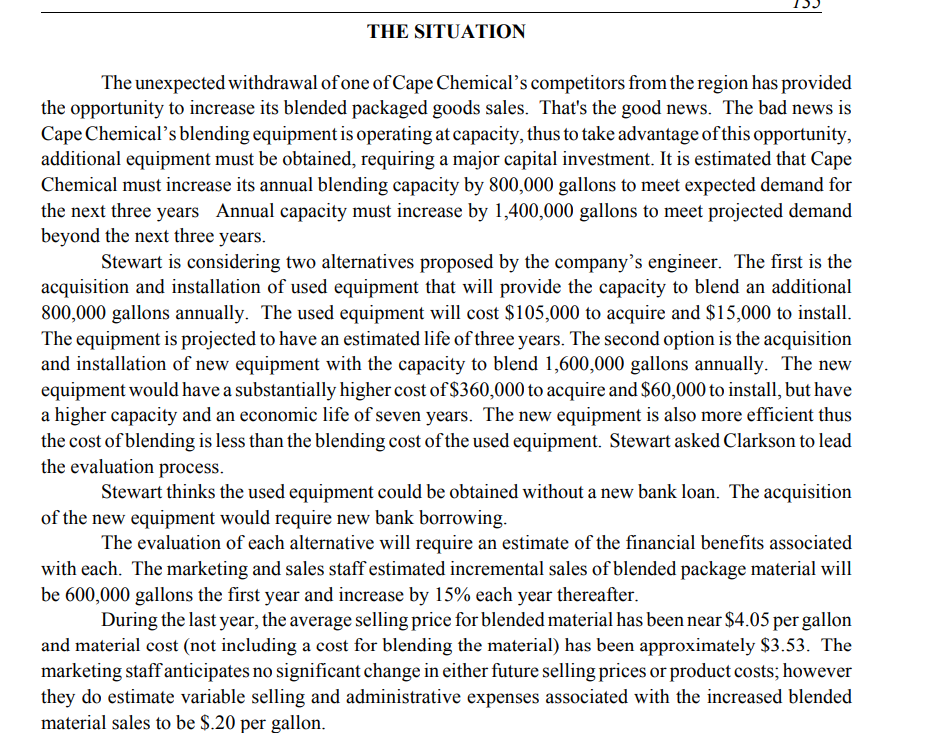
 SCL
THE SITUATION
‘The unexpected withdrawal of one of Cape Chemical’s competitors from the region has provided
the opportunity to increase its blended packaged goods sales. That's the good news. The bad news is
Cape Chemical’s blending equipment is operating at capacity, thus to take advantage of this opportunity,
additional equipment must be obtained, requiring a major capital investment. It is estimated that Cape
Chemical must increase its annual blending capacity by 800,000 gallons to meet expected demand for
the next three years Annual capacity must increase by 1,400,000 gallons to meet projected demand
beyond the next three years.
Stewart is considering two alternatives proposed by the company’s engineer. The first is the
acquisition and installation of used equipment that will provide the capacity to blend an additional
800,000 gallons annually. The used equipment will cost $105,000 to acquire and $15,000 to install.
‘The equipment is projected to have an estimated life of three years. The second option is the acquisition
and installation of new equipment with the capacity to blend 1,600,000 gallons annually. The new
equipment would have a substantially higher cost of $360,000 to acquire and $60,000 to install, but have
a higher capacity and an economic life of seven years. The new equipment is also more efficient thus
the cost of blending is less than the blending cost of the used equipment. Stewart asked Clarkson to lead
the evaluation process.
Stewart thinks the used equipment could be obtained without a new bank loan. The acquisition
of the new equipment would require new bank borrowing.
The evaluation of each alternative will require an estimate of the financial benefits associated
with each. The marketing and sales staff estimated incremental sales of blended package material will
be 600,000 gallons the first year and increase by 15% each year thereafter.
During the last year, the average selling price for blended material has been near $4.05 per gallon
and material cost (not including a cost for blending the material) has been approximately $3.53. The
‘marketing staff anticipates no significant change in either future selling prices or product costs; however
they do estimate variable selling and administrative expenses associated with the increased blended
material sales to be $.20 per gallon.
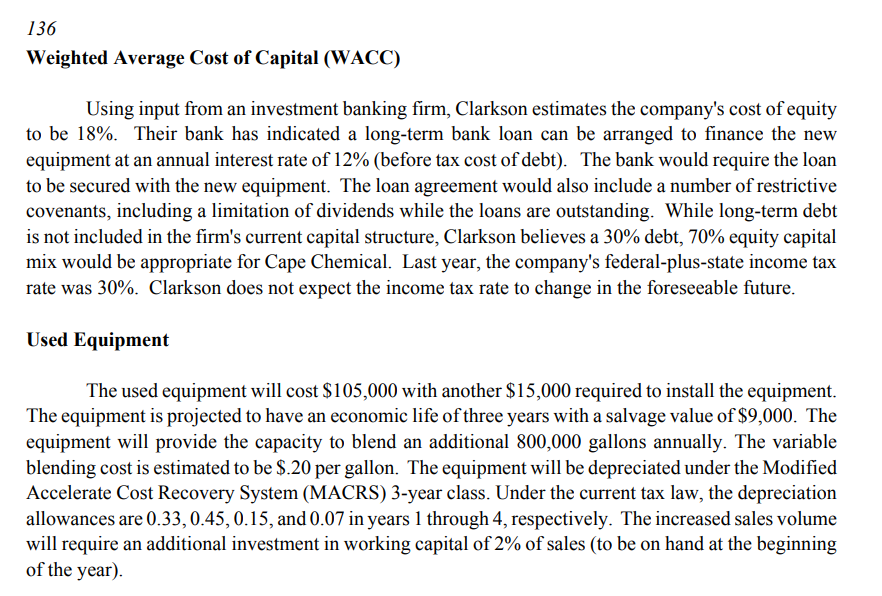
136
Weighted Average Cost of Capital (WACC)
Using input from an investment banking firm, Clarkson estimates the company’s cost of equity
to be 18%. Their bank has indicated a long-term bank loan can be arranged to finance the new
equipment at an annual interest rate of 12% (before tax cost of debt). The bank would require the loan
to be secured with the new equipment. The loan agreement would also include a number of restrictive
covenants, including a limitation of dividends while the loans are outstanding. While long-term debt
is not included in the firm's current capital structure, Clarkson believes a 30% debt, 70% equity capital
mix would be appropriate for Cape Chemical. Last year, the company's federal-plus-state income tax
rate was 30%. Clarkson does not expect the income tax rate to change in the foreseeable future.
Used Equipment
The used equipment will cost $105,000 with another $15,000 required to install the equipment.
‘The equipment is projected to have an economic life of three years with a salvage value of $9,000. The
equipment will provide the capacity to blend an additional 800,000 gallons annually. The variable
blending cost is estimated to be $.20 per gallon. The equipment will be depreciated under the Modified
Accelerate Cost Recovery System (MACRS) 3-year class. Under the current tax law, the depreciation
allowances are 0.33,0.45, 0.15, and 0.07 in years 1 through 4, respectively. The increased sales volume
will require an additional investment in working capital of 2% of sales (to be on hand at the beginning
of the year).
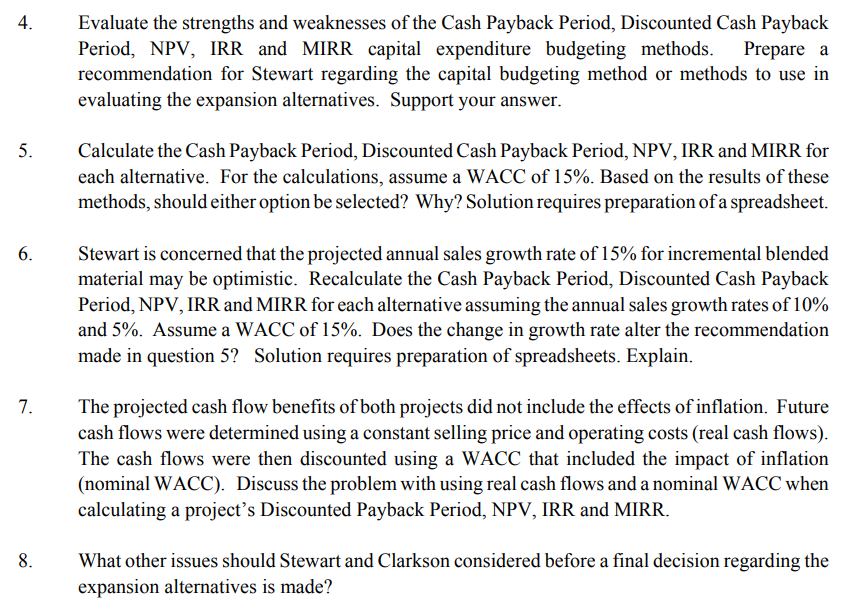
4. Evaluate the strengths and weaknesses of the Cash Payback Period, Discounted Cash Payback
Period, NPV, IRR and MIRR capital expenditure budgeting methods. Prepare a
recommendation for Stewart regarding the capital budgeting method or methods to use in
evaluating the expansion alternatives. Support your answer.
5. Calculate the Cash Payback Period, Discounted Cash Payback Period, NPV, IRR and MIRR for
each alternative. For the calculations, assume a WACC of 15%. Based on the results of these
‘methods, should either option be selected? Why? Solution requires preparation ofa spreadsheet.
6. Stewart is concerned that the projected annual sales growth rate of 15% for incremental blended
‘material may be optimistic. Recalculate the Cash Payback Period, Discounted Cash Payback
Period, NPV, IRR and MIRR for each alternative assuming the annual sales growth rates of 10%
and 5%. Assume a WACC of 15%. Does the change in growth rate alter the recommendation
‘made in question 5? Solution requires preparation of spreadsheets. Explain.
7. The projected cash flow benefits of both projects did not include the effects of inflation. Future
cash flows were determined using a constant selling price and operating costs (real cash flows).
The cash flows were then discounted using a WACC that included the impact of inflation
(nominal WACC). Discuss the problem with using real cash flows and a nominal WACC when
calculating a project’s Discounted Payback Period, NPV, IRR and MIRR.
8. ‘What other issues should Stewart and Clarkson considered before a final decision regarding the
expansion alternatives is made?
SCL
THE SITUATION
‘The unexpected withdrawal of one of Cape Chemical’s competitors from the region has provided
the opportunity to increase its blended packaged goods sales. That's the good news. The bad news is
Cape Chemical’s blending equipment is operating at capacity, thus to take advantage of this opportunity,
additional equipment must be obtained, requiring a major capital investment. It is estimated that Cape
Chemical must increase its annual blending capacity by 800,000 gallons to meet expected demand for
the next three years Annual capacity must increase by 1,400,000 gallons to meet projected demand
beyond the next three years.
Stewart is considering two alternatives proposed by the company’s engineer. The first is the
acquisition and installation of used equipment that will provide the capacity to blend an additional
800,000 gallons annually. The used equipment will cost $105,000 to acquire and $15,000 to install.
‘The equipment is projected to have an estimated life of three years. The second option is the acquisition
and installation of new equipment with the capacity to blend 1,600,000 gallons annually. The new
equipment would have a substantially higher cost of $360,000 to acquire and $60,000 to install, but have
a higher capacity and an economic life of seven years. The new equipment is also more efficient thus
the cost of blending is less than the blending cost of the used equipment. Stewart asked Clarkson to lead
the evaluation process.
Stewart thinks the used equipment could be obtained without a new bank loan. The acquisition
of the new equipment would require new bank borrowing.
The evaluation of each alternative will require an estimate of the financial benefits associated
with each. The marketing and sales staff estimated incremental sales of blended package material will
be 600,000 gallons the first year and increase by 15% each year thereafter.
During the last year, the average selling price for blended material has been near $4.05 per gallon
and material cost (not including a cost for blending the material) has been approximately $3.53. The
‘marketing staff anticipates no significant change in either future selling prices or product costs; however
they do estimate variable selling and administrative expenses associated with the increased blended
material sales to be $.20 per gallon.
136
Weighted Average Cost of Capital (WACC)
Using input from an investment banking firm, Clarkson estimates the company’s cost of equity
to be 18%. Their bank has indicated a long-term bank loan can be arranged to finance the new
equipment at an annual interest rate of 12% (before tax cost of debt). The bank would require the loan
to be secured with the new equipment. The loan agreement would also include a number of restrictive
covenants, including a limitation of dividends while the loans are outstanding. While long-term debt
is not included in the firm's current capital structure, Clarkson believes a 30% debt, 70% equity capital
mix would be appropriate for Cape Chemical. Last year, the company's federal-plus-state income tax
rate was 30%. Clarkson does not expect the income tax rate to change in the foreseeable future.
Used Equipment
The used equipment will cost $105,000 with another $15,000 required to install the equipment.
‘The equipment is projected to have an economic life of three years with a salvage value of $9,000. The
equipment will provide the capacity to blend an additional 800,000 gallons annually. The variable
blending cost is estimated to be $.20 per gallon. The equipment will be depreciated under the Modified
Accelerate Cost Recovery System (MACRS) 3-year class. Under the current tax law, the depreciation
allowances are 0.33,0.45, 0.15, and 0.07 in years 1 through 4, respectively. The increased sales volume
will require an additional investment in working capital of 2% of sales (to be on hand at the beginning
of the year).
4. Evaluate the strengths and weaknesses of the Cash Payback Period, Discounted Cash Payback
Period, NPV, IRR and MIRR capital expenditure budgeting methods. Prepare a
recommendation for Stewart regarding the capital budgeting method or methods to use in
evaluating the expansion alternatives. Support your answer.
5. Calculate the Cash Payback Period, Discounted Cash Payback Period, NPV, IRR and MIRR for
each alternative. For the calculations, assume a WACC of 15%. Based on the results of these
‘methods, should either option be selected? Why? Solution requires preparation ofa spreadsheet.
6. Stewart is concerned that the projected annual sales growth rate of 15% for incremental blended
‘material may be optimistic. Recalculate the Cash Payback Period, Discounted Cash Payback
Period, NPV, IRR and MIRR for each alternative assuming the annual sales growth rates of 10%
and 5%. Assume a WACC of 15%. Does the change in growth rate alter the recommendation
‘made in question 5? Solution requires preparation of spreadsheets. Explain.
7. The projected cash flow benefits of both projects did not include the effects of inflation. Future
cash flows were determined using a constant selling price and operating costs (real cash flows).
The cash flows were then discounted using a WACC that included the impact of inflation
(nominal WACC). Discuss the problem with using real cash flows and a nominal WACC when
calculating a project’s Discounted Payback Period, NPV, IRR and MIRR.
8. ‘What other issues should Stewart and Clarkson considered before a final decision regarding the
expansion alternatives is made?
Asked by: REDDY BHARGAVA SURYA TEJA
Created at: 2025-11-22 16:56:05
Final Answer:
📢 Instructions:
- Ask anything relatd to above question only.
- For new Question goto :