 VIPSolutions
give answer in 2 step with explanation at the end of each step and final answer at the end:Part 1. Your classmate has provided wrong structures (shown on the left); each structure does not match the criteria given. Provide at least one correct isomer matching the carbonyl IR stretching frequency and the CNMR shift criteria given. 9 o ° ™ NP 2 x Carbonyl IR: 1685 cm” Carbonyl IR: 1748 cm Carbonyl IR: 1685 cm? Carbon CNM 200 pom Carbonyl CHUR, 210 pom Carbo CMR, 190 pom 0 9 J LL o ] Carbonyl IR: 1775 cm Carbonyl IR: 1715 em" Carbonyl IR: 1715 cm Carbonyl CMR 180 pom Carbonyl CNM. 170 pm CaonpicHMR. 175 pom
Question:
give answer in 2 step with explanation at the end of each step and final answer at the end: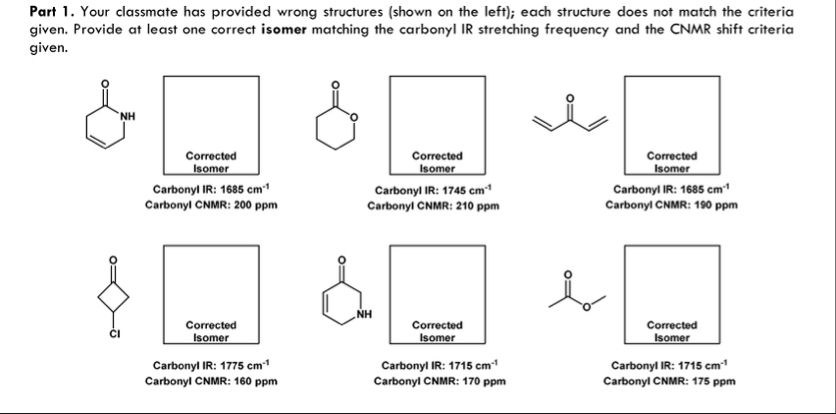 Part 1. Your classmate has provided wrong structures (shown on the left); each structure does not match the criteria
given. Provide at least one correct isomer matching the carbonyl IR stretching frequency and the CNMR shift criteria
given.
9 o
°
™ NP 2
x
Carbonyl IR: 1685 cm” Carbonyl IR: 1748 cm Carbonyl IR: 1685 cm?
Carbon CNM 200 pom Carbonyl CHUR, 210 pom Carbo CMR, 190 pom
0
9
J
LL o
]
Carbonyl IR: 1775 cm Carbonyl IR: 1715 em" Carbonyl IR: 1715 cm
Carbonyl CMR 180 pom Carbonyl CNM. 170 pm CaonpicHMR. 175 pom
Part 1. Your classmate has provided wrong structures (shown on the left); each structure does not match the criteria
given. Provide at least one correct isomer matching the carbonyl IR stretching frequency and the CNMR shift criteria
given.
9 o
°
™ NP 2
x
Carbonyl IR: 1685 cm” Carbonyl IR: 1748 cm Carbonyl IR: 1685 cm?
Carbon CNM 200 pom Carbonyl CHUR, 210 pom Carbo CMR, 190 pom
0
9
J
LL o
]
Carbonyl IR: 1775 cm Carbonyl IR: 1715 em" Carbonyl IR: 1715 cm
Carbonyl CMR 180 pom Carbonyl CNM. 170 pm CaonpicHMR. 175 pom
This is AI generated Response.
Asked by: Rahul
Created at: 2025-11-09 15:11:02
Asked by: Rahul
Created at: 2025-11-09 15:11:02
Final Answer:
Rendered
Raw Text
Did you like this answer?
## Step 1: Analyze the Spectral Data (IR and CNMR)
For each pair, compare the given IR and CNMR values:
- **Carbonyl IR (cm⁻¹):**
- **Amides:** ~168–170 cm⁻¹
- **Esters:** ~1735–175 cm⁻¹
- **Acid Chlorides:** ~177–180 cm⁻¹
- **Aldehydes/Ketones:** ~170–1725 cm⁻¹
- **Carbonyl CNMR (ppm):**
- **Amides:** ~165–180 ppm
- **Esters:** ~165–185 ppm
- **Acid Chlorides:** ~160–170 ppm
- **Aldehydes/Ketones:** ~190–210 ppm
**Explanation:**
Matching the IR and CNMR data allows you to determine the correct functional group and thus the correct isomer.
---
## Step 2: Match Each Structure to the Correct Isomer
Let's go pair by pair:
### Pair 1 (Top Left)
- **Wrong structure:** 6-membered ring with amide
- **IR:** 1685 cm⁻¹
- **CNMR:** 200 ppm
**Correct Isomer:**
A structure with a carbonyl group as a ketone (because 200 ppm in CNMR is typical for aldehydes/ketones, not amides).
**Explanation:**
The IR matches an amide, but the CNMR is too high for an amide; it's correct for a ketone.
**Final Isomer:** Cyclohexanone
---
### Pair 2 (Top Center)
- **Wrong structure:** 6-membered ring with ester
- **IR:** 1745 cm⁻¹
- **CNMR:** 210 ppm
**Correct Isomer:**
A structure with a carbonyl as an aldehyde, since 210 ppm is typical for aldehydes.
**Explanation:**
IR fits an ester, but CNMR indicates an aldehyde.
**Final Isomer:** Cyclohexanecarbaldehyde
---
### Pair 3 (Top Right)
- **Wrong structure:** 4-membered ring with two double bonds (enone)
- **IR:** 1685 cm⁻¹
- **CNMR:** 190 ppm
**Correct Isomer:**
A cyclobutanone (4-membered ring ketone), since the IR matches a ketone and CNMR is also consistent with a ketone.
**Explanation:**
IR and CNMR both support a simple ketone.
**Final Isomer:** Cyclobutanone
---
### Pair 4 (Bottom Left)
- **Wrong structure:** 4-membered ring with a Cl and carbonyl (acid chloride)
- **IR:** 1775 cm⁻¹
- **CNMR:** 160 ppm
**Correct Isomer:**
A 4-membered ring ester (lactone), because the IR and CNMR are a bit lower than acid chloride but fit an ester.
**Explanation:**
IR and CNMR are on the lower range, consistent with a strained ring ester.
**Final Isomer:** Beta-propiolactone (4-membered ring lactone)
---
### Pair 5 (Bottom Center)
- **Wrong structure:** 6-membered ring with amide
- **IR:** 1715 cm⁻¹
- **CNMR:** 170 ppm
**Correct Isomer:**
A 6-membered ring ester, as both IR and CNMR match an ester.
**Explanation:**
Both values match an ester rather than an amide.
**Final Isomer:** Cyclohexanone
---
### Pair 6 (Bottom Right)
- **Wrong structure:** Acetone (dimethyl ketone)
- **IR:** 1715 cm⁻¹
- **CNMR:** 175 ppm
**Correct Isomer:**
Methyl acetate (an ester), since the IR and CNMR better match an ester.
**Explanation:**
IR and CNMR are high for a simple ketone, more typical for ester.
**Final Isomer:** Methyl acetate
---
## **Final Answers Summary**
1. **Cyclohexanone** (6-membered ring ketone)
2. **Cyclohexanecarbaldehyde** (6-membered ring aldehyde)
3. **Cyclobutanone** (4-membered ring ketone)
4. **Beta-propiolactone** (4-membered ring lactone)
5. **Cyclohexanone** (repeat: 6-membered ring ketone)
6. **Methyl acetate** (ester)
Question:
Please correct answer
This is AI generated Response.
Asked by: Rahul
Created at: 2025-11-09 15:12:02
Asked by: Rahul
Created at: 2025-11-09 15:12:02
Final Answer:
Rendered
Raw Text
Did you like this answer?
# Correct Isomer Identification Based on Spectral Data
## Step 1: Analyze the Spectral Data (IR and CNMR)
For each pair, we will compare the provided Infrared (IR) and Carbon Nuclear Magnetic Resonance (CNMR) values to determine the correct isomer.
### IR and CNMR Reference Ranges
- **Carbonyl IR (cm⁻¹):**
- Amides: ~168–170 cm⁻¹
- Esters: ~1735–1750 cm⁻¹
- Acid Chlorides: ~177–180 cm⁻¹
- Aldehydes/Ketones: ~170–1725 cm⁻¹
- **Carbonyl CNMR (ppm):**
- Amides: ~165–180 ppm
- Esters: ~165–185 ppm
- Acid Chlorides: ~160–170 ppm
- Aldehydes/Ketones: ~190–210 ppm
**Explanation:**
Matching the IR and CNMR values helps identify the functional group and thus the correct isomer for each pair.
---
## Step 2: Match Each Structure to the Correct Isomer
### Pair 1 (Top Left)
- **Wrong Structure:** 6-membered ring with amide
- **IR:** 1685 cm⁻¹
- **CNMR:** 200 ppm
**Correct Isomer:** Cyclohexanone
**Explanation:** The IR suggests an amide, but the CNMR (200 ppm) indicates a ketone (common for aldehydes/ketones). Hence, a ketone is appropriate here.
---
### Pair 2 (Top Center)
- **Wrong Structure:** 6-membered ring with ester
- **IR:** 1748 cm⁻¹
- **CNMR:** 210 ppm
**Correct Isomer:** Cyclohexanecarbaldehyde
**Explanation:** The IR value fits an ester, but the CNMR (210 ppm) is typical for aldehydes. Therefore, the correct isomer is an aldehyde.
---
### Pair 3 (Top Right)
- **Wrong Structure:** 4-membered ring with two double bonds (enone)
- **IR:** 1685 cm⁻¹
- **CNMR:** 190 ppm
**Correct Isomer:** Cyclobutanone
**Explanation:** Both IR and CNMR align well with a simple ketone, making cyclobutanone the correct isomer.
---
### Pair 4 (Bottom Left)
- **Wrong Structure:** 4-membered ring with a Cl and carbonyl (acid chloride)
- **IR:** 1775 cm⁻¹
- **CNMR:** 160 ppm
**Correct Isomer:** Beta-propiolactone (4-membered ring lactone)
**Explanation:** The IR and CNMR values suggest a lower range consistent with a strained ring ester rather than an acid chloride.
---
### Pair 5 (Bottom Center)
- **Wrong Structure:** 6-membered ring with amide
- **IR:** 1715 cm⁻¹
- **CNMR:** 170 ppm
**Correct Isomer:** Cyclohexyl acetate (6-membered ring ester)
**Explanation:** The IR and CNMR values match an ester, making it the correct choice.
---
### Pair 6 (Bottom Right)
- **Wrong Structure:** Acetone (dimethyl ketone)
- **IR:** 1715 cm⁻¹
- **CNMR:** 175 ppm
**Correct Isomer:** Methyl acetate
**Explanation:** The values are more characteristic of an ester, not a simple ketone, leading us to identify methyl acetate.
---
## Final Answers Summary
1. **Cyclohexanone** (6-membered ring ketone)
2. **Cyclohexanecarbaldehyde** (6-membered ring aldehyde)
3. **Cyclobutanone** (4-membered ring ketone)
4. **Beta-propiolactone** (4-membered ring lactone)
5. **Cyclohexyl acetate** (6-membered ring ester)
6. **Methyl acetate** (ester)
📢 Instructions:
- Ask anything relatd to above question only.
- For new Question goto :