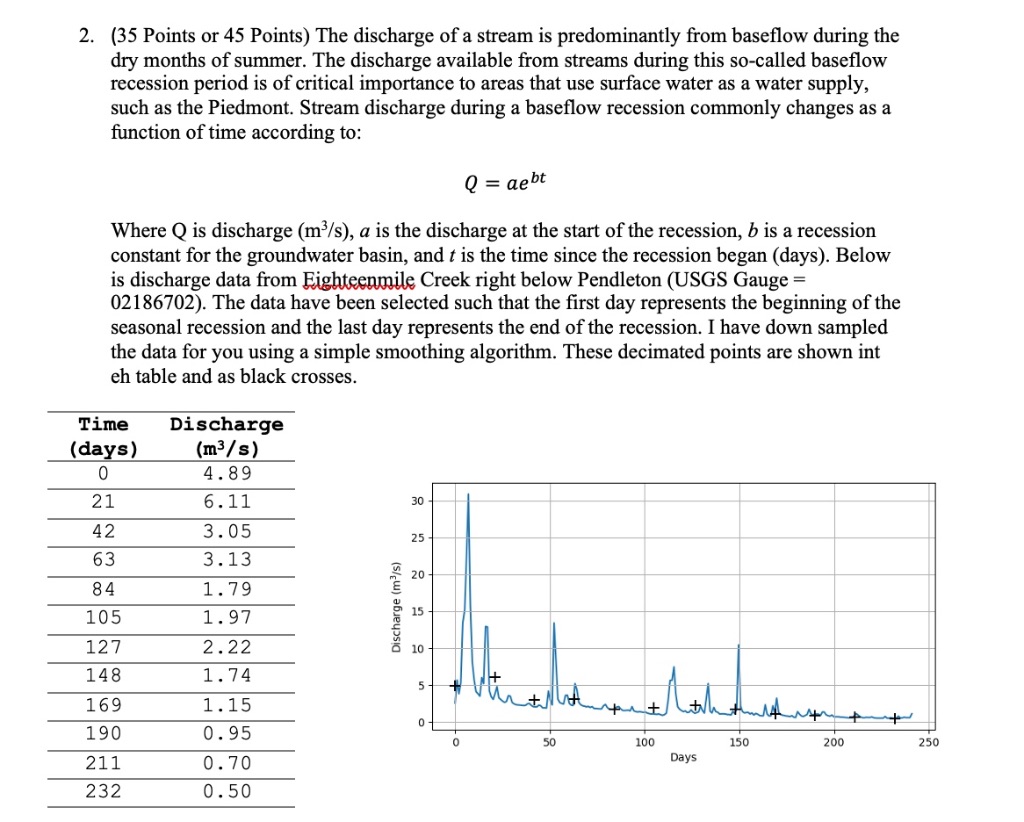
PLEASE SHOW ME HOW TO CALCULATE THE MODELED VALUES AND THE COEFFICIENT OF DETERMINATION! THE OBSERVED VALUES IS THE DISCHARGE VALUES LISTED.2. (35 Points or 45 Points) The discharge of a stream is predominantly from baseflow during the
dry months of summer. The discharge available from streams during this so-called baseflow
recession period is of critical importance to areas that use surface water as a water supply,
such as the Piedmont. Stream discharge during a baseflow recession commonly changes as a
function of time according to:
Q = aelt
Where Q is discharge (m/s), a is the discharge at the start of the recession, b is a recession
constant for the groundwater basin, and ¢ is the time since the recession began (days). Below
is discharge data from Eighteenmile Creek right below Pendleton (USGS Gauge =
02186702). The data have been selected such that the first day represents the beginning of the
seasonal recession and the last day represents the end of the recession. I have down sampled
the data for you using a simple smoothing algorithm. These decimated points are shown int
ch table and as black crosses.
Time Discharge
(days) (m3/s)
0 4.89
21, 6.11 Ed
12 3.05 3
63 3.13 =
Et 22
84 1.79 £
105 1.97 id
127 2.22 810
148 1.74 s
169 1.15
— = 5
190 0.95 [3 EY 100 150 200 250
211 0.70 Eye
232 0.50
Question:
PLEASE SHOW ME HOW TO CALCULATE THE MODELED VALUES AND THE COEFFICIENT OF DETERMINATION! THE OBSERVED VALUES IS THE DISCHARGE VALUES LISTED.2. (35 Points or 45 Points) The discharge of a stream is predominantly from baseflow during the
dry months of summer. The discharge available from streams during this so-called baseflow
recession period is of critical importance to areas that use surface water as a water supply,
such as the Piedmont. Stream discharge during a baseflow recession commonly changes as a
function of time according to:
Q = aelt
Where Q is discharge (m/s), a is the discharge at the start of the recession, b is a recession
constant for the groundwater basin, and ¢ is the time since the recession began (days). Below
is discharge data from Eighteenmile Creek right below Pendleton (USGS Gauge =
02186702). The data have been selected such that the first day represents the beginning of the
seasonal recession and the last day represents the end of the recession. I have down sampled
the data for you using a simple smoothing algorithm. These decimated points are shown int
ch table and as black crosses.
Time Discharge
(days) (m3/s)
0 4.89
21, 6.11 Ed
12 3.05 3
63 3.13 =
Et 22
84 1.79 £
105 1.97 id
127 2.22 810
148 1.74 s
169 1.15
— = 5
190 0.95 [3 EY 100 150 200 250
211 0.70 Eye
232 0.50
This is AI generated Response.
Asked by: Harshit
Created at: 2025-09-26 21:28:08
Final Answer:
RenderedRaw Text
Did you like this answer?
# Calculating Modeled Values and Coefficient of Determination (\(R^2\))
Let's break your task into two parts:
## 1. **Modeling the Discharge Values**
The discharge is modeled as:
\[
Q = a e^{bt}
\]
Where:
- \( Q \) = discharge (m³/s)
- \( a \) = initial discharge (at \( t = \))
- \( b \) = recession constant
- \( t \) = time (days)
### **Step 1: Linearizing the Equation**
Take the natural logarithm of both sides:
\[
\ln Q = \ln a + bt
\]
This is a linear equation of the form \( y = c + mx \), where:
- \( y = \ln Q \)
- \( c = \ln a \)
- \( m = b \)
- \( x = t \)
### **Step 2: Prepare the Data**
| Time (days) | Discharge (\(Q\)) | \(\ln(Q)\) |
|-------------|-------------------|------------|
| | 4.89 | 1.587 |
| 21 | 6.11 | 1.810 |
| 42 | 3.05 | 1.116 |
| 63 | 3.13 | 1.141 |
| 84 | 1.79 | .583 |
| 105 | 1.97 | .677 |
| 127 | 2.22 | .798 |
| 148 | 1.74 | .555 |
| 169 | 1.15 | .140 |
| 190 | .95 | -.051 |
| 211 | .70 | -.357 |
| 232 | .50 | -.693 |
*(You can fill in the natural log values using a calculator: \(\ln(Q)\))*
### **Step 3: Linear Regression on \((t, \ln Q)\)**
Use least squares to fit a line \( \ln Q = \ln a + bt \). This can be done in Excel, Python, or even by hand for a small dataset.
#### **Quick Calculation Example**
If you use Excel:
- Place \( t \) in one column and \( \ln Q \) in another.
- Use the `=LINEST()` function to get the slope (\( b \)) and intercept (\( \ln a \)).
#### **Manual Calculation Outline** (for the slope \(b\)):
\[
b = \frac{N \sum (t_i \ln Q_i) - \sum t_i \sum \ln Q_i}{N \sum t_i^2 - (\sum t_i)^2}
\]
\[
\ln a = \frac{\sum \ln Q_i - b \sum t_i}{N}
\]
Where \(N\) is the number of data points.
### **Step 4: Calculate Modeled Values**
With the fitted \( a \) and \( b \), plug each \( t \) into:
\[
Q_{\text{modeled}} = a e^{bt}
\]
---
## 2. **Calculating the Coefficient of Determination (\( R^2 \))**
The \( R^2 \) value measures how well the model explains the observed data.
\[
R^2 = 1 - \frac{\sum (Q_{\text{observed}} - Q_{\text{modeled}})^2}{\sum (Q_{\text{observed}} - \bar{Q}_{\text{observed}})^2}
\]
Where:
- \( Q_{\text{observed}} \) = observed discharge values
- \( Q_{\text{modeled}} \) = modeled discharge values
- \( \bar{Q}_{\text{observed}} \) = mean of observed discharge values
---
## **Summary of Steps**
1. **Take the natural log of all discharge values.**
2. **Fit a straight line to \( (t, \ln Q) \) using linear regression to get \( b \) and \( \ln a \).**
3. **Exponentiate the intercept to get \( a \).**
4. **Calculate modeled values using \( Q_{\text{modeled}} = a e^{bt} \) for all \( t \).**
5. **Calculate \( R^2 \) using the formula above.**
---
### **Example (with made-up regression values):**
Suppose regression gives \( \ln a = 1.7 \), \( b = -.008 \):
\[
a = e^{1.7} = 5.4739
\]
So:
\[
Q_{\text{modeled}} = 5.47 \cdot e^{-.008 t}
\]
Plug each \( t \) into this equation for modeled values, then compute \( R^2 \) as shown.
---
## **If you want Python/Excel code, let me know!**
Would you like a step-by-step in Excel or Python? Or a worked numerical example?
VIPSolutions focuses on clear, step‑by‑step explanations so you can learn quickly. Whether you need an AI‑generated walkthrough or a short hint to get unstuck, each solution is organized for fast reading and easy review later.
Search similar questions, compare approaches, and bookmark the best answers for revision. Our goal is simple: quick, reliable study help that feels natural—not noisy.
 VIPSolutions
 2. (35 Points or 45 Points) The discharge of a stream is predominantly from baseflow during the
dry months of summer. The discharge available from streams during this so-called baseflow
recession period is of critical importance to areas that use surface water as a water supply,
such as the Piedmont. Stream discharge during a baseflow recession commonly changes as a
function of time according to:
Q = aelt
Where Q is discharge (m/s), a is the discharge at the start of the recession, b is a recession
constant for the groundwater basin, and ¢ is the time since the recession began (days). Below
is discharge data from Eighteenmile Creek right below Pendleton (USGS Gauge =
02186702). The data have been selected such that the first day represents the beginning of the
seasonal recession and the last day represents the end of the recession. I have down sampled
the data for you using a simple smoothing algorithm. These decimated points are shown int
ch table and as black crosses.
Time Discharge
(days) (m3/s)
0 4.89
21, 6.11 Ed
12 3.05 3
63 3.13 =
Et 22
84 1.79 £
105 1.97 id
127 2.22 810
148 1.74 s
169 1.15
— = 5
190 0.95 [3 EY 100 150 200 250
211 0.70 Eye
232 0.50
2. (35 Points or 45 Points) The discharge of a stream is predominantly from baseflow during the
dry months of summer. The discharge available from streams during this so-called baseflow
recession period is of critical importance to areas that use surface water as a water supply,
such as the Piedmont. Stream discharge during a baseflow recession commonly changes as a
function of time according to:
Q = aelt
Where Q is discharge (m/s), a is the discharge at the start of the recession, b is a recession
constant for the groundwater basin, and ¢ is the time since the recession began (days). Below
is discharge data from Eighteenmile Creek right below Pendleton (USGS Gauge =
02186702). The data have been selected such that the first day represents the beginning of the
seasonal recession and the last day represents the end of the recession. I have down sampled
the data for you using a simple smoothing algorithm. These decimated points are shown int
ch table and as black crosses.
Time Discharge
(days) (m3/s)
0 4.89
21, 6.11 Ed
12 3.05 3
63 3.13 =
Et 22
84 1.79 £
105 1.97 id
127 2.22 810
148 1.74 s
169 1.15
— = 5
190 0.95 [3 EY 100 150 200 250
211 0.70 Eye
232 0.50