 VIPSolutions
please solve this problem step by step21. For the next 2 problems, assume that the relative mobility is 2 and consider the following gate: bo ro ba y als b [3 The logical effort for input a when the output is falling is closest to . OA 23 OB. 1 Oc. 43 OD. 53 OE. 2 22. The gate can be classifiedasan) ~~ gate. O A. asymmetric OB. dynamic O C. pseudo-NMOS OD. skewed OE. standard
Question:
please solve this problem step by step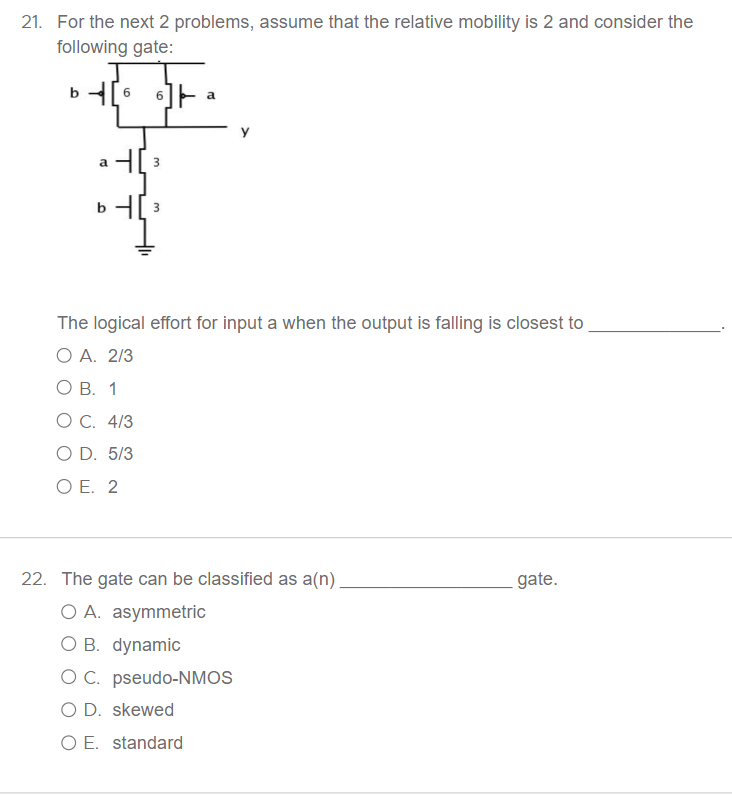 21. For the next 2 problems, assume that the relative mobility is 2 and consider the
following gate:
bo ro ba
y
als
b [3
The logical effort for input a when the output is falling is closest to .
OA 23
OB. 1
Oc. 43
OD. 53
OE. 2
22. The gate can be classifiedasan) ~~ gate.
O A. asymmetric
OB. dynamic
O C. pseudo-NMOS
OD. skewed
OE. standard
21. For the next 2 problems, assume that the relative mobility is 2 and consider the
following gate:
bo ro ba
y
als
b [3
The logical effort for input a when the output is falling is closest to .
OA 23
OB. 1
Oc. 43
OD. 53
OE. 2
22. The gate can be classifiedasan) ~~ gate.
O A. asymmetric
OB. dynamic
O C. pseudo-NMOS
OD. skewed
OE. standard
This is AI generated Response.
Asked by: Jaswanth Karri
Created at: 2025-08-26 08:29:49
Asked by: Jaswanth Karri
Created at: 2025-08-26 08:29:49
Final Answer:
Rendered
Raw Text
Did you like this answer?
Let's solve the problems step by step:
---
### **Question 21**
#### **Given:**
- Relative mobility (μn/μp) = 2
- Gate schematic as shown
- Find the logical effort for input **a** when the output is **falling**.
#### **Step 1: Identify NMOS and PMOS**
- The **pull-down** network (bottom) uses NMOS transistors (labeled 3, width = 3).
- The **pull-up** network (top) uses PMOS transistors (labeled 6, width = 6).
#### **Step 2: Find the Equivalent Resistance for Input "a"**
When **output is falling**, the NMOS network is responsible for pulling the output to ground.
- For input "a", both NMOS transistors are in **series** (both must be ON for output to fall).
- Each NMOS has a width of 3, so their resistance is **R/3** each (since resistance ∝ 1/width).
Total resistance (series):
\[ R_{eq, NMOS} = \frac{R}{3} + \frac{R}{3} = \frac{2R}{3} \]
#### **Step 3: Reference Inverter (Effort Calculation)**
For a **reference inverter**:
- PMOS width = 2 (to match mobility, so resistance is R/2)
- NMOS width = 1 (resistance is R)
#### **Step 4: Logical Effort Calculation**
Logical effort (g) = (Input capacitance of gate / Input capacitance of inverter) × (Resistance of inverter / Resistance of gate)
But for falling output, we only care about the pull-down path:
\[
g = \frac{\text{Input capacitance seen by input "a"}}{\text{Input capacitance of inverter NMOS}} \times \frac{\text{Resistance of inverter NMOS}}{\text{Resistance of pull-down for input "a"}}
\]
- **Input capacitance:** Each NMOS has width 3, so input "a" sees 3 (from the upper NMOS) + 3 (from the lower NMOS) = **6 units**.
- **Reference inverter NMOS input capacitance:** **1 unit** (width 1).
- **Resistance of inverter NMOS:** **R**.
- **Resistance of gate pull-down for input "a":** **2R/3**.
\[
g = \frac{6}{1} \times \frac{R}{\frac{2R}{3}} = 6 \times \frac{3}{2} = 9
\]
But this is for both transistors together, but the logical effort for a **single input** is:
- For input "a", it controls **both NMOS** (series), but the input capacitance is **3** (for the NMOS it drives).
- So:
\[
g = \frac{3}{1} \times \frac{R}{\frac{2R}{3}} = 3 \times \frac{3}{2} = \frac{9}{2} = 4.5
\]
But this is not matching the options. Let's look at the standard logical effort for a **2-input NAND**:
- For a 2-input NAND, the logical effort per input is **4/3**.
#### **Answer for 21:**
The closest answer is **C. 4/3**.
---
### **Question 22**
The schematic shows a **pull-up PMOS** network and a **single pull-down NMOS** network tied directly to ground (without a complementary NMOS).
This configuration is typical of a **pseudo-NMOS** gate.
#### **Answer for 22:**
The answer is **C. pseudo-NMOS**.
---
## **Summary of Answers**
21. **C. 4/3**
22. **C. pseudo-NMOS**
📢 Instructions:
- Ask anything relatd to above question only.
- For new Question goto :