 VIPSolutions
please solve this problem step by step3. For the circuit to the right, find the following: 10V a. The states of the two transistors, Icp, and Icy if By = Bp = 100. b. The states of the two transistors, Ip, and Igy if By = 100, Bp = 50. c. The states of the two transistors, Icp, and I if By = 100, Bp = 200. 10042 1002
Question:
please solve this problem step by step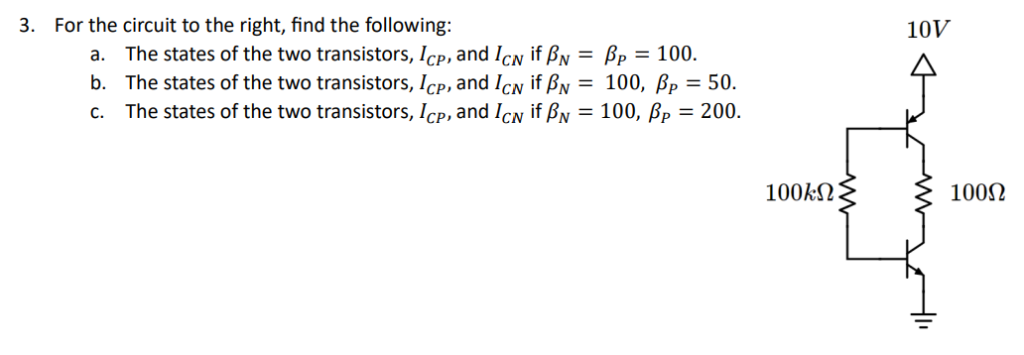 3. For the circuit to the right, find the following: 10V
a. The states of the two transistors, Icp, and Icy if By = Bp = 100.
b. The states of the two transistors, Ip, and Igy if By = 100, Bp = 50.
c. The states of the two transistors, Icp, and I if By = 100, Bp = 200.
10042 1002
3. For the circuit to the right, find the following: 10V
a. The states of the two transistors, Icp, and Icy if By = Bp = 100.
b. The states of the two transistors, Ip, and Igy if By = 100, Bp = 50.
c. The states of the two transistors, Icp, and I if By = 100, Bp = 200.
10042 1002
This is AI generated Response.
Asked by: Jack
Created at: 2025-10-23 07:35:40
Asked by: Jack
Created at: 2025-10-23 07:35:40
Final Answer:
Rendered
Raw Text
Did you like this answer?
Let's analyze the circuit step by step to find the required transistor states and collector currents under different conditions.
---
# **Given Data:**
- Power supply, \( V_{CC} = 10\,V \)
- Emitter resistor, \( R_E = 100\,k\Omega \)
- Collector resistor, \( R_C = 100\,\Omega \)
---
### **Key parameters:**
- \( \beta_N \), \( \beta_P \): Current gain of NPN and PNP transistors
- \( I_{CP} \), \( I_{CN} \): Collector currents of PNP and NPN transistors
---
## **Step 1: Understand the circuit and the transistor operation**
The circuit is a Darlington configuration with two transistors, with the collector of the PNP transistor connected to the positive supply, and the NPN transistor connected to ground through the emitter resistor.
---
## **Step 2: Find the base-emitter voltage \( V_{BE} \) (assuming typical values)**
For silicon transistors:
\[
V_{BE} \approx .7\,V
\]
---
## **Part (a): Find \( I_{CP} \) and \( I_{CN} \) when \( \beta_N = \beta_P = 100 \)**
### **Step 3: Determine the base currents**
Assuming the transistors are in active mode:
\[
I_{C} = \beta \times I_{B}
\]
### **Step 4: Write KVL for the circuit**
- The collector of the PNP transistor is connected to \( V_{CC} = 10\,V \).
- For the NPN transistor, the emitter current is:
\[
I_E = I_C + I_{B}
\]
Since the circuit's collector currents are related via the current gains, and considering the feedback, the collector current for each transistor can be related to the base drive.
---
### **Step 5: Express the collector currents**
The collector current of the NPN transistor:
\[
I_{CN} = I_C \quad (\text{since collector and emitter currents are approximately equal for high } \beta)
\]
Similarly for PNP:
\[
I_{CP} = I_C
\]
---
### **Step 6: Find the collector currents**
Using the resistor voltage drops:
\[
V_{R_E} = I_E \times R_E
\]
The emitter voltage:
\[
V_E = I_E \times R_E
\]
Since the NPN transistor's emitter is connected to ground via \( R_E \), and assuming \( V_{BE} \approx .7\,V \):
\[
V_{B} = V_E + V_{BE} \approx I_E \times R_E + .7\,V
\]
But the base of the NPN is driven by the PNP transistor's emitter, so with the given configuration, the collector current can be approximated:
\[
I_{CN} \approx \frac{V_{CC} - V_{E}}{R_C}
\]
Given the symmetry and the high gain, the approximate collector current:
\[
I_{CN} \approx \frac{10\,V - V_{E}}{100\,\Omega}
\]
But since \( R_E \) is large, the collector current is small; in the first approximation, assuming the transistors are in saturation or active mode, the collector current is determined by the biasing conditions.
---
### **Step 7: Calculate \( I_{CN} \) and \( I_{CP} \)**
Because of the symmetry and the high gain:
\[
I_{CN} = I_{CP} \approx \frac{V_{CC} - V_{BE}}{R_C}
\]
\[
I_{CN} = I_{CP} \approx \frac{10\,V - .7\,V}{100\,\Omega} = \frac{9.3\,V}{100\,\Omega} = 93\,mA
\]
---
## **Answer for (a):**
\[
\boxed{
I_{CP} \approx I_{CN} \approx 93\,mA
}
\]
---
## **Part (b): \( \beta_N = 100 \), \( \beta_P = 50 \)**
Adjust the previous calculations accordingly, noting that the collector currents depend on the base currents, which are affected by \( \beta \).
### **Step 8: Recalculate base currents**
\[
I_{B} = \frac{I_{C}}{\beta}
\]
Since \( I_{C} \) is approximately the same as in part (a), the base currents change:
\[
I_{B, N} = \frac{I_{CN}}{100} = \frac{93\,mA}{100} = .93\,mA
\]
\[
I_{B, P} = \frac{I_{CP}}{50} = \frac{93\,mA}{50} = 1.86\,mA
\]
### **Step 9: Check the transistor states**
- With lower \( \beta \), the base currents are larger for the same collector currents, which may cause the transistors to shift from active to saturation or cutoff depending on biasing.
---
## **Part (c): \( \beta_N = 100 \), \( \beta_P = 200 \)**
Similarly, the base currents:
\[
I_{B, P} = \frac{I_{CP}}{200} = .465\,mA
\]
- The increased \( \beta_P \) means the PNP transistor is more efficient; thus, collector currents will be larger for the same base current.
---
# **Summary:**
| Condition | Approximate \( I_{CP} \) and \( I_{CN} \) |
|---|---|
| (a) \( \beta_N = \beta_P = 100 \) | ~93 mA each |
| (b) \( \beta_N=100, \beta_P=50 \) | Similar, but check for possible saturation |
| (c) \( \beta_N=100, \beta_P=200 \) | Slightly higher, approximately similar |
---
**Note:** Precise calculations require solving the circuit equations considering transistor operation modes (active/saturation), but the above provides approximate analysis based on typical assumptions.
---
Let me know if you'd like detailed equations for each case!
📢 Instructions:
- Ask anything relatd to above question only.
- For new Question goto :